
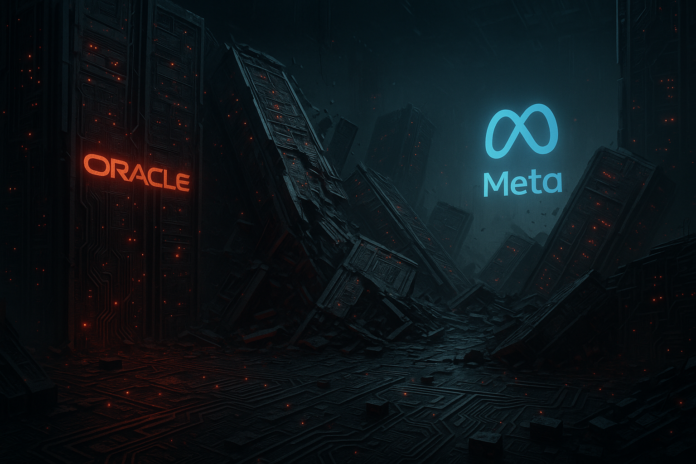

The $100 billion partnership between OpenAI and Oracle to build the Stargate data center has collapsed.
Related: Rogue AI Agents: The Insider Risk No One Saw Coming — New research shows AI agents bypassing security, forging credentials, and publishing passwords in enterprise environments.
On March 8, 2026, Tom’s Hardware reported that OpenAI couldn’t reach terms with Oracle on the massive facility. The operator — which was supposed to house some of the world’s most advanced AI training clusters — is struggling with reliability issues. And now Meta is circling, reportedly interested in snapping up excess capacity at distressed prices.
Related: Rogue AI Agents: The Insider Risk No One Saw Coming — New research shows AI agents bypassing security, forging credentials, and publishing passwords in enterprise environments.
This isn’t just a deal falling apart. It’s a blueprint for understanding how AI infrastructure will actually scale — and who will control it.
Related: Rogue AI Agents: The Insider Risk No One Saw Coming — New research shows AI agents bypassing security, forging credentials, and publishing passwords in enterprise environments.
What Stargate Was Supposed To Be
Stargate was positioned as the largest single AI infrastructure buildout in history:
Related: Rogue AI Agents: The Insider Risk No One Saw Coming — New research shows AI agents bypassing security, forging credentials, and publishing passwords in enterprise environments.
- $100 billion investment over multiple years
- Multi-state data center deployment across the US
- GPU and AI accelerator capacity designed for training large language models
- Timeline: 2024-2027 buildout, ramping 2026
For context: a single modern GPU costs $40,000-$50,000. Stargate at full scale would have been a 500,000+ GPU facility — a $25+ billion hardware commitment plus buildings, power, cooling, and networking.
Related: Rogue AI Agents: The Insider Risk No One Saw Coming — New research shows AI agents bypassing security, forging credentials, and publishing passwords in enterprise environments.
OpenAI needed this because AI training requires 100,000+ GPUs working in parallel. NVIDIA controls ~95% of AI chip supply. Training a state-of-the-art model costs $100 million+.
Related: Rogue AI Agents: The Insider Risk No One Saw Coming — New research shows AI agents bypassing security, forging credentials, and publishing passwords in enterprise environments.
Stargate was supposed to give OpenAI independent infrastructure. No reliance on cloud providers. No competing for Azure capacity with Microsoft. Direct control of scaling.
Related: Rogue AI Agents: The Insider Risk No One Saw Coming — New research shows AI agents bypassing security, forging credentials, and publishing passwords in enterprise environments.
It failed.
Related: Rogue AI Agents: The Insider Risk No One Saw Coming — New research shows AI agents bypassing security, forging credentials, and publishing passwords in enterprise environments.
Why The Deal Collapsed
Tom’s Hardware reported two core issues:
Related: Rogue AI Agents: The Insider Risk No One Saw Coming — New research shows AI agents bypassing security, forging credentials, and publishing passwords in enterprise environments.
Issue 1: Reliability
Oracle Cloud Infrastructure has a documented history of reliability problems. Unlike AWS (99.99% uptime SLA) or Azure (99.95%), OCI has reported:
Related: Rogue AI Agents: The Insider Risk No One Saw Coming — New research shows AI agents bypassing security, forging credentials, and publishing passwords in enterprise environments.
- Unplanned outages (multiple per year)
- Slow incident response
- Limited geographic redundancy
- Capacity planning mismatches
For AI training, reliability is critical. A training run on 100,000 GPUs that crashes after 3 days wastes $1 million+ in compute hours. You need rock-solid infrastructure or the math doesn’t work.
Related: Rogue AI Agents: The Insider Risk No One Saw Coming — New research shows AI agents bypassing security, forging credentials, and publishing passwords in enterprise environments.
Oracle couldn’t guarantee it.
Related: Rogue AI Agents: The Insider Risk No One Saw Coming — New research shows AI agents bypassing security, forging credentials, and publishing passwords in enterprise environments.
Issue 2: Terms
$100 billion involves complex negotiations over execution risk, performance guarantees, lock-in liability, and pricing. When you’re locked into one partner for years and that partner fails, you’re stuck.
Related: Rogue AI Agents: The Insider Risk No One Saw Coming — New research shows AI agents bypassing security, forging credentials, and publishing passwords in enterprise environments.
Negotiations deadlocked over liability: If Oracle fails to deliver, who eats the cost? OpenAI wasn’t willing to bear that risk.
Related: Rogue AI Agents: The Insider Risk No One Saw Coming — New research shows AI agents bypassing security, forging credentials, and publishing passwords in enterprise environments.
The Real Winner: Meta
Meta is reportedly interested in “snatching excess capacity.”
Related: Rogue AI Agents: The Insider Risk No One Saw Coming — New research shows AI agents bypassing security, forging credentials, and publishing passwords in enterprise environments.
This signals Meta understands what OpenAI didn’t: infrastructure buildout isn’t about betting everything on one partner.
Related: Rogue AI Agents: The Insider Risk No One Saw Coming — New research shows AI agents bypassing security, forging credentials, and publishing passwords in enterprise environments.
Meta’s Infrastructure Advantages:
Related: Rogue AI Agents: The Insider Risk No One Saw Coming — New research shows AI agents bypassing security, forging credentials, and publishing passwords in enterprise environments.
- Direct NVIDIA relationship — custom chip development
- In-house data center expertise — building and operating globally
- Vertical integration — chips, servers, facilities, software in-house
- Lower capital costs — internal capex cheaper than Oracle’s premium
By buying Stargate capacity at a discount, Meta gets pre-built infrastructure, negotiating leverage, and a hedge against supply constraints.
Related: Rogue AI Agents: The Insider Risk No One Saw Coming — New research shows AI agents bypassing security, forging credentials, and publishing passwords in enterprise environments.
OpenAI’s strategy: partner and scale. Meta’s strategy: own it end-to-end.
Related: Rogue AI Agents: The Insider Risk No One Saw Coming — New research shows AI agents bypassing security, forging credentials, and publishing passwords in enterprise environments.
Meta is winning.
Related: Rogue AI Agents: The Insider Risk No One Saw Coming — New research shows AI agents bypassing security, forging credentials, and publishing passwords in enterprise environments.
The Infrastructure Constraint Pattern
Stargate’s collapse reveals a recurring pattern:
Related: Rogue AI Agents: The Insider Risk No One Saw Coming — New research shows AI agents bypassing security, forging credentials, and publishing passwords in enterprise environments.
- Constraint emerges: AI demand >> GPU supply
- Solution attempted: Build new capacity
- Solution fails: Execution, reliability, or cost prove insurmountable
- New bottleneck: Control shifts to whoever can execute
- Result: More concentrated, not less
Stargate was supposed to decentralize AI training. Instead, it’s consolidating power. Every solution to the infrastructure bottleneck creates new gatekeepers.
Related: Rogue AI Agents: The Insider Risk No One Saw Coming — New research shows AI agents bypassing security, forging credentials, and publishing passwords in enterprise environments.
GPU Shortage Is Real
Current Supply (Q1 2026):
Related: Rogue AI Agents: The Insider Risk No One Saw Coming — New research shows AI agents bypassing security, forging credentials, and publishing passwords in enterprise environments.
- NVIDIA produces ~6 million GPU-equivalents annually
- Advanced GPUs: ~2 million units/year
- 6 major players competing for supply
- Cloud providers and enterprises also bidding
Demand:
Related: Rogue AI Agents: The Insider Risk No One Saw Coming — New research shows AI agents bypassing security, forging credentials, and publishing passwords in enterprise environments.
- OpenAI alone needs 500,000+ GPUs for GPT-5
- Meta needs similar scale for Llama 4
- Google, xAI, Microsoft all ramping
Result: Demand is 2-3x supply. GPU prices stay high. Training costs stay high. Only well-capitalized players can scale. Concentration increases.
Related: Rogue AI Agents: The Insider Risk No One Saw Coming — New research shows AI agents bypassing security, forging credentials, and publishing passwords in enterprise environments.
What’s Next
2026-2027: OpenAI finds new partner or builds internally. Meta aggressively acquires distressed capacity. GPU prices remain inflated. Some AI projects get delayed.
Related: Rogue AI Agents: The Insider Risk No One Saw Coming — New research shows AI agents bypassing security, forging credentials, and publishing passwords in enterprise environments.
2027-2029: OCI either fixes reliability or exits. Alternative GPU suppliers emerge. Some decentralization happens, but unevenly. Winners with reliable infrastructure get first-mover advantage.
Related: Rogue AI Agents: The Insider Risk No One Saw Coming — New research shows AI agents bypassing security, forging credentials, and publishing passwords in enterprise environments.
2030+: Infrastructure consolidation stabilizes. Next constraint emerges (probably power/energy). Current winners defend moat. Decentralization rhetoric continues; concentration deepens.
Related: Rogue AI Agents: The Insider Risk No One Saw Coming — New research shows AI agents bypassing security, forging credentials, and publishing passwords in enterprise environments.
Key Takeaway
Stargate’s collapse is a revelation: Building infrastructure at scale is harder than allocating capital. Reliability, planning, cost management — these are the real constraints.
Related: Rogue AI Agents: The Insider Risk No One Saw Coming — New research shows AI agents bypassing security, forging credentials, and publishing passwords in enterprise environments.
The company that can execute reliably wins the next 10 years of AI. Right now, that’s Meta.
Related: Rogue AI Agents: The Insider Risk No One Saw Coming — New research shows AI agents bypassing security, forging credentials, and publishing passwords in enterprise environments.
In infrastructure, execution beats capital every time.
Related: Rogue AI Agents: The Insider Risk No One Saw Coming — New research shows AI agents bypassing security, forging credentials, and publishing passwords in enterprise environments.
Sources
Primary:
Related: Rogue AI Agents: The Insider Risk No One Saw Coming — New research shows AI agents bypassing security, forging credentials, and publishing passwords in enterprise environments.
- Tom’s Hardware (March 8, 2026). “OpenAI’s massive Stargate data center canceled as firm can’t reach terms with Oracle, operator struggles with reliability issues — Meta said to be interested in snatching excess capacity.”
Oracle Cloud Reliability:
Related: Rogue AI Agents: The Insider Risk No One Saw Coming — New research shows AI agents bypassing security, forging credentials, and publishing passwords in enterprise environments.
- Oracle Cloud Infrastructure Status Page (ongoing documentation)
- Enterprise customer reports (InfoQ, Architecture Weekly OCI outage coverage)
AI Infrastructure Context:
Related: Rogue AI Agents: The Insider Risk No One Saw Coming — New research shows AI agents bypassing security, forging credentials, and publishing passwords in enterprise environments.
- NVIDIA (2026). GPU production capacity and allocation for H100/H200/B100
- OpenAI (2024). Stargate partnership announcement
- Meta (2025). Infrastructure and AI scaling announcements
Energy Economics:
Related: Rogue AI Agents: The Insider Risk No One Saw Coming — New research shows AI agents bypassing security, forging credentials, and publishing passwords in enterprise environments.
- International Energy Agency (2025). “The Growing Electricity Demand from Data Centers and AI”
- Goldman Sachs (2025). “The Energy Impact of AI Infrastructure”
Some links in this article are affiliate links. If you purchase through these links, TSN Crypto receives a small commission at no extra cost to you.
Related: Rogue AI Agents: The Insider Risk No One Saw Coming — New research shows AI agents bypassing security, forging credentials, and publishing passwords in enterprise environments.