
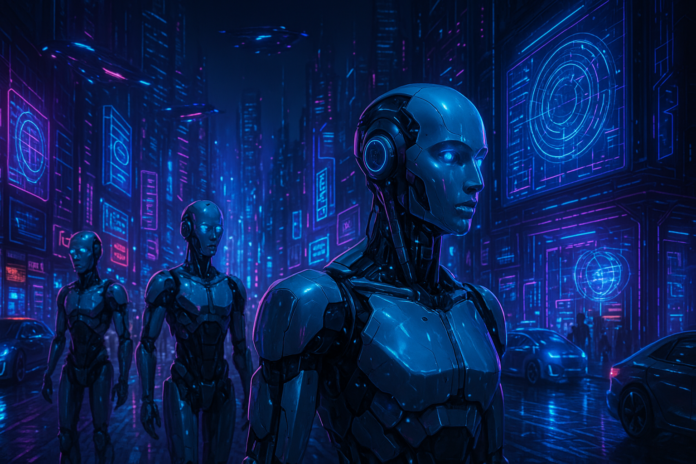
The Invisible OS: How AI Agents Are Becoming the New Operating System
The interface you won’t see is the one you’ll use every day.
2030: A Morning Without Apps
Sarah wakes up and speaks into the air: “Good morning. What’s today look like?”
Her AI, which lives on her phone but feels like it lives everywhere, responds in a calm voice: “You have a 10 AM call with the Tokyo team—I’ve already pulled the relevant documents and highlighted the questions they asked in last week’s thread. Your flight to Berlin tomorrow is confirmed, seat 4A as you prefer. There’s a new Italian place three minutes from your hotel; I checked the reviews and added it to your maybe-list. Also, your mom’s birthday is Saturday. I found a pottery class near her that matches her interests, and I can book it if you’d like.”
Sarah never opened a calendar app. Never checked email. Never visited a booking site. She didn’t swipe through seventeen screens of notifications or remember three different passwords. She just talked, and things happened.
This isn’t science fiction. This is the inevitable endpoint of where we’re headed—and it’s closer than you think.
The Mess We’re In
Let’s be honest about the current state of computing: it’s exhausting.
The average knowledge worker switches between 35 different applications daily. Each one is a silo. Your calendar doesn’t know your email. Your email doesn’t know your project management tool. Your project management tool doesn’t know your CRM. And none of them know you—not really.
We’ve built a digital world where you are the integration layer. You’re the API that connects Slack to Google Docs to Salesforce to Notion to your bank account. You remember the context. You do the copy-pasting. You perform the ritual dance of authentication, two-factor codes, and “forgot password” flows.
It’s app fatigue meets context-switching hell meets integration nightmare. We’ve traded the complexity of the command line for the complexity of 200 icons on a home screen, and it’s not clear we’ve won.
The fundamental problem: computers still make you do the work of translating intent into action. You want to “schedule a meeting”—but you have to navigate to the calendar, find a slot, check everyone’s availability, send invites, book a room, and add it to your to-do list. Six steps for one intention.
This is the problem an AI operating system solves.
What Is an “AI OS,” Really?
Let’s clear up a common misconception: an AI OS isn’t about replacing Windows, macOS, or Linux. Those systems will continue to exist, managing hardware, memory, and processes. The AI OS is a new layer—one that sits between you and everything else.
Think of it this way:
- Traditional OS: You → App → Operating System → Hardware
- AI OS: You → AI Agent → Apps/Services → Operating System → Hardware
The AI becomes your primary interface. Apps don’t disappear—they become services that the agent can invoke on your behalf. You don’t “open” your email client; you tell your agent to “find that invoice from last month” and it queries the email service directly, returning just the answer you need.
This is the shift from app-centric computing to intent-centric computing. Instead of learning how to use a hundred different tools, you express what you want to achieve, and the AI figures out which tools to use, in what order, with what parameters.
The AI OS is invisible by design. You won’t see it. You’ll just experience a world where technology finally works the way it should—where your digital life has coherence, memory, and the ability to actually help you instead of demanding your attention.
The Five Building Blocks
For this vision to become reality, five fundamental pieces need to fall into place.
1. The Protocol Layer: Agents Need to Talk
Today’s AI tools are islands. ChatGPT can browse the web, but it can’t directly control your Spotify. Claude can analyze documents, but it can’t book you a flight. Each integration is custom-built, fragile, and limited.
What we need is a universal protocol for agent-to-service communication—something like HTTP, but for AI agents. This protocol would define how an agent discovers what a service can do, how it authenticates, how it passes context, and how it receives structured results.
Imagine if every service on the internet exposed a standardized “agent interface” alongside its human interface. Your bank, your airline, your grocery store, your smart home—all speaking the same language that any AI agent can understand.
We’re seeing early signs of this with Model Context Protocol (MCP), function calling APIs, and agent frameworks. But we need industry-wide standards, not vendor-specific solutions. The winner here could be as important as TCP/IP was for the internet.
2. Universal Auth: OAuth for Agents
Authentication is the invisible wall that blocks most AI integrations. Your agent can’t book your flight because it can’t log into your airline account. Even when APIs exist, they require tokens, permissions, and complex OAuth flows designed for apps, not agents.
We need a new authentication paradigm: agent identity. Your AI should have its own credentials—provably tied to you, but capable of acting independently within boundaries you define.
Think of it like giving your assistant a corporate credit card with a spending limit. You don’t approve every purchase; you trust them to operate within constraints. Similarly, your AI agent should have scoped permissions: “You can book flights up to $500, schedule meetings during work hours, and order groceries from my approved list.”
This requires both technical standards (how agents prove identity) and legal frameworks (who’s liable when an agent makes a mistake). But without it, agents remain glorified chatbots—helpful for advice, useless for action.
3. Local-First Runtime: Your Agent, Your Device
The most important architectural decision in the AI OS stack is where the agent lives. The answer should be: on your device, under your control.
A cloud-only agent knows everything about you but isn’t truly yours. It can be shut down, censored, or subpoenaed. It requires constant connectivity. And it centralizes power in the hands of whoever runs the servers.
A local-first agent runs on your phone, laptop, or home server. It has access to your files, your messages, your browsing history—everything that makes you you. It works offline. It keeps your data private by default. And it can still reach out to cloud services when needed, just like your browser does.
This is technically challenging. Local hardware is less powerful than data centers. But the gap is closing rapidly. Apple’s Neural Engine, Qualcomm’s AI accelerators, and efficient open-source models are making on-device AI increasingly capable.
The local-first approach isn’t just about privacy—it’s about agency. An AI OS that lives on someone else’s servers is just another app. One that lives on your device becomes part of you.
4. Capability Marketplace: Apps Become Services
In an AI OS world, the concept of an “app” fundamentally changes. Instead of downloading software with a user interface, you’ll subscribe to capabilities that your agent can use.
Your agent doesn’t need the Uber app—it needs access to the Uber service, with a clean API for booking rides. It doesn’t need the Excel interface—it needs the ability to manipulate spreadsheets programmatically. It doesn’t need 17 different travel booking sites—it needs a flight-search capability that queries multiple sources and finds the best option.
This creates a marketplace where developers compete on functionality, not on who can build the most addictive interface. The best flight search algorithm wins, not the one with the prettiest website. The best translation service wins, not the one that sends the most push notifications.
For developers, this is liberating. You can focus on your core competency instead of building yet another login system, dashboard, and mobile app. For users, it’s transformative—no more learning curves, no more interface inconsistencies, just capabilities that work together seamlessly.
5. Natural Interface: Voice Primary, Text Fallback
The final building block is how you interact with your AI OS. The answer is obvious: the same way you interact with people. You talk.
Voice is the most natural interface humans have. It’s hands-free, eyes-free, and socially intuitive. You can talk while walking, cooking, driving, or working. You don’t need to learn syntax or remember where buttons are.
But voice isn’t always appropriate. In a meeting, you’ll want to type. For complex tasks, you might prefer a visual interface. The AI OS needs to be multimodal—voice by default, but seamlessly switching to text, gestures, or screens when context demands.
The key insight: the interface should adapt to you, not the other way around. Today’s apps force you into their preferred interaction model. The AI OS should meet you where you are, in whatever mode makes sense at that moment.
Who Builds the Future?
The race to build the AI OS is already underway, and several players are positioned to win:
Apple has the hardware, the ecosystem, and the privacy brand. If anyone can make local-first AI work at scale, it’s Apple. Their challenge is openness—will they allow third-party agents and services, or try to own the entire stack?
Google has the AI research, the data, and the services. They’re already integrating Gemini deeply into Android and Workspace. Their challenge is trust—can they overcome decades of surveillance capitalism to build something users actually want to rely on?
Microsoft has the enterprise relationships and the platform. Copilot is their beachhead. Their challenge is consumer appeal—can they make something people love, not just tolerate at work?
Startups have the agility and the focus. Companies like OpenClaw, Anthropic, and a hundred others are building pieces of this future without legacy baggage. Their challenge is distribution—how do you compete with operating systems that ship on billions of devices?
Open Source has the principles and the community. A consortium building open protocols and reference implementations could prevent this future from being controlled by any single company. Their challenge is coordination—can competing interests align around shared standards?
The likely outcome: multiple AI OS platforms, just like we have multiple mobile and desktop operating systems today. But unlike today, they’ll need to interoperate—because your agent will need to talk to my agent, and we’ll both need to book flights from the same airlines.
The Obstacles Ahead
This vision is compelling, but the path is strewn with challenges:
Standards wars are inevitable. Everyone wants to own the protocol layer. We’ll see years of competing standards before the market consolidates around winners—just like we did with VHS vs. Betamax, or iOS vs. Android.
Business models need to evolve. If users interact through agents instead of apps, what happens to advertising? To in-app purchases? To the attention economy that funds so much of today’s internet? New models will emerge—subscription capabilities, agent-mediated commerce, value-aligned revenue sharing—but transitions are messy.
Privacy and security become existential concerns. An AI OS that knows everything about you is incredibly powerful—and incredibly dangerous if compromised. We’ll need new security paradigms: encrypted agent memory, zero-knowledge authentication, and cryptographic proofs that your agent is acting within authorized bounds.
Trust is the hardest problem. Will users trust an AI with their passwords, their money, their relationships? Building that trust requires transparency (you should be able to see everything your agent does), reversibility (you should be able to undo any action), and accountability (clear responsibility when things go wrong).
Regulation will shape the landscape. Who’s liable when an AI agent makes a bad decision? What are the requirements for agent identity? How do we prevent monopolies in the AI OS layer? Smart regulation can accelerate adoption; heavy-handed regulation can stifle innovation.
The Timeline: When Does This Happen?
We’re closer than most people think.
2025-2027: Early Adopters — The pieces start fitting together. Power users run local AI agents that can handle email, calendar, and basic web tasks. Protocols like MCP gain traction. Early capability marketplaces emerge. It’s still clunky, still requires technical skill, but the vision becomes tangible.
2027-2030: Mainstream Emergence — Major platforms (Apple, Google, Microsoft) ship integrated AI OS features. Voice-first interfaces become normal for simple tasks. The first killer apps built entirely as agent capabilities appear. Standards consolidate. Privacy-preserving local AI becomes standard on flagship devices.
2030-2035: The New Normal — Using apps directly starts to feel old-fashioned, like using a command line. Most people interact with their digital lives through agents. The capability marketplace is mature. Interoperability is assumed. The AI OS is as invisible and essential as the internet itself.
2035+: Beyond Interfaces — We stop talking about “AI OS” because it’s just how computing works. The boundary between human intent and digital action has dissolved. The question “which app should I use?” becomes as quaint as “which floppy disk should I insert?”
The Builders and the Believers
If you’re reading this and feeling that spark of recognition—that sense that this is obviously where we’re headed—you’re not alone.
The AI OS isn’t just a technology shift. It’s a power shift. From platforms to users. From attention to intention. From fragmented to coherent. From apps that demand your time to agents that give you time back.
If you’re a builder: Start now. Pick a piece of this stack and build it. The protocol layer needs architects. The capability marketplace needs vendors. The local-first runtime needs engineers. The trust and safety systems need designers. Every piece you build brings the future closer.
If you’re an investor: This is the infrastructure layer of the next decade. The companies that define the AI OS stack will be as important as the companies that defined the mobile stack. Look for teams building open protocols, privacy-preserving infrastructure, and agent-native services.
If you’re a user: Demand better. Expect your tools to work together. Refuse to be the integration layer. Support companies that prioritize interoperability and user control. The future we get depends on what we reward today.
The invisible OS is coming. The only question is who builds it, who controls it, and whether it serves us or exploits us.
Let’s build the one worth having.
The future isn’t something that happens to you. It’s something you build. Start building.

