
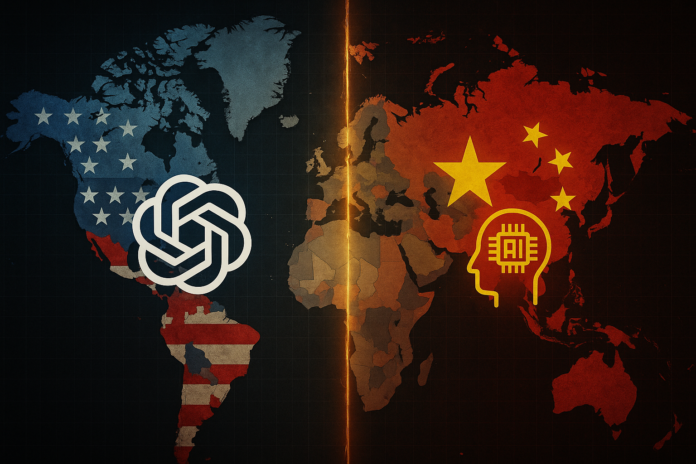
The AI Bipolar World: How America and China Are Dividing the Future
The world is splitting in two. Not along old fault lines of ideology or geography. Along a new axis: artificial intelligence capability.
On one side: the United States, home to ChatGPT, Claude, Gemini, Copilot, and Grok. The frontier labs. The trillion-dollar valuations. The models that power the global internet.
On the other: China, with Wenxin Yiyan, Qwen, Ernie Bot, GLM-130B, and Kimi. State-backed, rapidly advancing, and increasingly cut off from Western technology.
Everyone else? They’re picking sides. Or trying desperately to build a third path that probably doesn’t exist.
This isn’t just a technology competition. It’s the formation of a new world order. And the implications will shape everything—from geopolitics to economics to the very structure of human society.
The American Empire: Innovation Through Chaos
The United States dominates AI not through central planning but through its opposite: chaos, competition, and capital.
OpenAI, Anthropic, Google DeepMind, Meta, xAI, and dozens of smaller labs compete ruthlessly. They poach each other’s researchers. They race to release capabilities. They raise billions from venture capitalists and corporate balance sheets.
The result: American models lead on virtually every benchmark. GPT-4 and Claude power millions of businesses. Gemini integrates across Google’s global infrastructure. Copilot is becoming the default interface for knowledge work.
America’s advantages:
- NVIDIA dominance — The chips that train AI are designed in California
- Capital markets — Trillions in VC and public market funding
- Talent magnet — The world’s best researchers come to American universities and companies
- English language — The internet’s lingua franca becomes AI’s training data
- Cloud infrastructure — AWS, Azure, and Google Cloud host the world’s compute
But American AI dominance has vulnerabilities. The ecosystem depends on global supply chains for chips—particularly Taiwan’s TSMC. It relies on immigrant talent that immigration policy could restrict. And it’s increasingly cut off from China’s market and data.
The Chinese Challenge: Scale Through Coordination
China approaches AI differently. Not as a competitive market but as a national mission.
Baidu’s Wenxin Yiyan, Alibaba’s Qwen, ByteDance’s various models, and dozens of state-backed initiatives operate with government coordination. They share training data. They align on safety standards. They benefit from China’s massive domestic market and limited Western competition.
The results are impressive. Chinese models have closed much of the gap with American leaders. In some domains—multimodal understanding, certain language tasks—they’ve achieved parity or superiority.
China’s advantages:
- Data scale — 1.4 billion people generating training data
- State coordination — National AI strategy with massive funding
- Manufacturing — Growing domestic chip production despite sanctions
- Application focus — Less research, more deployment at scale
- Controlled market — No American competition domestically
China’s challenges are equally significant. Export controls limit access to advanced chips. The brain drain to American labs continues. And state control may stifle the chaotic innovation that produces breakthroughs.
The Vassal States: Everyone Else
Outside the bipolar core, nations face an uncomfortable choice.
Europe: The Regulatory Superpower
France’s Mistral represents Europe’s best shot at AI sovereignty. It’s a capable model, well-funded, and genuinely European. But it’s not competitive with American or Chinese leaders.
The EU’s strategy increasingly focuses on regulation rather than innovation. The AI Act imposes strict requirements that favor incumbents who can afford compliance. Europe may become a rule-maker for AI it doesn’t build.
The risk: Europe regulates itself into irrelevance, becoming a consumer of American and Chinese models rather than a producer.
The Middle East: Petrodollars Buying Time
Saudi Arabia’s ALLaM and the UAE’s Falcon represent a different approach: buy your way in. Billions invested. American researchers hired. Massive compute clusters built.
But money alone doesn’t produce frontier AI. The talent, ecosystem, and iterative learning require decades to build. The Gulf states may find themselves with expensive infrastructure running American and Chinese models.
India: The Great Hope
India has the talent, the market, and the ambition. But it lacks the capital and chip access. Indian AI efforts remain fragmented, underfunded, and dependent on American cloud infrastructure.
The tragedy: India produces world-class AI researchers who overwhelmingly work for American companies.
Israel, Canada, UK: Satellite Powers
These nations have genuine AI capabilities. DeepMind (UK, now Google). Cohere (Canada). AI21 Labs (Israel). But they’re either acquired by American giants or serving niche markets.
Their fate: valuable contributors to the American ecosystem, not independent powers.
Russia: Isolated and Falling Behind
Sanctions have crippled Russian AI development. YandexGPT exists but lacks the compute, data, and talent to compete. Russia’s AI future is as a vassal state—likely Chinese-aligned given geopolitical realities.
The Three Paths Forward
Nations outside the bipolar core face three strategic options:
Path 1: Alignment
Accept American or Chinese dominance and align accordingly. Use their models, their clouds, their standards. Trade sovereignty for capability.
Most nations will choose this path. It’s the path of least resistance. But it means accepting permanent technological dependence.
Path 2: Neutrality
Try to maintain access to both American and Chinese ecosystems. Play both sides. Extract concessions through competition.
This path is increasingly difficult. Both powers demand alignment. Technology transfer comes with strings. And the middle ground shrinks as bipolarity intensifies.
Path 3: Sovereignty
Attempt to build domestic AI capability. Invest billions. Train local models. Accept inferior performance for independence.
This is Europe’s stated path. It’s expensive, risky, and likely to fail. But for nations with the resources and will, it may be the only alternative to vassal status.
What This Means for the Future
The AI bipolar world will reshape everything:
Economics
AI productivity gains will concentrate in America and China. Their GDP growth will outpace the rest. The digital divide becomes a chasm.
Companies will face pressure to choose ecosystems. Use American AI, lose Chinese market access. Use Chinese AI, face American sanctions. Neutrality becomes impossible.
Geopolitics
AI alliances will reshape military relationships. Nations with American AI get American security guarantees. Nations with Chinese AI align with Beijing.
The old NATO vs. Warsaw Pact structure may reemerge as AI alliance blocs.
Culture
American and Chinese AI will shape global culture. Their values, biases, and assumptions embedded in the models everyone uses.
The English internet and the Chinese internet may become distinct cultural spheres, with AI reinforcing the separation.
Military
Autonomous weapons, cyber capabilities, and intelligence analysis will depend on AI. The AI gap becomes a military gap.
Nations without frontier AI become militarily irrelevant, dependent on alliance protection.
The Wildcards
Several factors could disrupt the bipolar order:
Open Source
Meta’s Llama, Mistral, and others offer capable open-source models. These democratize access to AI capabilities outside the bipolar core.
But open source doesn’t solve the chip problem. Training still requires NVIDIA GPUs. Inference at scale still requires cloud infrastructure. Open source may delay dependence without preventing it.
Regulation
Heavy-handed regulation in America or China could slow their progress. Europe’s AI Act, if emulated, could fragment the market further.
But regulation typically favors incumbents. The bipolar powers have the resources to comply. Smaller players don’t.
Breakthrough
A fundamental AI breakthrough—artificial general intelligence, novel architectures, or unexpected capabilities—could reshuffle the deck.
But breakthroughs require the same ingredients that created the bipolar order: talent, capital, and compute. The same players are likely to benefit.
The Bottom Line
The AI world is becoming bipolar. America and China are the superpowers. Everyone else is choosing sides or accepting irrelevance.
This isn’t temporary. The ingredients for AI dominance—chips, talent, data, capital—are structural advantages that compound over time. The gap between the core and the periphery will widen, not narrow.
For nations outside the core, the choices are stark: align, neutralize, or invest massively in sovereignty with limited odds of success.
For individuals, the implications are equally profound. Your AI tools will come from America or China. Your economic opportunities will depend on which sphere you inhabit. Your cultural inputs will be shaped by one of two dominant narratives.
The bipolar world isn’t coming. It’s here.
The only question is which side you’re on—or whether there’s room for a third path that history suggests doesn’t exist.
Related: Read our analysis of Trump’s AI Council—how America is consolidating its AI dominance through industrial policy.
Sources
- OpenAI, Anthropic, Google DeepMind, Meta, xAI – Company information and model capabilities
- Baidu, Alibaba, ByteDance – Chinese AI model documentation
- Mistral AI – European AI capabilities
- Cohere, AI21 Labs – Alternative AI providers
- Geopolitical analysis of AI competition
- Chip export controls and supply chain analysis

