
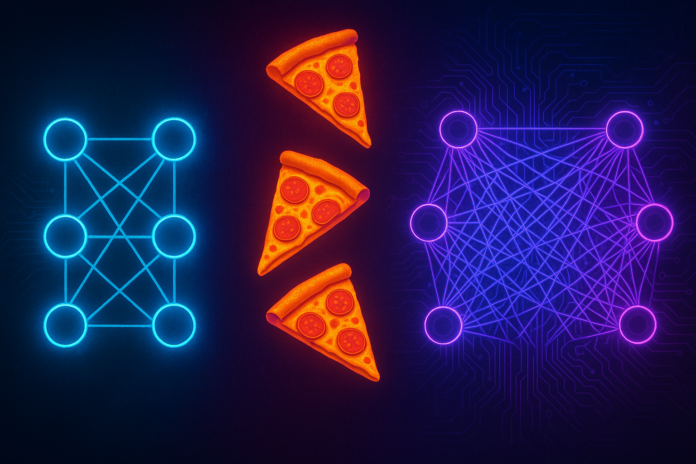
Machine Learning vs Deep Learning: The Complete Guide (With Pizza)
Everyone talks about machine learning and deep learning, but few can explain the difference clearly. One uses human-defined features. The other discovers features automatically. One works with structured data. The other handles raw images and text. Understanding when to use each—and why—separates AI practitioners from AI tourists.
The Hierarchy: Where Everything Fits
Before comparing machine learning and deep learning, you need to understand where they sit in the AI landscape:
Artificial Intelligence (AI)
    └── Machine Learning (ML)
            └── Neural Networks (NN)
                    └── Deep Learning (DL)
Deep learning is always machine learning. Machine learning is always AI. But not all AI uses machine learning, and not all machine learning uses deep neural networks.
This matters because the terms get used interchangeably in marketing materials. When a vendor says “AI-powered,” they might mean simple rules. When they say “machine learning,” they might mean a basic algorithm. When they say “deep learning,” they’re claiming sophisticated neural networks. Knowing the hierarchy helps you ask the right questions.
The Pizza Test: A Practical Example
The best way to understand the difference is through a concrete example. Let’s build a model that decides whether to order pizza for dinner.
The Machine Learning Approach
We’ll use three factors to make our decision:
- Time: Will ordering save time? (Yes = 1, No = 0)
- Health: Will I lose weight? (Yes = 1, No = 0)
- Money: Will it save money? (Yes = 1, No = 0)
For tonight: Time = 1 (yes, saves time), Health = 0 (no, ordering all toppings), Money = 1 (yes, have a coupon).
Now we assign weights to each factor based on importance:
- Time weight (W1): 5 (I value my time highly)
- Health weight (W2): 3 (I care about fitness, but not obsessively)
- Money weight (W3): 2 (dinner won’t break the bank either way)
Our threshold for ordering is 5. The calculation:
(1 × 5) + (0 × 3) + (1 × 2) - 5 = +2
Positive result means pizza night. This is a simple neural network—a perceptron with weighted inputs and a threshold. It’s machine learning because the model learns the weights from data rather than having them hardcoded.
What Makes It “Deep”?
Here’s the critical distinction: our pizza model has two layers (input and output). A neural network becomes “deep” when it has more than three layers—including input and output.
Machine Learning (2-3 layers):
Input → Output

Deep Learning (4+ layers):
Input → Hidden Layer 1 → Hidden Layer 2 → ... → Output
Those hidden layers are where the magic happens. Each layer transforms the data, extracting increasingly complex features. Early layers might detect simple patterns. Deeper layers combine those patterns into sophisticated representations.
The Real Difference: Feature Engineering
Layer count matters, but it’s not the fundamental difference. The real distinction is who defines the features.
Machine Learning: Human-Defined Features
In classical machine learning, human experts determine what features matter. If we’re building a model to classify food images, humans might decide that:
- Bread type distinguishes pizza from burgers
- Shape helps identify tacos
- Toppings separate different pizza types
Humans label thousands of images with these characteristics. The machine learning model learns from human-defined features. This is called supervised learning because humans supervise by providing labeled examples and engineered features.
Deep Learning: Automatic Feature Discovery
Deep learning doesn’t require human-defined features. Show a deep neural network thousands of food images—no labels, no feature descriptions—and it will:
- Discover that round shapes with melted cheese correlate with “pizza”
- Learn that elongated shapes with fillings indicate “tacos”
- Recognize that circular patties between buns mean “burgers”
The network learns these features automatically by observing patterns across massive datasets. No human told it to look for cheese or bun shapes. It discovered what distinguishes each food type through pattern recognition.
This capability—learning features from raw, unstructured data—is deep learning’s superpower.
Supervised vs Unsupervised: The Learning Types
This distinction connects to broader machine learning categories:
Supervised Learning
Requires labeled data. Humans provide correct answers during training. The algorithm learns to map inputs to known outputs.
Examples:
- Email spam detection (labeled as spam/not spam)
- Credit card fraud detection (labeled as fraud/legitimate)
- Medical diagnosis (labeled with confirmed diseases)
Characteristics:
- Requires human labeling effort
- Performance depends on label quality
- Well-understood, widely used
Unsupervised Learning
Works with unlabeled data. The algorithm discovers hidden patterns and structures without guidance.
Examples:
- Customer segmentation (grouping similar customers)
- Anomaly detection (finding unusual patterns)
- Recommendation systems (discovering item similarities)
Characteristics:
- No labeling required
- Discovers unexpected patterns
- Results require human interpretation
The Deep Learning Advantage
Classical machine learning primarily uses supervised learning. Deep learning excels at both:
- Supervised deep learning: Image classification with labels, language translation with paired examples
- Unsupervised deep learning: Feature learning from raw images, pattern discovery in text
This flexibility—learning from labeled or unlabeled data, structured or unstructured inputs—makes deep learning applicable to problems classical ML cannot solve.
How Neural Networks Actually Learn
Whether shallow or deep, neural networks learn through two fundamental processes:
Forward Propagation
Data flows through the network from input to output. Each neuron applies weights to its inputs, sums them, and passes the result through an activation function. The final layer produces a prediction.
In our pizza example:
Inputs (time, health, money)
    ↓
Multiply by weights (5, 3, 2)
    ↓
Sum and subtract threshold
    ↓
Output (+2 = order pizza)
Backpropagation
After forward propagation produces a prediction, backpropagation improves the model:
- Calculate error: Compare prediction to actual result
- Attribute error: Determine which neurons contributed to the mistake
- Adjust weights: Update connections to reduce future error
- Repeat: Process thousands of examples until accurate
Backpropagation moves backward through the network—from output to input—hence the name. It’s how neural networks learn from mistakes without human intervention.
When to Use Machine Learning vs Deep Learning
Use Classical Machine Learning When:
You have limited data. Deep learning requires massive datasets. With hundreds or thousands of examples, classical ML often outperforms deep learning.
Features are well-understood. If domain experts can identify what matters—credit score for loans, keywords for spam detection—classical ML works efficiently.
Interpretability matters. Many industries require explaining why decisions were made. Classical ML models (decision trees, linear regression) are more interpretable than deep neural networks.
Resources are constrained. Deep learning requires significant computational power. Classical ML runs on modest hardware.
Data is structured. Tabular data with clear columns and rows is perfect for classical ML.
Use Deep Learning When:
You have massive datasets. Deep learning improves with more data. When you have millions of examples, deep learning shines.
Working with unstructured data. Images, audio, video, and text require feature extraction that deep learning automates.
Features are complex or unknown. When you cannot easily describe what distinguishes classes—what makes a cat a cat in pixel terms—deep learning discovers the features.
Maximum accuracy is required. For problems where 95% accuracy isn’t good enough, deep learning often achieves 99%+.
You have computational resources. GPUs and cloud computing make deep learning feasible for organizations with appropriate infrastructure.
Real-World Applications
Machine Learning in Production
Credit Scoring: Banks use classical ML (logistic regression, random forests) to assess loan default risk. Features like income, credit history, and debt-to-income ratio are well-understood and interpretable.
Demand Forecasting: Retailers predict product demand using time series models. Historical sales data, seasonality, and promotions provide structured inputs.
Fraud Detection: Financial institutions flag suspicious transactions using gradient boosting machines. Transaction amount, location, and timing are engineered features.
Deep Learning in Production
Computer Vision: Self-driving cars use convolutional neural networks (CNNs) to detect pedestrians, traffic signs, and lane markings. No human engineered “pedestrian features”—the network learns from millions of labeled images.
Natural Language Processing: GPT and similar models use transformer architectures (a deep learning variant) to understand and generate text. They learn language patterns from billions of examples without explicit grammar rules.
Medical Imaging: Deep learning models detect cancers in radiology scans with accuracy matching or exceeding human specialists. They learn subtle patterns invisible to the human eye.
Speech Recognition: Virtual assistants convert speech to text using recurrent neural networks and transformers. They handle accents, background noise, and context without explicit phonetic rules.
Common Misconceptions
Misconception 1: “Deep learning is always better”
Reality: For many problems, classical ML outperforms deep learning. With limited data or well-understood features, simpler models work better and are easier to maintain.
Misconception 2: “Machine learning requires less data”
Reality: Both benefit from more data. Deep learning just has higher minimum requirements. Classical ML can work with hundreds of examples; deep learning typically needs thousands or millions.
Misconception 3: “Deep learning is black box, ML is interpretable”
Reality: Some classical ML models (random forests, SVMs) are also difficult to interpret. Some deep learning techniques (attention visualization) provide insight into model decisions. Interpretability varies across both categories.
Misconception 4: “You need to choose one or the other”
Reality: Modern AI systems often combine both. A self-driving car might use classical ML for route planning and deep learning for object detection. Hybrid approaches leverage strengths of each.
The Future: Convergence and Specialization
The boundary between machine learning and deep learning continues evolving:
Transfer Learning: Pre-trained deep learning models (trained on massive datasets) get fine-tuned for specific tasks with limited data. This brings deep learning capabilities to smaller data scenarios.
AutoML: Automated machine learning systems try both classical and deep approaches, selecting the best for your specific problem and dataset.
Neural Architecture Search: AI systems design neural network architectures automatically, optimizing layer types and connections for specific problems.
Explainable AI: Researchers develop techniques to make deep learning more interpretable—LIME, SHAP, and attention mechanisms help explain why models make specific decisions.
Practical Recommendations
For Business Leaders
Start with the problem, not the technology. Don’t ask “should we use deep learning?” Ask “what accuracy do we need, what data do we have, and what interpretability requirements exist?”
Benchmark both approaches. For important problems, try classical ML and deep learning. Measure performance, training time, and maintenance requirements.
Consider hybrid solutions. Use deep learning for perception tasks (images, text) and classical ML for decision-making based on extracted features.
For Practitioners
Master classical ML first. Understanding logistic regression, random forests, and gradient boosting provides foundation for deep learning.
Learn feature engineering. Even with deep learning capabilities, understanding how to represent data matters. Good features help all models.
Understand your data. Before choosing an approach, analyze data size, structure, and quality. These factors determine viable approaches more than problem complexity.
Conclusion
Machine learning and deep learning are not competitors—they’re tools for different jobs. Machine learning excels with structured data, limited examples, and well-understood features. Deep learning handles unstructured data, massive datasets, and complex pattern recognition.
The pizza example illustrates the fundamental mechanism: weighted inputs, thresholds, and decisions. Whether shallow or deep, neural networks operate on these principles. The depth determines complexity of patterns the network can learn.
Understanding both approaches—and when to use each—separates effective AI practitioners from those following hype. The best solution often combines both: deep learning for perception, classical ML for decision-making, human judgment for validation.
As datasets grow and computational costs fall, deep learning becomes viable for more problems. But classical machine learning remains essential—often outperforming deep approaches, always providing interpretability, frequently requiring less data and resources.
The question isn’t which is better. The question is which fits your specific problem, data, constraints, and requirements.
Related: Learn the foundations in our Complete Beginner’s Guide to AI or explore specific applications with our guides on AI chatbots and generative AI tools.
Sources
- IBM AI Developer Professional Certificate – Machine Learning vs Deep Learning
- “Deep Learning” by Ian Goodfellow, Yoshua Bengio, and Aaron Courville
- Google AI Blog: “Understanding Deep Learning”
- OpenAI Research Publications

