
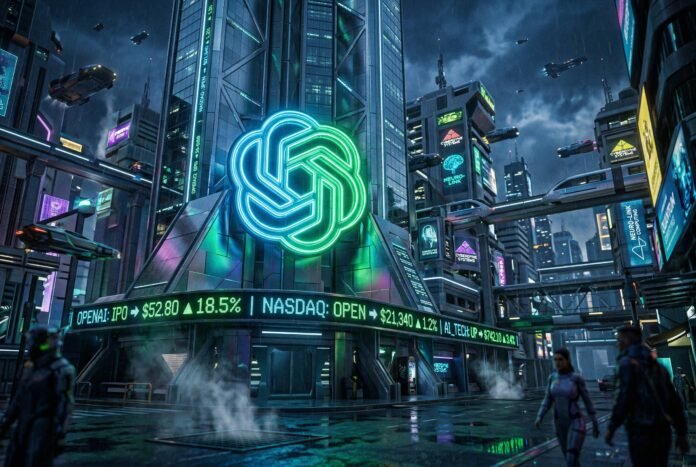
OpenAI just closed a $122 billion funding round at a post-money valuation of $852 billion. In February 2026, it hit a $25 billion annualized revenue run rate. And now it is taking early steps toward a public listing as soon as late 2026.
This is the AI industry defining moment. The company that started the modern AI race is preparing to go public — even as it expects to lose $14 billion in 2026 alone. That number is not a typo. It is the cost of building the future.
The Numbers That Matter
OpenAI’s $25 billion annualized revenue is driven by two engines: ChatGPT Pro subscriptions, and deep enterprise integrations now representing 40% of total revenue — up from 30% a year ago. Enterprise and consumer revenue will reach parity by end of 2026.
That shift matters enormously. Consumer subscriptions are sticky but commoditizing. Enterprise revenue — agentic workflows, API integrations, custom deployments — builds durable moats. Anthropic is approaching $19 billion in annualized revenue. The race to public markets between these two will be the defining financial story of the AI era.
Why Lose $14 Billion?
The expected $14 billion loss in 2026 is not mismanagement — it is deliberate infrastructure spending at a scale that would bankrupt most companies. OpenAI is burning cash on compute, talent, and research because the alternative is falling behind in a race where second place means irrelevance.
The $122 billion war chest gives it runway to absorb those losses and emerge dominant. The pattern is familiar: Amazon Web Services ran at losses for years before becoming the most profitable division of one of the world’s most valuable companies. As we explored in our analysis of what happens when AI agents start spending real money, the agentic workflow layer is where the real enterprise money is. OpenAI is positioning as the default intelligence engine for that layer.
The Media Acquisition Play
One detail deserving more attention: OpenAI’s acquisition of TBPN, a business talk show popular among Silicon Valley’s elite. This is not a vanity project. It is a deliberate move to control the narrative around AI — owning a distribution channel that reaches the exact audience making enterprise purchasing decisions. In a world where perception shapes adoption, owning your media is a competitive advantage.
What an IPO Actually Means
An OpenAI IPO would be one of the largest in history — potentially exceeding the valuations of most Fortune 500 companies on day one. It would also fundamentally change governance. Right now, OpenAI operates under a hybrid structure giving its nonprofit board significant control. Going public shifts that balance dramatically toward shareholder primacy.
For the crypto and decentralization community, this is worth watching carefully. A publicly traded OpenAI — beholden to quarterly earnings and activist investors — will behave very differently from the mission-driven research lab it once was. The pressure to monetize aggressively, to cut safety research that does not generate revenue, will be relentless.
The centralization of AI intelligence is accelerating. An IPO is not the end of that story. It is the beginning of a more aggressive chapter. And if you care about who controls the intelligence layer of the future, that should focus your attention.

