
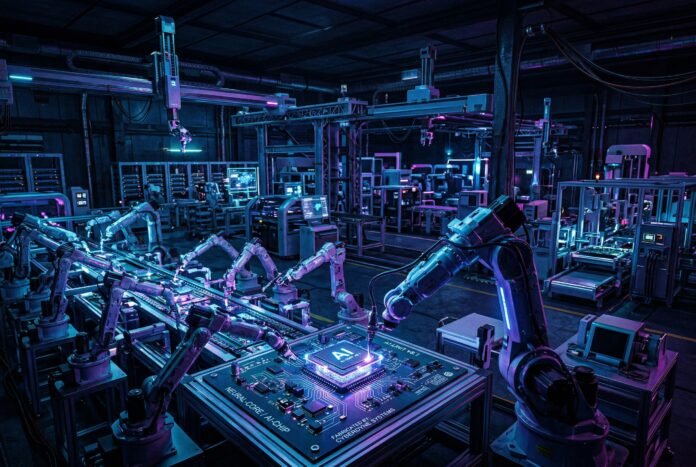
The Capacity Crisis That Could Freeze AI Growth
Imagine the most advanced manufacturing process on Earth — the one behind every cutting-edge AI chip, every next-generation smartphone processor, every autonomous driving system. Now imagine that capacity is completely sold out for the next two years.
That’s not a hypothetical. In an internal briefing dated April 3, 2026, TSMC executives revealed that their 3nm fabrication capacity is sold out through 2028. The world’s most important chipmaking technology has hit a wall — and everyone building AI is about to feel it.
The Perfect Storm Behind the Bottleneck
Three forces converged simultaneously to create this crisis:
- AI demand explosion: Every major breakthrough in artificial intelligence — from large language models to generative video to autonomous systems — requires exponentially more compute power. And that compute runs on TSMC’s 3nm process.
- Supply chain squeeze: Advanced packaging materials, EUV lithography equipment, and the handful of engineers who know how to operate these fabs are all in critically short supply.
- Geopolitical friction: The U.S.-China tech war has fragmented global semiconductor supply chains. Washington’s MATCH Act explicitly targets Chinese chip ambitions, forcing TSMC to navigate political minefields when expanding capacity. Western allies demand “friend-shored” production. China wants sovereignty. TSMC is caught in the middle.
The result: TSMC’s existing fabs can’t scale fast enough to meet demand, and demand is still accelerating.
The GigaFab: TSMC’s Moonshot
Faced with a wall, TSMC is planning to build through it. The company’s response is a project internally dubbed the “GigaFab” — a massive expansion designed to double its advanced-node capacity within three years.
While TSMC hasn’t released exact specifications, industry analysts expect the GigaFab to:
- Incorporate next-generation EUV lithography machines beyond ASML’s current offerings
- Feature integrated advanced packaging facilities on-site, eliminating the current bottlenecks where completed wafers sit waiting for packaging capacity
- Use AI-driven yield optimization to extract more usable chips per wafer while reducing energy consumption
- Potentially span multiple geographic locations for redundancy and political compliance
It’s ambitious. It’s necessary. And it won’t arrive in time.
Who Gets Squeezed First?
AI Startups
If you’re competing for NVIDIA GPUs right now, imagine also competing for custom AI chip manufacturing slots. The lead times for 3nm production are about to stretch from months into years. Every startup racing to build the next foundation model just got another constraint to worry about.
Consumer Electronics
Next-generation smartphones, laptops, and gaming consoles all depend on 3nm processors. Delays and price increases are coming. Apple, Qualcomm, and AMD are all fighting for the same limited wafer starts.
Automotive and IoT
These industries run on mature nodes — 28nm, 40nm — but as TSMC prioritizes 3nm expansion, those older fabs get less investment and attention. The ripple effects could extend further down the technology stack than most people expect.
The China Gap Is Widening
Meanwhile, Chinese chipmakers like SMIC remain 5–10 years behind TSMC in AI data center chips. Despite massive state investment, China can’t close the gap fast enough to relieve global pressure.
This isn’t just a capacity problem — it’s a capability problem. And it means the global semiconductor industry is structurally dependent on TSMC’s decisions in a way that hasn’t been true since the early days of silicon valley.
Memory Shortages Compound the Problem
As Digitimes reports, global memory chip shortages have shifted the industry’s focus from price competition to securing supply. Advanced production capacity is being prioritized for AI-specific memory products like HBM4, squeezing mature process memory availability for consumer and industrial applications.
The bottleneck isn’t just at the logic layer. It’s everywhere.
The AI Acceleration Paradox
Here’s the uncomfortable truth: every AI breakthrough creates more demand for the same constrained supply. Better models need more compute. More compute needs more chips. More chips need more fab capacity. But fabs take years to build.
This is the paradox at the heart of the current AI boom. The technology is accelerating, but the physical infrastructure supporting it cannot keep pace.
What Comes Next
For tech companies: Expect longer lead times, higher costs, and increased pressure to design for efficiency over raw performance. The era of throwing more silicon at a problem is ending — at least temporarily.
For investors: TSMC stock remains a bellwether for the entire semiconductor industry. But the real opportunity might be in the supply chain — materials suppliers, packaging companies, lithography equipment makers, and the firms that build the fabs themselves.
For the broader economy: The 2026–2028 shortage is locked in. No amount of political will or corporate investment can compress a five-year construction timeline into two. The question isn’t whether the shortage will impact growth — it’s how severe the impact will be.
The Bottom Line
The semiconductor industry’s most critical bottleneck just got tighter. TSMC’s GigaFab is a necessary moonshot — the kind of bet that defines decades. But it won’t arrive in time to prevent three years of constrained growth, rising costs, and geopolitical friction over the world’s most important manufacturing technology.
The chips aren’t coming fast enough. And the AI revolution just found its ceiling.
Sources
- Distill Intelligence — Semiconductors & AI Chips Weekly Briefing, April 3, 2026
- Tom’s Hardware — Chinese Chip Industry Leaders Admit 5–10 Year AI Chip Lag
- Digitimes — Memory Shortage Persists as AI-Era Supply-Demand Imbalance Deepens
- IndexBox — Arm Launches First Internal AI Data Center CPU
Related Reading
- The MATCH Act: Washington Just Escalated the Chip War — And ASML Is in the Crosshairs
- TSMC’s 2nm Crisis: The Chip War That Could Reshape AI
- The Semiconductor Revolution: 2026’s Game-Changers in Chips and AI
- Google’s TurboQuant: The Software Breakthrough That Just Shook the $500 Billion Memory Chip Market
- Six AI Announcements in Four Hours: The Labs Are Not Accelerating. You Can Just See It Now.

