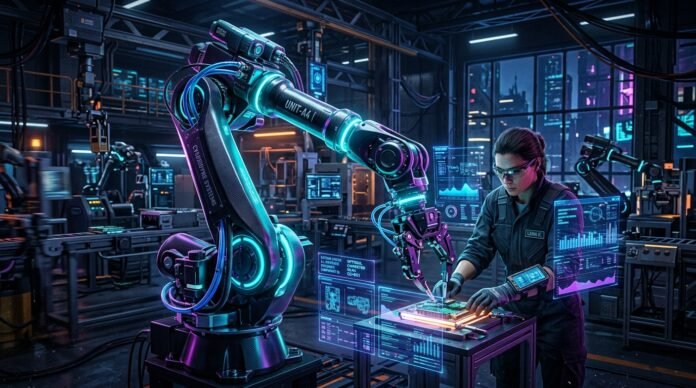
From factory floors to operating rooms—how robots and intelligent automation are reshaping the global economy.
In 1961, General Motors installed the first industrial robot on its assembly line in Trenton, New Jersey. The Unimate, a 4,000-pound mechanical arm, performed die casting and welding tasks that were dangerous for human workers.
Six decades later, robots have evolved far beyond simple repetitive motions. They perform surgery with sub-millimeter precision, navigate warehouses autonomously, explore the surface of Mars, and collaborate safely with human workers. The global industrial robotics market, valued at $43 billion in 2023, is projected to reach $81 billion by 2030.
The Anatomy of a Robot: How Machines Come to Life
All robots share three fundamental components that enable them to sense, decide, and act.
Sensors: The Eyes and Ears
Sensors gather information about the robot’s environment:
- Vision systems: Cameras for object recognition, navigation, quality inspection
- Proximity sensors: Lidar, ultrasonic sensors for navigation and collision avoidance
- Environmental sensors: Temperature, vibration, gas detection
Actuators: The Muscles
Actuators convert energy into physical movement:
- Electric motors: Precise position control for manufacturing
- Hydraulic actuators: High-force movement for heavy industry
- Pneumatic actuators: Fast, light movements for pick-and-place
Controllers: The Brain
Controllers process sensor data, make decisions, and command actuators:
- Traditional controllers: Execute pre-programmed sequences
- AI-powered controllers: Use machine learning to adapt and learn
The AI Revolution in Robotics
Computer Vision: Understanding the Visual World
Computer vision enables robots to interpret visual information:
- Object recognition: Identify objects in cluttered environments
- Scene understanding: Comprehend spatial relationships and context
- Visual servoing: Real-time visual feedback to guide actions
Natural Language Processing: Conversational Robots
NLP enables robots to understand and respond to human speech:
- Voice-controlled robots: Warehouse workers direct picking robots verbally
- Multimodal interaction: Combine voice with gesture and gaze
- Contextual understanding: Interpret commands in context
Reinforcement Learning: Robots That Learn
Reinforcement learning enables robots to acquire skills through trial and error:
- Motor skill acquisition: Boston Dynamics robots learn acrobatic feats
- Manipulation skills: Learn to grasp unfamiliar objects
- Navigation: Learn traffic patterns and optimize routes
Collaborative Robots: Working Alongside Humans
Collaborative robots, or “cobots,” are designed to work safely alongside humans.
What Makes Cobots Different
- Safety by design: Force-limiting joints, slow movement, contact detection
- Ease of programming: “Teach by demonstration” rather than complex coding
- Flexibility: Rapid redeployment for different tasks
Cobot Applications
Manufacturing: Over 50,000 Universal Robots operate worldwide in machine tending, assembly, and quality inspection.
Logistics: Amazon deploys thousands of cobots in fulfillment centers, bringing shelves to human pickers.
Healthcare: Surgical cobots like the da Vinci system extend surgeon capabilities with steady, scaled motion.
Industry Transformations
Manufacturing: The Factory of the Future
Automotive: Modern factories contain hundreds of robots performing welding, painting, assembly, and material handling.
Electronics: Robots place surface-mount components with sub-millimeter accuracy.
Food and beverage: Robots handle raw meat, package delicate items, and palletize shipments.
Healthcare: Precision and Assistance
Surgical robots: Robotic prostatectomy, hysterectomy, and cardiac surgery offer better outcomes than open surgery.
Rehabilitation robots: Provide consistent, repeatable therapy for stroke and spinal cord injury patients.
Hospital logistics: TUG robots navigate corridors delivering medications, meals, and supplies.
Agriculture: Precision Farming
Harvesting robots: Strawberry-picking and lettuce-thinning robots use computer vision and gentle grippers.
Monitoring robots: Patrol fields collecting data on crop health, soil conditions, and pest presence.
Weeding robots: Laser-weeding robots identify and destroy weeds without herbicides.
Robotic Process Automation: Software Robots
What RPA Is
RPA uses software “bots” to automate repetitive, rule-based digital tasks. Unlike physical robots that manipulate objects, RPA bots manipulate data.
Where RPA Delivers Value
Finance and accounting: Invoice processing—bots perform the same steps as humans in under a minute with perfect accuracy.
Human resources: Employee onboarding—bots orchestrate dozens of steps across multiple systems.
Customer service: Bots handle routine inquiries, freeing human agents for complex issues.
The RPA Market
The RPA market grew from under $200 million in 2015 to over $3 billion in 2023. Major vendors include UiPath, Automation Anywhere, and Blue Prism.
Survey results: 86% of decision-makers view RPA as important to digital transformation.
The Future of Robotics and Automation
Democratization of Robotics
Robotics is becoming accessible to smaller organizations through cobots, cloud robotics platforms, and no-code automation tools.
Human-Machine Collaboration
The future is robots working with humans, not replacing them. Cobots in manufacturing, RPA handling routine tasks, surgical robots extending physician capabilities.
Autonomy and Adaptation
Robots are becoming more autonomous—warehouse robots navigate without predefined paths, agricultural robots treat individual plants, service robots handle unexpected situations.
Ethical and Social Considerations
Employment impacts: Managing transitions as automation affects manufacturing and white-collar work.
Privacy concerns: Balancing benefits of robotics with privacy protection as robots collect data.
Safety standards: Evolving regulations as robots operate closer to humans.
Conclusion
The robot that General Motors installed in 1961 performed simple, repetitive welding. Today’s robots perform surgery, explore other planets, and collaborate safely with human workers.
For businesses, robotics and automation offer compelling value: increased productivity, improved quality, reduced costs, and continuous operation. For society, the questions are profound—how do we ensure benefits are broadly shared, manage workforce transitions, and maintain human agency as machines become more capable?
The machines are transforming industry and work. Understanding this transformation—and shaping it—is one of the defining challenges of our time.
Related Reading
- AI, Machine Learning, and Foundation Models — The AI technologies powering modern robotics
- AI Agents: The Rise of Autonomous Software — Autonomous systems and decision-making
- NVIDIA’s “Physical AI” Play — The convergence of AI and robotics
- The Road to Autonomy — Autonomous vehicles as robotic systems
- The AI Infrastructure Stack — Technical foundations for robotic systems
Sources
- IBM Training: “Robotics and Automation”
- International Federation of Robotics (IFR) World Robotics Report 2023
- McKinsey Global Institute: “The Future of Work in America”
- Boston Consulting Group: “The Rise of Collaborative Robots”
- PEGA Systems: RPA Market Survey
Follow @tsnmediahub on X for breaking AI news as it happens.
Follow on X