
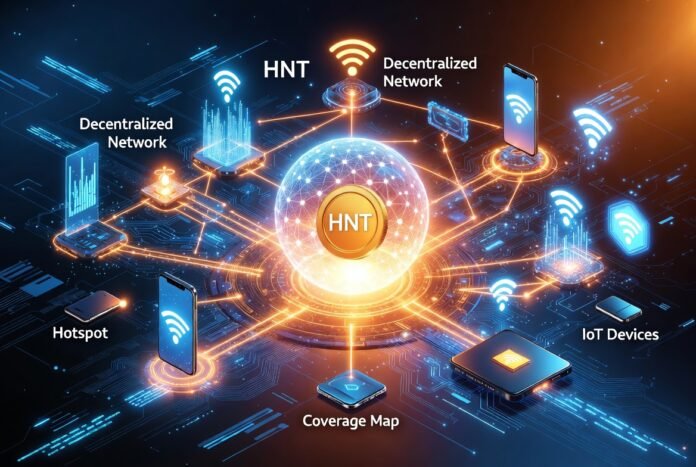
Helium (HNT) is a groundbreaking decentralized wireless network that empowers individuals and businesses to build and own infrastructure for IoT (Internet of Things) and mobile connectivity. Launched in 2019, it flips the traditional telecom model by using community-hosted “Hotspots”—small, energy-efficient devices that provide coverage for low-power wide-area networks (LoRaWAN for IoT) and cellular offload (5G/Wi-Fi). This “people-powered” approach addresses scalability issues in legacy telecom, where building towers is expensive and slow. Instead, anyone can deploy a Hotspot, earn HNT tokens for providing coverage and transferring data, and contribute to a global, resilient network.
At its core, Helium democratizes connectivity in a multi-trillion-dollar industry dominated by monopolies. It supports applications like smart cities, asset tracking, environmental monitoring, and mobile data offloading for carriers. By early 2026, with over 1 million Hotspots deployed worldwide, Helium has become a leader in DePIN (Decentralized Physical Infrastructure Networks), bridging blockchain with real-world utility.
How Helium Works: Core Mechanics and Ecosystem
Network Architecture
- Hotspots: These are the backbone—plug-and-play devices that mine HNT by proving coverage via Proof-of-Coverage (PoC) challenges. Hotspots use radio frequencies to connect devices, transferring data packets and earning rewards proportional to usage.
- Dual Networks:
- Helium IoT Network: Focuses on low-bandwidth IoT devices (e.g., sensors for agriculture or logistics). It uses LoRaWAN technology for long-range, low-power connections.
- Helium Mobile Network: Launched in 2023, this handles cellular data offload, partnering with carriers like T-Mobile and AT&T to provide seamless Wi-Fi/5G access. Users can subscribe to Helium Mobile plans, which blend decentralized coverage with traditional networks.
- Consensus and Security: Built on Solana blockchain since migrating in 2023, it uses a hybrid consensus for efficiency. PoC ensures honest participation, with validators challenging Hotspots to verify location and coverage.
Tokenomics
HNT is the native token, with a total supply capped at 223 million (as of 2026). Key aspects:
- Earning Mechanism: Hotspot owners earn ~70% of mined HNT for coverage and data transfer; the rest goes to the network treasury and validators.
- Burning and Utility: Data Credits (DCs) are burned HNT equivalents used to pay for data transfer. This creates deflationary pressure. Mobile Network adds MOBILE tokens (burnable for DCs), unified under HNT governance.
- Halvings: Occur every two years; the most recent in 2025 reduced emissions, boosting scarcity.
- Staking and Governance: HNT holders can stake for veHNT (voting escrow) to influence proposals via the Helium Improvement Proposal (HIP) process.
The ecosystem includes developers building on Oracles for data verification, partnerships with enterprises, and tools like Helium Wallet for managing earnings. It’s accessible: Buy a Hotspot (~$200-500), set it up, and start earning passively.
Helium’s Performance in 2025: A Year of Explosive Growth
2025 was a breakout year for Helium, marked by “survival of the fittest” in DePIN amid market volatility. Despite crypto dips, Helium’s focus on real utility drove adoption. Key highlights:
- Market Cap and Price: Circulating market cap rose 9.1% quarter-over-quarter in Q3 to $453.9 million, though rankings slipped slightly. HNT price hovered around $1-5, with bullish predictions reaching $50-60.
- Network Milestones: Cumulative carrier data offloaded reached 2,721 TB in Q2, up 138.5% quarter-over-quarter, thanks to partnerships like AT&T (enabling Wi-Fi on 62,000+ US Hotspots).
- Funding and Initiatives: A $50M grant fund boosted expansions, including Helium Plus for enterprise tools.
- Global Reach: Expansions into Brazil and Mexico added thousands of Hotspots, targeting underserved areas.
Increase in Users and Network Adoption in 2025
User growth was phenomenal, reflecting Helium’s shift to demand-driven models:
- Daily Active Users (DAU): Surged to nearly 1.7 million, with peaks approaching 2 million—a testament to deepening engagement in IoT and mobile.
- Helium Mobile Subscribers: Exploded from 160,300 in Q1 to 311,200 in Q2 (94.1% increase), surpassing 311,000 by mid-year. This was fueled by affordable plans ($20/month unlimited) and carrier integrations.
- Hotspot Deployments: Over 1 million active Hotspots by year-end, up significantly from prior years, with strong growth in the US, Europe, and Latin America.
- Data Traffic: IoT data packets transferred grew exponentially, supporting millions of connected devices (e.g., sensors, trackers).
- Overall User Metrics: Account signups and active addresses tripled in some quarters, driven by real-world use cases like smart agriculture and urban connectivity.
This growth outpaced many DePIN peers, with Helium Mobile becoming a key driver—proving decentralized networks can compete with telecom giants.
Expectations for 2026 and Beyond
Looking to 2026, Helium is poised for sustained expansion, with analysts optimistic amid AI-IoT synergies and regulatory tailwinds. Price predictions vary:
- Conservative: $1.29–1.43 minimum, averaging $1.50–2.00.
- Bullish: Up to $61.63 (1,768% growth) if adoption surges. Others forecast $3.3–5.52.
Key drivers:
- Network Scaling: Further carrier partnerships (e.g., more offload deals) could push DAU to 3–5 million and data offload to petabytes.
- Tokenomics Enhancements: Post-halving scarcity, plus MOBILE/IOT token burns, may drive HNT value.
- Ecosystem Growth: Focus on DeSci (decentralized science) integrations, global expansions (Asia/Africa), and Helium Plus upgrades for enterprises.
- Challenges: Regulatory hurdles in spectrum use and competition from centralized 5G could temper growth, but Helium’s community model provides resilience.
- Long-Term Vision: By 2030, HNT could reach $10–100 in optimistic scenarios, powered by billions of IoT devices.
Helium’s trajectory hinges on continued real-world adoption—watch for Q1 2026 updates on subscriber milestones and new HIPs. If you’re considering involvement, start with a Hotspot deployment for passive income in this evolving DePIN leader.
Sources & Credits
- Messari DePIN Sector Reports (Q3 2025)
- Helium Network Official Blog and State of the Network Reports (2025)
- CoinGecko & CoinMarketCap: HNT Token Data (January 2026)
- DePIN Scan & Helium Explorer Network Metrics (2025–2026)
- Crypto Analyst Reports from BeInCrypto, Cointribune, and The Block (2025)
- Helium Improvement Proposals (HIPs) and Community Governance Updates
- Carrier Partnership Announcements (AT&T, T-Mobile) – 2025
All data and metrics are based on publicly available reports and official network statistics as of January 2026.

 is revolutionizing decentralized AI, Render is powering the future of GPU compute, and Helium is building people-powered wireless networks. Real-world utility, massive growth, and the hottest crypto trend of the year—read now and get ahead in 2026!)