
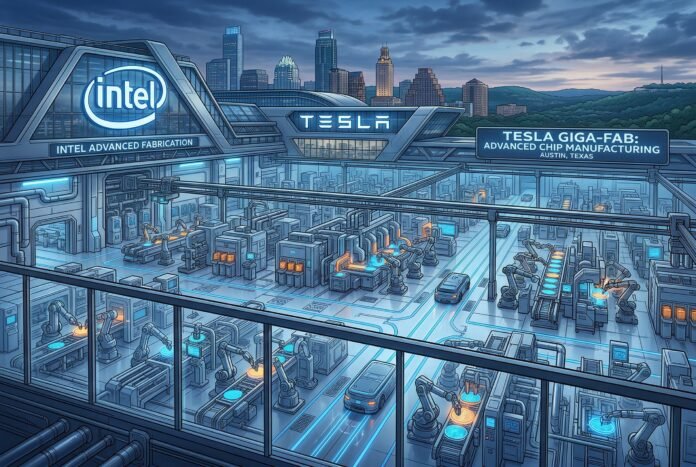
Intel has spent the better part of a decade falling behind. The company that once dominated semiconductor manufacturing missed the mobile revolution, fumbled advanced process nodes, and watched rivals TSMC and Samsung capture the most lucrative chip contracts. Its stock has been a graveyard for investor capital.
So when Intel announced on April 7, 2026, that it was joining Elon Musk’s Terafab project, the market responded with something it has not shown Intel in years: genuine enthusiasm. The stock jumped. Analysts upgraded. For the first time in a long time, Intel had a credible path forward.
The question is whether Terafab represents Intel’s salvation — or merely the latest ambitious project to falter under the weight of Musk’s timelines and Intel’s execution challenges.
What Is Terafab?
Terafab is a planned semiconductor fabrication mega-project announced by Elon Musk on March 21, 2026, in Austin, Texas. The name reflects its ambition: producing more than one terawatt of AI compute annually. For context, global data center power consumption is roughly 200-300 terawatt-hours per year. Terafab aims to produce enough compute capacity to fundamentally reshape that infrastructure.
The project is a joint venture between Musk’s companies:
- Tesla — providing demand for robotaxi chips and humanoid robot processors
- SpaceX — offering satellite applications and space-hardened computing needs
- xAI — designing AI training and inference accelerators
- Now Intel — contributing manufacturing expertise and foundry capacity
The facility will be constructed adjacent to Gigafactory Texas, leveraging existing infrastructure, supply chains, and the regulatory relationships Musk has cultivated in the state.
Intel’s Role: Manufacturing Partner
Intel’s contribution to Terafab is specific and critical. The company announced it will help refactor silicon fab technology for the project, with Intel Foundry Services providing manufacturing capacity for AI chips designed by xAI and Tesla.
This is not a passive investment. Intel brings:
- Decades of fab expertise — process engineering, yield optimization, equipment relationships
- Intel Foundry Services infrastructure — existing facilities that can be expanded
- Talent — engineers and technicians with experience at leading-edge nodes
- Credibility — with government regulators and CHIPS Act administrators
Intel’s official statement emphasized the strategic fit: Our ability to design, fabricate, and deliver leading-edge silicon will help accelerate advances in AI and robotics.
Why Intel Needs This
Intel’s struggles are well-documented. The company that invented the microprocessor and dominated the PC era has fallen behind in nearly every growth market:
- Mobile: ARM-based chips power virtually every smartphone
- AI accelerators: NVIDIA captures the overwhelming majority of AI training workloads
- Manufacturing: TSMC produces more advanced chips at better yields
- Foundry services: Intel’s efforts to manufacture for others have lagged expectations
The company’s market capitalization has shrunk by hundreds of billions. It has ceded technological leadership. It has burned through CEOs and strategies.
Terafab offers something Intel desperately needs: a customer with massive demand, deep pockets, and tolerance for risk. Musk’s companies need chips at a scale that justifies the capital investment Intel has already made in its manufacturing infrastructure. If Terafab succeeds, Intel has a path to foundry relevance. If it fails, Intel is no worse off than before.
Why Musk Needs Intel
Musk’s vertical integration strategy is approaching completion. He controls:
- xAI — the models (Grok and successors)
- Tesla — the applications (robotaxis, Optimus humanoid robots)
- SpaceX — the infrastructure (Starlink satellite network)
- Terafab — the chip design and manufacturing vision
What he lacked was manufacturing expertise. Building a chip fabrication plant is not like building a car factory or a rocket production line. It requires:
- Specialized equipment — EUV lithography machines that cost 00 million each and have single-source suppliers
- Process chemistry expertise — manipulating materials at the atomic level
- Yield optimization — the difference between a working fab and an expensive failure
- Talent — engineers with experience at 3nm, 2nm, and beyond
Intel has all of these. Musk has the capital, the demand, and the willingness to move fast. The partnership makes strategic sense for both parties.
The Scale of Ambition
Terafab’s stated goal — one terawatt of annual compute production — is difficult to contextualize. Consider:
- NVIDIA’s current AI chip production delivers roughly 5-10 megawatts of compute capacity annually
- Global AI training cluster capacity is estimated at 50-100 megawatts today
- Terafab’s target is 1,000 megawatts (one terawatt), or roughly 10-20x current global capacity
This is not incremental growth. This is a fundamental restructuring of the global AI compute supply chain.
The implications extend beyond Musk’s companies. If Terafab achieves even a fraction of its targets, it becomes a major supplier to the broader AI industry. It challenges NVIDIA’s dominance in AI accelerators. It threatens TSMC’s position as the world’s most advanced foundry. It reshapes the economics of AI training and inference.
The Geopolitical Dimension
Terafab does not exist in a vacuum. It arrives at a moment when semiconductor manufacturing has become a national security priority:
- The CHIPS Act provides 2 billion in subsidies for domestic chip production
- Taiwan tensions create existential risk for companies dependent on TSMC
- China’s semiconductor ambitions drive urgency in Western reshoring efforts
- Export controls on advanced chips to China accelerate domestic demand
Intel’s participation in Terafab aligns with all of these priorities. A massive domestic fab project supports CHIPS Act goals. It reduces dependence on Taiwan. It strengthens the US position in the AI race with China. It creates jobs, technology leadership, and supply chain resilience.
The Biden administration has made domestic manufacturing a centerpiece of economic policy. Terafab, with Intel’s involvement, is exactly the kind of project that attracts government support — subsidies, tax incentives, regulatory fast-tracking, and diplomatic protection.
The Risks
For all its promise, Terafab faces substantial challenges:
Execution Risk: Intel has a track record of missing timelines and process node targets. Its 10nm and 7nm transitions were years late and billions over budget. Terafab requires Intel to execute at a level it has not demonstrated recently.
Capital Intensity: A leading-edge fab costs 0 billion or more. Terafab’s scale suggests multiples of that. Musk has capital, but semiconductor manufacturing has a way of consuming more money than planned.
Talent Shortage: The semiconductor industry faces a critical shortage of experienced engineers. Terafab will compete with Intel’s existing operations, TSMC’s Arizona facility, Samsung’s Texas projects, and the broader tech industry for limited talent.
Technology Risk: Producing chips at 2nm and beyond requires technology that does not fully exist yet. EUV lithography, new materials, novel transistor structures — all are works in progress.
Musk Risk: Elon Musk has a history of optimistic timelines. Tesla’s Full Self-Driving has been coming next year for nearly a decade. SpaceX’s Mars timeline has slipped repeatedly. Terafab’s aggressive targets may prove similarly elastic.
What Happens Next
The immediate focus will be on site preparation and regulatory approvals in Texas. Construction of a greenfield fab takes 3-5 years under optimal conditions. Terafab’s scale and ambition suggest a longer timeline — perhaps 5-7 years to full production.
In the interim, Intel will likely expand existing foundry capacity to serve early Terafab needs. This provides revenue and learning opportunities while the main facility is constructed.
The partnership structure remains unclear. Is Intel an equal partner? A contractor? A minority investor? These details will emerge in coming months and will shape how risks and rewards are distributed.
The Bottom Line
Intel’s Terafab partnership is a Hail Mary pass — a desperate bid for relevance by a company that has lost its way. It is also a genuinely strategic move that leverages Intel’s remaining strengths (manufacturing expertise, government relationships, existing infrastructure) against its weaknesses (lack of customers, technological lag, capital constraints).
For Musk, Terafab represents the final piece of the vertical integration puzzle. With Intel’s help, he can design, manufacture, and deploy AI chips without dependence on NVIDIA, TSMC, or any other supplier. That independence has strategic and economic value that justifies the massive capital commitment.
For the broader technology industry, Terafab is a wildcard. If it succeeds, it reshapes the competitive landscape. If it fails, it consumes billions in capital and years of effort with little to show.
The safe bet is that Terafab will be late, over budget, and less transformative than promised. The interesting bet is that it will fundamentally alter the economics of AI infrastructure and cement Musk’s control over the full AI stack.
Intel stock jumped on the announcement because investors finally saw a path. Whether that path leads anywhere depends on execution — Intel’s to improve, Musk’s to manage, and both to deliver.
Sources
- Bloomberg: Intel rises after announcing role in Musk’s Terafab project — Market reaction and partnership details
- Reuters: Intel joins Musk’s Terafab mega AI chip project — Official announcement and strategic context
- TechCrunch: Intel signs on to Elon Musk’s Terafab chips project — Technical details and facility location
- Tom’s Hardware: Intel joins Elon Musk’s TeraFab project — Manufacturing scope and Intel’s role
- The Verge: Intel will help build Elon Musk’s Terafab AI chip factory — Analysis of challenges and risks
This article was produced with AI assistance for research and drafting. All sources verified and cited.

