
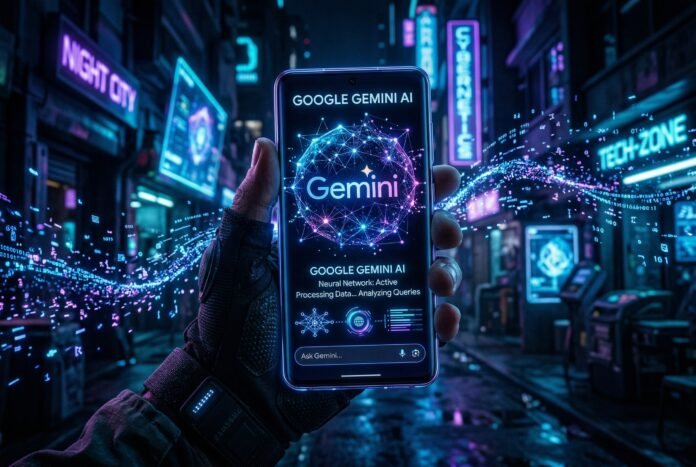
The Relocation of the Gatekeeper
At CES 2026, Samsung didn’t just announce a roadmap—they declared an annexation. By the end of this year, Samsung intends to have 800 million devices running Google’s Gemini AI. A doubling of last year’s 400 million figure. It is an aggressive, breathtaking expansion—and it deserves more scrutiny than it’s getting.
For the average user, the pitch is seamless convenience. Your phone will summarize your emails, suggest restaurant reservations based on historical calorie intake, and manage your smart home with proactive efficiency. But for those watching the deeper tectonic shifts in tech infrastructure, this isn’t just about software updates. It’s a masterclass in the relocation of the gatekeeper.
In the early days of the smartphone era, the gatekeeper was the app store. By controlling the distribution of code, Apple and Google dictated the terms of engagement for developers and users alike. Today, as software becomes increasingly commoditized, the gatekeeper is moving up the stack. It’s no longer just about where you install software—it’s about whose intelligence acts as the layer between you and your own reality.
800 Million Nodes in Google’s Network
By embedding Gemini at the OS and hardware level across 800 million devices, Samsung and Google are creating a seamless, centralized intelligence loop. They are not merely adding a chatbot—they are operationalizing a data-harvesting architecture that doesn’t just record what you do. It interprets who you are, what you need, and what you’re likely to buy next.
This is the part that should give pause. When your phone’s AI assistant is baked into the silicon and trained on your every interaction, you are no longer a customer. You are a node in a private intelligence network—contributing data you don’t own, to a model you can’t audit, for a corporation you didn’t elect.
Samsung’s co-CEO TM Roh framed this as an AI-first mandate. In practice, it means Google’s Gemini will be the default intelligence layer for nearly a billion devices by year’s end. That’s not a feature. That’s infrastructure—and infrastructure, once entrenched, is extraordinarily hard to replace.
Infrastructure as the Real Constraint
There is a massive physical strain buried behind this ambition. Shipping 800 million AI-ready devices requires a supply chain of silicon, rare earth metals, HBM memory chips, and advanced power management—all currently constrained by global geopolitical tensions. As we have explored in our analysis of Samsung’s 3 billion AI chip gambit, memory is now the critical bottleneck in the AI hardware stack.
We are seeing a convergence where compute demand is escalating faster than the underlying energy and semiconductor infrastructure can scale. Samsung’s gamble isn’t just to sell units—it’s to lock in their position as the hardware partner for the most pervasive AI intelligence network in the world. Those who control the hardware gate ultimately decide how the underlying AI network is permissioned, regulated, and monetized.
The chip supply chain risk is real. Samsung has acknowledged that rising parts prices could lead to delays in future launches. Unstable chip prices remain a concern for its 2026 plans. The 800 million target is ambitious precisely because the infrastructure to support it is still being built under pressure.
The Decentralization Paradox
Where does this leave the user? In a world increasingly interested in decentralized finance and digital self-sovereignty, the Samsung-Google alliance represents the diametric opposite philosophy.
It is an environment of extreme convenience—but at the cost of extreme dependency. If your device is fundamentally a node in a centralized Gemini network, you are not the owner; you are the product. Your interactions train a model that you have no stake in, building a moat for shareholders you didn’t vote for.
The real question isn’t whether 800 million Gemini devices will improve user experience. It almost certainly will, in the short term. The question is whether the infrastructure for personal AI—where the hardware and the model are owned by the user—will ever be commercially viable, or if the gatekeepers will successfully lock the ecosystem behind corporate intelligence before anyone notices the bars going up.
As we’ve noted before: gatekeepers don’t disappear—they relocate. From app stores to OS layers. From software to hardware. And now, from hardware to the intelligence layer running on top of it.
800 million devices is not a product launch. It’s a land grab.
Sources
- Reuters: Samsung to double AI mobile devices to 800 million in 2026
- Android Headlines: Samsung Pushes for Gemini AI Inside 800M Galaxy Devices in 2026
- National CIO Review: Samsung to Double AI-Enabled Devices to 800 Million in 2026
- Sammy Fans: Samsung targeting 800 million Gemini AI devices in 2026
- FinancialContent: Samsung Targets 800 Million AI-Powered Devices, Deepening Google Gemini Alliance

