
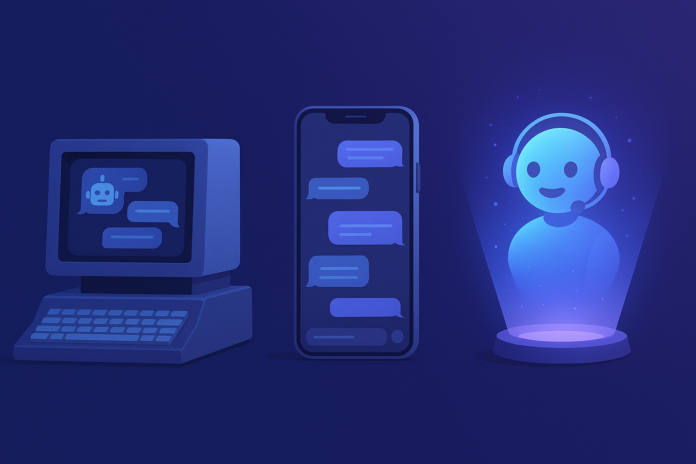
The Complete Guide to AI Chatbots: From Simple Scripts to Digital Employees
AI chatbots have evolved from clunky automated responders to sophisticated digital assistants that can hold conversations, solve problems, and even process transactions. Whether you’re a business owner looking to automate customer service or a professional wanting to understand this technology, this guide covers everything you need to know about where chatbots are today—and where they’re headed tomorrow.
What Is an AI Chatbot?
An AI chatbot is software that uses artificial intelligence to understand and respond to human language. Unlike traditional software that requires specific commands, chatbots interpret natural language—the way people actually speak and write.
Modern chatbots can:
- Answer questions in natural conversation
- Perform tasks like booking appointments or processing orders
- Learn from interactions to improve over time
- Handle multiple languages
- Integrate with business systems and databases
The key difference from older automated systems: AI chatbots understand intent, not just keywords. They grasp what you’re trying to accomplish, even if you phrase it differently than expected.
The Three Generations of Chatbots
Understanding chatbot evolution helps explain why today’s systems are so much more capable than what existed even five years ago.
First Generation: Rule-Based (1960s–2010s)
Early chatbots followed simple if-then logic. If a user said “hours,” the bot responded with business hours. If they said something unexpected, the bot broke.
Characteristics:
- Predefined response patterns
- No learning capability
- Brittle—easily confused by variations
- Required extensive manual programming
Example: ELIZA (1966) simulated a psychotherapist by pattern matching. Clever for its time, but had no real understanding.
Second Generation: Machine Learning (2010s–2020)
Machine learning enabled chatbots to improve from data. Instead of hardcoded rules, these systems recognized patterns in thousands of conversations.
Characteristics:
- Intent recognition
- Pattern learning from data
- Better handling of variations
- Required training datasets
Example: Early versions of Siri and Alexa could understand different ways of asking the same question.
Third Generation: Generative AI (2020–Present)
Today’s chatbots use large language models (LLMs) trained on vast amounts of text. They generate responses dynamically rather than selecting from predefined options.
Characteristics:
- Context-aware conversations
- Human-like responses
- Handle novel situations
- Personalized interactions
Examples: ChatGPT, Claude, Google Gemini, advanced versions of Siri and Alexa.
How Modern AI Chatbots Work
Understanding the technical process helps you evaluate chatbot capabilities and limitations.
Step 1: Input Processing
The chatbot receives your message and converts it into a format it can analyze. For voice interactions, speech-to-technology first transcribes audio to text.
What happens:
- Text normalization (handling typos, slang)
- Language detection
- Initial keyword identification
Step 2: Intent Recognition
The core AI analyzes what you’re trying to accomplish. This goes beyond keyword matching to understand context and purpose.
Example:
- “I need to return these shoes” → Intent: Process return
- “These don’t fit” → Intent: Process return (same intent, different words)
- “What’s your return policy?” → Intent: Information request (different intent)
Step 3: Context Analysis
Advanced chatbots maintain conversation history. They remember what you said earlier and use that context to provide relevant responses.
Example conversation:
- User: “I want to book a flight to Paris”
- Bot: “What dates are you traveling?”
- User: “Next Tuesday”
- Bot: “I have flights to Paris on March 4th…”
The bot remembered “Paris” from the first message.
Step 4: Response Generation
The chatbot constructs an appropriate response. In generative AI systems, this happens dynamically rather than selecting from pre-written templates.
Sources for response:
- Knowledge base (FAQs, product info)
- External APIs (weather, stock prices, account data)
- Generated text (for open-ended conversations)
Step 5: Learning and Improvement
Modern chatbots improve over time. They analyze which responses were helpful and adjust future behavior.
Learning signals:
- User satisfaction ratings
- Conversation completion rates
- Human agent takeover frequency
- Follow-up question patterns
Current Applications Across Industries
Chatbots have moved beyond simple customer service to transform how businesses operate.
Customer Service
The most common application. Chatbots handle routine inquiries, freeing human agents for complex issues.
Typical uses:
- Order status checks
- Password resets
- FAQ responses
- Initial troubleshooting
Benefits: 24/7 availability, instant response, consistent information, cost reduction.
E-Commerce
Chatbots guide shoppers through the buying process and handle post-purchase support.
Capabilities:
- Product recommendations based on preferences
- Size and fit guidance
- Checkout assistance
- Return processing
- Order modifications
Impact: Reduced cart abandonment, increased conversion rates, improved customer satisfaction.
Healthcare
Healthcare chatbots provide initial triage, appointment scheduling, and patient education.
Applications:
- Symptom assessment
- Medication reminders
- Appointment booking
- Mental health support
- Chronic disease monitoring
Important limitation: Healthcare chatbots provide information, not medical diagnosis. They triage and guide but don’t replace doctors.
Financial Services
Banks and financial institutions use chatbots for account management and fraud prevention.
Functions:
- Balance inquiries
- Transaction history
- Fraud alerts
- Payment processing
- Investment information
Education
Educational chatbots provide personalized learning support and administrative assistance.
Uses:
- Language learning practice
- Homework help
- Course recommendations
- Administrative questions
- Study scheduling
Internal Enterprise Use
Companies increasingly deploy chatbots for employee support.
Applications:
- IT helpdesk (password resets, troubleshooting)
- HR inquiries (benefits, policies, time off)
- Finance (expense reports, approvals)
- Facilities (maintenance requests)
Benefit: Employees get instant answers without waiting for human support during business hours.
Major Chatbot Platforms
Choosing the right platform depends on your technical capabilities, budget, and use case.
Enterprise Platforms
IBM Watson Assistant
- Best for: Large enterprises with complex needs
- Strengths: Security, integration capabilities, industry-specific solutions
- Considerations: Higher cost, steeper learning curve
Microsoft Azure Bot Service
- Best for: Organizations already using Microsoft ecosystem
- Strengths: Integration with Office 365, Teams, Azure services
- Considerations: Requires technical expertise
Google Dialogflow
- Best for: Developers building custom solutions
- Strengths: Natural language understanding, multi-language support
- Considerations: Requires development resources
Small Business and Startup Platforms
Chatfuel
- Best for: Facebook Messenger bots
- Strengths: No-code interface, quick deployment
- Limitations: Platform-specific (Meta ecosystem)
ManyChat
- Best for: Marketing automation on messaging platforms
- Strengths: Visual builder, marketing-focused features
- Limitations: Less suitable for complex transactions
Intercom
- Best for: Customer support with human handoff
- Strengths: Unified customer communication platform
- Considerations: Mid-range pricing
Generative AI Chatbots
OpenAI GPT (ChatGPT API)
- Best for: Natural conversations, content generation
- Strengths: Human-like responses, broad knowledge
- Considerations: Requires careful prompt engineering, ongoing costs
Anthropic Claude
- Best for: Longer conversations, document analysis
- Strengths: Large context window, safety focus
- Considerations: Newer platform, evolving capabilities
Google Gemini
- Best for: Multimodal interactions (text, image, voice)
- Strengths: Integration with Google services
- Considerations: Still maturing compared to GPT
Benefits of AI Chatbots
Understanding the value proposition helps build the business case for chatbot investment.
24/7 Availability
Chatbots don’t sleep, take breaks, or call in sick. They provide consistent service around the clock.
Impact: Customers get immediate responses regardless of time zone or business hours.
Scalability
One chatbot can handle thousands of simultaneous conversations. Adding capacity doesn’t require proportional hiring.
Example: A retail chatbot handles Black Friday traffic spikes without additional staffing costs.
Cost Efficiency
After initial development, chatbots reduce per-interaction costs significantly compared to human agents.
Typical savings: 30-50% reduction in customer service costs (varies by implementation).
Consistency
Chatbots provide the same accurate information every time. No variation based on agent training, mood, or fatigue.
Data Collection
Every conversation generates data about customer needs, preferences, and pain points.
Applications:
- Product improvement insights
- Common issue identification
- Customer preference analysis
- Service gap detection
Personalization at Scale
Chatbots can access customer history and preferences to provide individualized experiences impossible with human agents handling high volumes.
Limitations and Challenges
Realistic expectations prevent disappointment and ensure appropriate use cases.
Understanding Limitations
Chatbots excel at routine, predictable interactions. They struggle with:
- Novel situations outside training data
- Nuanced emotional contexts
- Complex multi-step problem solving
- Situations requiring human judgment
The Handoff Problem
When chatbots fail, transferring to human agents can be clumsy. Context may be lost, forcing customers to repeat information.
Best practice: Design seamless handoffs with full conversation history transfer.
Maintenance Requirements
Chatbots aren’t “set and forget.” They require:
- Regular updates as products/services change
- Monitoring for misunderstood queries
- Retraining as language evolves
- Security updates
Initial Development Costs
Quality chatbots require upfront investment in:
- Development or platform subscription
- Integration with existing systems
- Training data preparation
- Testing and refinement
Future Trends
The chatbot landscape continues evolving rapidly. Here’s what to expect in the near term.
Sentiment Analysis Integration
Future chatbots will detect customer emotions and adapt responses accordingly.
Example: Detecting frustration and automatically escalating to human agents, or offering empathetic responses to upset customers.
Multimodal Capabilities
Chatbots will handle text, voice, images, and video seamlessly within the same conversation.
Example: A customer uploads a photo of a broken product, and the chatbot processes the image to initiate a return.
Proactive Engagement
Rather than waiting for customer contact, chatbots will reach out based on predicted needs.
Example: “I noticed you haven’t logged in for two weeks. Is there anything I can help with?”
Deeper System Integration
Chatbots will connect with more business systems, enabling complex transactions.
Example: Processing refunds, modifying orders, or updating account details without human intervention.
Voice-First Interfaces
As voice recognition improves, more interactions will happen through spoken conversation rather than text.
Implementation Best Practices
If you’re considering chatbot implementation, these principles increase success probability.
Start with Clear Use Cases
Don’t try to automate everything. Identify specific, high-volume, routine interactions where chatbots excel.
Good starting points:
- FAQ responses
- Order status checks
- Appointment scheduling
- Basic troubleshooting
Design for Failure
Assume the chatbot won’t understand sometimes. Plan graceful handoffs to human agents.
Train with Real Data
Use actual customer conversations to train your chatbot, not hypothetical examples. Real users phrase things unexpectedly.
Monitor and Iterate
Launch is just the beginning. Regularly review conversations, identify failure points, and improve.
Set Realistic Expectations
Be honest with customers about chatbot capabilities. Don’t pretend it’s human when it’s not.
Measure What Matters
Track metrics that indicate success:
- Resolution rate (without human intervention)
- Customer satisfaction scores
- Response time
- Cost per interaction
- Human agent workload reduction
The Bottom Line
AI chatbots have evolved from novelty to necessity for businesses handling customer interactions at scale. They’re not replacements for human judgment and empathy, but powerful tools for handling routine tasks efficiently.
The technology continues improving rapidly. Today’s limitations will likely be solved within years, not decades. Organizations that understand and implement chatbots effectively gain significant advantages in customer service efficiency and availability.
The question isn’t whether chatbots will transform your industry—it’s whether you’ll lead that transformation or follow it.
Related: Explore the complete generative AI toolkit covering text, image, voice, music, and video creation tools.
Related: Explore how AI agents are learning to spend money autonomously—the next evolution beyond chatbots.
Related: Explore the complete generative AI toolkit covering text, image, voice, music, and video creation tools.
Sources
- IBM Watson Assistant Documentation
- OpenAI API Documentation
- Google Dialogflow Best Practices
- Chatbot industry analysis and market reports
- Enterprise AI implementation case studies

