
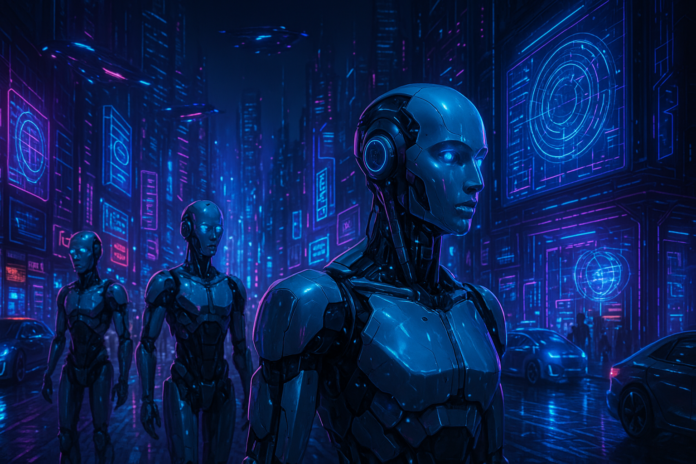
The Physical AI Awakening: How March 2026 Redefined the Tech Landscape
From trillion-dollar chip orders to autonomous warships, the age of digital intelligence meeting physical reality has arrived
The Convergence Moment
March 2026 will be remembered as the month the technology industry collectively pivoted from talking about AI to building it into the physical world. While headlines focused on individual product launches and earnings beats, a deeper pattern emerged: the transition from chatbots and image generators to robots, autonomous vehicles, drones, and intelligent systems that interact with reality itself. This wasn’t just another month of tech news—it was the moment the “Physical AI” thesis went mainstream.
Three seemingly unrelated developments signaled this shift: Nvidia’s Jensen Huang standing on stage announcing a trillion dollars in chip orders through 2027, the Pentagon quietly integrating Palantir’s AI into core military operations, and Bitcoin miners securing billion-dollar credit lines to transform into AI data center operators. Each tells part of a larger story about where technology—and capital—is flowing in 2026.
Nvidia’s Trillion-Dollar Bet on Physical AI
The most significant technology announcement of March 2026 wasn’t a product—it was a number: $1 trillion. That’s the cumulative value of orders Jensen Huang revealed for Nvidia’s Blackwell and upcoming Vera Rubin architectures through 2027. To put this in perspective, that’s larger than the GDP of most countries and represents the single largest hardware commitment in technology history.
But the dollar figure, staggering as it is, tells only part of the story. What Nvidia unveiled at GTC 2026 was a comprehensive platform for “Physical AI”—systems that don’t just process information but act upon the physical world.
The Cosmos Revolution
Central to Nvidia’s vision is Cosmos, a family of world models designed specifically for physical AI applications. Unlike large language models that predict text, Cosmos models predict how the physical world behaves—physics, object permanence, cause and effect. These aren’t theoretical research projects; they’re production-ready systems that enable robots and autonomous vehicles to simulate thousands of scenarios before acting in the real world.
The implications are profound. A warehouse robot powered by Cosmos can simulate an entire shift’s worth of edge cases—dropped packages, unexpected obstacles, human interference—before its first real-world movement. An autonomous vehicle can experience millions of virtual miles in diverse conditions before touching public roads.
Alpamayo and the Autonomous Future
Nvidia’s Alpamayo models represent the company’s push into production-grade autonomous driving. These aren’t the “full self-driving” promises of years past—they’re Level 4-capable systems designed for specific operational domains. The partnerships announced alongside Alpamayo reveal Nvidia’s strategy: Uber will deploy robotaxi services starting in 2027, while Nissan, BYD, Hyundai, and Geely are integrating the technology for consumer vehicles.
The geographic diversity of these partnerships matters. BYD and Geely bring Chinese manufacturing scale. Hyundai offers Korean engineering and global distribution. Nissan provides Japanese precision and established automotive credibility. Together, they represent a coalition determined to make autonomous transportation the default rather than the exception.
Edge Computing: The Neotron 3 Super
Perhaps the most technically impressive announcement was the Neotron 3 Super, an edge AI accelerator designed for local inference. As AI moves into physical systems—robots, vehicles, drones—cloud connectivity can’t be assumed. The Neotron 3 Super enables complex AI workloads to run locally, with millisecond latency and without network dependency.
This addresses a critical bottleneck in physical AI deployment. Previous generations required constant cloud connectivity, creating unacceptable latency for safety-critical applications and vulnerability to network outages. The Neotron architecture brings data center-class inference to the edge.
Isaac and the Humanoid Wave
Nvidia’s Isaac platform for humanoid robotics, combined with the company’s unexpected partnership with Disney, signals mainstream acceptance of humanoid robots. Disney’s involvement suggests these systems are moving beyond industrial applications into consumer and entertainment contexts—a market potentially larger than manufacturing automation.
The Isaac platform provides the simulation, training, and deployment infrastructure for humanoid systems. Combined with Cosmos world models, robots can learn complex manipulation tasks in simulation before attempting them in reality. This dramatically accelerates development timelines and reduces the cost of robotic training.
OpenAI’s Infrastructure Ambitions
While Nvidia builds the hardware layer, OpenAI is scaling the human infrastructure required for AI’s next phase. The company announced plans to double its workforce from 4,500 to 8,000 by the end of 2026, with hiring focused on three areas: engineering, research, and what the company calls “technical ambassadorship.”
The first two categories are expected—OpenAI needs more researchers pushing the boundaries of model capabilities and more engineers building the systems that deploy them. But “technical ambassadorship” reveals something important about where AI is heading in 2026.
This role—essentially technical sales engineering for the enterprise—recognizes that AI deployment is no longer about API access and prompt engineering. Enterprise customers need help integrating AI into existing workflows, customizing models for specific domains, and building the infrastructure to support AI-native applications. OpenAI is building an army of technical consultants to bridge the gap between research breakthroughs and production deployment.
The scale of this hiring—adding 3,500 people in under a year—suggests OpenAI anticipates massive enterprise demand. It also indicates the company recognizes that winning the AI infrastructure war requires more than better models; it requires better support, integration, and services.
The Defense Tech Renaissance
March 2026 also marked a turning point for AI in military applications. Three developments, taken together, suggest defense technology is entering a new phase of AI integration.
Gecko Robotics and the AI-Powered Navy
Gecko Robotics secured a significant contract with the U.S. Navy for AI-powered ship inspection and repair. The company’s robots crawl across vessel surfaces, using computer vision and ultrasonic sensors to detect corrosion, cracks, and structural issues before they become critical.
This represents a shift from reactive to predictive maintenance—a theme we’ll see repeated across physical AI applications. Rather than waiting for failures, AI systems continuously monitor asset health and predict maintenance needs. For the Navy, this means ships spend more time operational and less time in drydock.
Autonomous Electronic Warfare
L3Harris and Shield AI announced a partnership focused on autonomous electronic warfare systems. These AI-powered platforms can identify, analyze, and counter electronic threats without human intervention—a critical capability as warfare increasingly moves into the electromagnetic spectrum.
The autonomy aspect matters. Electronic warfare happens at machine speeds; human reaction times are too slow to be effective. These systems must identify threats, select countermeasures, and execute responses in milliseconds. Only AI can operate at these timescales.
Palantir Becomes Core Military Infrastructure
Perhaps most significantly, the Pentagon formally adopted Palantir’s AI platform as a core military system. This isn’t a pilot program or experimental deployment—it’s institutional recognition that AI is now fundamental to military operations.
Palantir’s platform integrates data from satellites, drones, sensors, and human intelligence into unified operational pictures. The AI layer doesn’t just aggregate data; it identifies patterns, predicts enemy movements, and recommends courses of action. For commanders, it means decision-making based on comprehensive, real-time intelligence rather than partial information and intuition.
The military adoption of AI carries profound implications for civilian technology. Defense applications often drive innovation that eventually reaches consumer markets—GPS, the internet, and autonomous vehicles all followed this path. The Pentagon’s embrace of AI suggests we’re still in the early innings of this technological transformation.
Crypto and AI: The Convergence Accelerates
The relationship between cryptocurrency and AI deepened significantly in March 2026, with developments that suggest these technologies are increasingly intertwined rather than separate domains.
Bitcoin’s March Turnaround
After a challenging start to 2026, Bitcoin rallied to $71,000 in March—a significant psychological and technical level. The recovery coincided with broader risk-on sentiment in technology markets, but crypto-specific factors drove the move.
Strategy (formerly MicroStrategy) continued its Bitcoin accumulation strategy with a $76.6 million purchase, bringing the company’s total holdings to well over 500,000 BTC. Michael Saylor’s conviction trade continues to influence institutional sentiment toward Bitcoin as a treasury reserve asset.
The Great Pivot: Miners Become AI Operators
The most significant crypto-AI development was JPMorgan and Morgan Stanley providing $1 billion in credit to a major Bitcoin miner pivoting to AI data center operations. This financing represents institutional validation of a trend that’s been building for months: Bitcoin miners leveraging their existing infrastructure—cheap power, cooling systems, and data center expertise—to capture AI compute demand.
The logic is compelling. Bitcoin mining facilities are essentially specialized data centers optimized for power-hungry computation. As AI training and inference demand explodes, these facilities can be repurposed for AI workloads with minimal modification. The miners get higher-margin revenue streams; the AI industry gets ready-built infrastructure.
This convergence creates interesting second-order effects. Bitcoin mining becomes a hedge against AI infrastructure demand—if crypto prices fall, miners can pivot to AI compute. If AI demand softens, they can return to mining. The flexibility makes these assets more valuable than pure-play miners or pure-play data centers.
The Physical AI Thesis
Stepping back from individual developments, a clear pattern emerges: we’re witnessing the transition from digital AI to physical AI.
The first phase of AI—where we are now ending—focused on information processing. Chatbots, image generators, code assistants, and recommendation systems all manipulate digital information. They’re powerful, transformative even, but they interact with the world indirectly through screens and speakers.
The next phase—just beginning—focuses on systems that interact directly with physical reality. Robots that manipulate objects. Vehicles that navigate environments. Drones that inspect infrastructure. Sensors that monitor the physical world and actuators that modify it.
Why Edge Computing Matters
This transition makes edge computing critical. Physical systems can’t rely on cloud connectivity—latency is too high, connectivity too unreliable, and privacy concerns too significant. The Neotron 3 Super and similar edge AI accelerators enable sophisticated intelligence to run locally, on devices, without network dependency.
We’re seeing the emergence of a three-tier architecture:
1. Cloud for training, large-scale inference, and coordination
2. Edge for real-time processing and local decision-making
3. Device for immediate response and privacy-sensitive operations
This architecture enables AI to operate in the physical world with the responsiveness and reliability that applications demand.
The Capital Reallocation
The trillion-dollar Nvidia orders, the billion-dollar miner financing, OpenAI’s aggressive hiring, and defense AI contracts all represent capital reallocating toward physical AI infrastructure. This isn’t speculative investment—it’s deployment capital for systems that will operate for decades.
The scale of this reallocation suggests we’re at an inflection point comparable to the early days of cloud computing or mobile internet. The infrastructure being built today will enable applications we can barely imagine, just as AWS and the iPhone enabled services that seemed like science fiction in 2006.
What Comes Next
Looking ahead, several developments seem likely based on March’s momentum:
Autonomous vehicle deployment will accelerate. The Nvidia partnerships suggest 2027 robotaxi launches are realistic timelines, not aspirational targets. The technology is reaching production readiness; regulatory and insurance frameworks will be the primary constraints.
Humanoid robots will enter commercial service. Disney’s involvement suggests consumer-facing applications, but the immediate impact will be in logistics, warehousing, and manufacturing. The labor implications are profound—physical AI doesn’t just augment human workers; in many cases, it replaces them.
Defense AI will drive civilian innovation. Military applications of AI will create technologies and expertise that flow into commercial markets. The companies building autonomous systems for defense today will be building autonomous systems for logistics, agriculture, and transportation tomorrow.
Crypto and AI infrastructure will continue converging. The miner-to-AI-data-center pivot is just the beginning. We may see AI compute markets denominated in cryptocurrency, decentralized AI training networks, and blockchain-based coordination for autonomous systems.
Edge AI will become the default. As physical AI deployment scales, the assumption of cloud connectivity will fade. Devices will be expected to operate intelligently regardless of network conditions, with cloud synchronization happening opportunistically rather than continuously.
Conclusion: The Real World Beckons
March 2026 was the month AI grew up. After years of impressive but ultimately digital applications, the technology industry turned its attention to the physical world. The trillion-dollar commitments, the defense contracts, the workforce expansions, and the infrastructure pivots all point in the same direction: AI is becoming embodied.
This transition carries profound implications. Digital AI transformed information work; physical AI will transform everything else. Manufacturing, logistics, transportation, agriculture, construction, defense—these sectors represent far larger economic value than software and media. They’re also far more resistant to automation because they require interaction with the messy, unpredictable physical world.
That resistance is crumbling. The combination of world models that understand physics, edge computing that enables local intelligence, and hardware platforms designed for physical interaction is creating capabilities that seemed impossible just years ago.
For investors, entrepreneurs, and technologists, the message is clear: the opportunities of the next decade will be in physical AI. The digital transformation is largely complete. The physical transformation is just beginning.
The chatbots were impressive. The robots will be transformative.
Related Reading
For more on AI, Bitcoin, and the evolving tech landscape, explore these related articles:
– Bitcoin Surges to $71,000 as Trump Postpones Iran Strikes — How geopolitical developments are driving Bitcoin price action and institutional interest in 2026.
– NVIDIA GTC 2026: The $1 Trillion Infrastructure Bet Reshaping AI — A deeper dive into Jensen Huang’s infrastructure announcements and what they mean for the AI industry.
– The 2026 AI Agent Stack: What’s Actually Working (And What’s on Fire) — Understanding the infrastructure and tools powering the next generation of AI applications.
Sources
1. NVIDIA GTC 2026 Keynote – Jensen Huang
2. NVIDIA Cosmos World Models
3. NVIDIA Isaac Robotics Platform
4. OpenAI Hiring Plans 2026 – TechCrunch
5. Gecko Robotics Navy Contract – Defense News
6. L3Harris and Shield AI Partnership – Breaking Defense
7. Palantir AI Platform Military Adoption – Reuters
8. Strategy (MicroStrategy) Bitcoin Purchase – SEC Filing
9. Bitcoin Miners $1B Credit Line for AI Data Centers – Bloomberg
10. Bitcoin Price Data – CoinGecko
11. Uber and NVIDIA Robotaxi Partnership – Uber Newsroom
12. NVIDIA Automotive Partners (BYD, Nissan, Hyundai, Geely)
13. Disney and NVIDIA Humanoid Robot Partnership
14. JPMorgan and Morgan Stanley AI Infrastructure Financing
Published March 2026 | tsnmedia.org

