
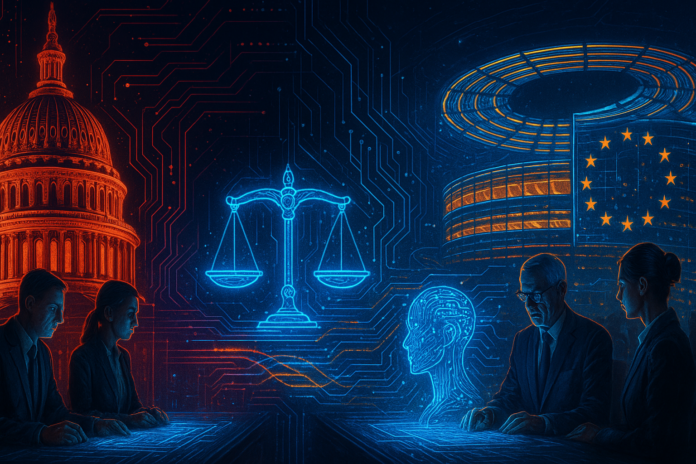
Deck: Washington is floating a “light-touch” national framework while Brussels is already scheduling audits, sandboxes, and bans. Founders, compliance teams, and investors now have to ship products into two radically different rulebooks that arrive at the same time.
TL;DR
- United States: The White House’s March 20 National Policy Framework plus Senator Marsha Blackburn’s 291-page TRUMP AMERICA AI Act amount to an ambitious wish list. They signal sweeping federal preemption, copyright rewrites, and new liability standards, but nothing is law yet.
- European Union: The AI Act already has teeth. Parliament just approved Digital Omnibus changes that set hard compliance dates (Aug 2026 through Aug 2028), mandatory national sandboxes, and even a ban on “nudifier” apps unless strong safeguards exist.
- Why it matters: Builders face a paradox—America promises flexibility but uncertainty, Europe offers clarity but heavy process. Expansion plans need to account for both simultaneously.
1. The Stakes: AI Deployment Outruns Governance
Generative models moved from novelty to infrastructure in 18 months. Enterprises now run agentic workflows, multimodal copilots, and fully delegated systems, but they’re doing so under a patchwork of executive orders, state privacy statutes, and Europe’s first-mover rulebook. The result, as Serious Insights argues, is a “readiness gap” where governance, security, and talent lag behind capability. Policy choices in Washington and Brussels will determine how quickly that gap closes—and who pays when AI goes sideways.
2. Washington’s Draft: A Framework Without Handcuffs (Yet)
2.1 The National Policy Framework (White House, March 20)
President Trump’s framework is a non-binding set of legislative recommendations, but it tells Congress exactly what the administration wants:
- Federal preemption of most state AI laws to end the “patchwork” that business groups say is impossible to navigate (though states would keep fraud and consumer-protection powers).
- Use the regulators we already have—SEC for finance, FDA for medical, FTC for deceptive practices—rather than stand up a brand-new AI agency.
- Protect speech and IP simultaneously: defend model providers that train on copyrighted data while encouraging compensation mechanisms determined by the courts.
- Defend national security by letting DoD and intelligence agencies tap frontier models without waiting for new statutes.
- “Light-touch” defaults: agencies are encouraged to collaborate on standards and voluntary certifications before reaching for enforcement.
There’s political theatre here too. The framework leans on Executive Order 14365 (Dec 2025), which instructed Commerce to catalog “onerous” state AI laws and empowered an AI Litigation Task Force to sue governors who overreach. That inventory is still late, underscoring how much of this plan exists on paper rather than in courtrooms.
2.2 Blackburn’s TRUMP AMERICA AI Act
If the framework is the philosophy, Senator Blackburn’s 291-page draft bill is the playbook. Highlights:
- Duty of care + liability safe harbor: Model and chatbot developers would owe users a federally defined duty of care. Meeting prescribed controls could shield them from certain lawsuits, while failures would create a direct federal cause of action.
- Copyright reversal: Unauthorized use of copyrighted works for training would not be considered fair use unless licensed—flipping the assumption many US labs rely on today.
- Mandatory audits: High-risk conversational systems that touch politics would need annual third-party bias audits and certification filings.
- Transparency baseline: Providers would have to maintain incident logs, disclose training data classes, and publish safety reports for high-risk categories.
- Preemption clause: Once enacted, the bill would override most state AI statutes, exactly what the White House has been lobbying for.
Takeaway: The US is signaling seriousness about centralized AI law, but both the Framework and the TRUMP Act are drafts. Lobbying, election-year dynamics, and the courts will shape whatever final text—if any—emerges.
3. Brussels’ Reality: Enforcement Timers Are Already Running
Europe is past the “vision” stage. The AI Act, adopted in 2024, is now being tuned via the Digital Omnibus package approved by Parliament on 26 March 2026. Rather than weakening the law, lawmakers clarified how it lands:
- Hard compliance dates: Standalone Annex III high-risk systems must comply by 2 December 2027; AI embedded in Annex I products (think medical devices, industrial equipment) has until 2 August 2028. No more conditional triggers.
- Transparency first: Article 50 obligations for general-purpose AI and deployers start in August 2026, forcing documentation, model cards, and user disclosures well before the high-risk deadlines kick in.
- Nudification ban: Systems that generate sexually explicit imagery of identifiable people without consent are outright prohibited unless safeguards prevent abuse.
- Digital Omnibus alignment: Parliament wants AI rules to mesh with Machinery, Medical Devices, and other sectoral directives to avoid double audits.
Beyond statutes, Brussels is building infrastructure:
- Mandatory sandboxes: Every Member State must operate at least one AI regulatory sandbox by 2 August 2026. These controlled environments let startups test real products under regulator oversight.
- Notified bodies + market surveillance: The same conformity machinery used for CE-marked products is being extended to AI, meaning third-party auditors will certify high-risk systems before they ship.
- Extraterritorial reach: The Act applies whenever an AI system outputs into the EU, so global SaaS providers inherit obligations even if the code never touches European soil.
Takeaway: Europe trades speed for certainty. You might not love the paperwork, but you know the schedule, the documentation templates, and the penalty regime.
4. The Practical Differences (and Similarities)
| Dimension | United States (Framework + Draft Bill) | European Union (AI Act + Omnibus) |
|---|---|---|
| Legal status | Aspirational: no binding obligations yet. | Binding: law on the books with set dates. |
| Regulatory posture | “Light-touch,” agency-led, innovation-first. | Risk-tiered, precautionary, fundamental-rights-first. |
| Preemption | Seeks to wipe out most state AI laws. | Harmonizes 27 Member States via single regulation. |
| Liability | New federal causes of action + safe harbors proposed. | Existing product liability augmented by AI-specific duties; fines up to 7% of global turnover. |
| Transparency | Proposed incident logs and bias reports for high-risk systems. | Article 50 transparency legally mandated Aug 2026 onward. |
| Sandboxes | Mentioned conceptually, optional. | Mandatory national sandboxes with EU coordination. |
| Copyright stance | Training on copyrighted works deemed not fair use without license. | Risk-based: obligations focus on dataset governance; fair-use equivalent varies per Member State. |
| Timeline certainty | Depends on Congress; election cycle risk. | Clock already running with staged deadlines. |
5. What Builders, Investors, and Policy Teams Should Do Now
5.1 Map Your Deployment Geography
- US-only today? Track the TRUMP Act’s committee journey, but keep complying with state-level rules (Colorado’s AI law, California’s proposed SB 1047 analogues). Preemption might arrive, but it’s not here yet.
- EU exposure? Build a compliance backlog backward from August 2026. Prioritize transparency assets (model cards, risk logs) since those are due first and benefit both markets.
5.2 Build Dual-Track Governance
- Policy overlays: Create a control matrix that aligns US draft obligations (duty of care, bias audits) with EU requirements (risk management, data governance, human oversight). That way, whichever jurisdiction tightens first, you’re ready.
- Documentation discipline: Article 50 artifacts (technical documentation, post-market monitoring plans) double as evidence for any future US safe harbor. Treat Europe as the training ground for global compliance muscle.
5.3 Design for Sandboxes and Pilots
- EU sandboxes: Identify which Member State sandbox fits your sector (Finland for health, Spain for mobility, etc.). Early participation can serve as “regulatory due diligence” when pitching customers.
- US pilots: If Commerce’s AI Litigation Task Force begins challenging state laws, expect temporary injunctions and pilot programs. Be ready to testify or provide impact data—policy is being shaped by real deployments.
5.4 Reassess IP and data strategy
- Licensing budgets: If Blackburn’s copyright provisions survive, frontier labs and even internal enterprise teams will need explicit licenses or synthetic data pipelines. Start modeling costs versus relocating training to friendlier jurisdictions.
- Dataset hygiene: Europe’s traceability obligations will force you to log dataset provenance anyway. Make that log robust enough to defend US lawsuits.
5.5 Communicate with customers
- US clients need reassurance that your roadmap anticipates federal rules without abandoning state compliance in the interim.
- EU clients will ask for conformity plans, sandbox participation proof, and timeline commitments. Be proactive with quarterly governance updates.
6. Strategic Narrative: Choice vs. Clarity
The divergence boils down to choice vs. clarity:
- Choice (US): Lawmakers want innovators to choose their own controls under high-level duties, trusting existing agencies and courts to punish bad actors. The risk is paralysis—without binding law, enterprises stall investments while waiting for signals.
- Clarity (EU): Regulators prefer mandated, auditable controls. The risk is over-specification—compliance budgets soar, smaller teams struggle, and innovation may migrate.
Savvy operators will treat Europe as the minimum viable compliance stack and layer US requirements on top once Congress acts. The inverse (waiting for Washington) is far riskier given August 2026 transparency deadlines.
7. Key Dates to Watch
- April–July 2026: Congressional hearings on the TRUMP AMERICA AI Act; expect amendments responding to copyright lobby pressure.
- 2 August 2026: EU Article 50 transparency duties + mandatory national sandboxes go live.
- Late 2026: Possible US floor vote if the draft bill clears committee; Commerce Task Force may publish its overdue state-law inventory.
- 2 December 2027 / 2 August 2028: EU high-risk compliance deadlines hit—audits, conformity assessments, and CE markings required.
8. Bottom Line
AI governance is no longer a theoretical panel discussion. Brussels has already pressed “start” on enforcement, while Washington is trying to write a single playbook before 50 state referees blow different whistles. The smartest move is to architect products and compliance programs that satisfy the stricter regime (Europe) while staying nimble enough to plug into whatever Congress finally passes. Anything less is gambling that regulators will move slower than your roadmap—a bet that history says you lose.
Related Reading
- The AI Power Council: Trump Assembles Tech’s Titans to Shape America’s Future — Deep dive on Washington’s new AI advisory bloc and what it signals about federal oversight.
- The Regulatory Wave: How EU MiCA and the AI Act Are Reshaping Tech — Broader look at Europe’s twin regulatory pushes and their spillover effects.
- The AI Bipolar World: How America and China Are Dividing the Future — Geopolitical framing of the AI race that pairs with this policy showdown.
Sources
- White House, “National Policy Framework for Artificial Intelligence” (20 Mar 2026)
- Holland & Knight, “White House Releases a National Policy Framework for Artificial Intelligence” (25 Mar 2026)
- Latham & Watkins, “Trump Administration Takes Major Steps Toward Comprehensive Federal AI Regulation” (26 Mar 2026)
- Executive Order 14365, “Removing Barriers to American Leadership in Artificial Intelligence” (11 Dec 2025)
- Lexology, “Quarterly AI Update | Q1 2026” (29 Mar 2026)
- GamingTechLaw, “EU AI Act Update: Parliament Approves Digital Omnibus Changes” (26 Mar 2026)
- European Parliament Think Tank, “AI Regulatory Sandboxes: State of Play and Implementation Challenges” (1 Apr 2026)
- Barr Advisory, “Everything You Need to Know About the EU AI Act in 2026” (Mar 2026)
- CIO, “Top Global and US AI Regulations to Look Out For” (1 Apr 2026)
- Serious Insights, “State of AI 2026 – March Update” (29 Mar 2026)
- European Parliament, “Artificial Intelligence Act: Delayed Application, Ban on Nudifier Apps” (23 Mar 2026)
- European Parliament, “EU AI Act: First Regulation on Artificial Intelligence” (1 Jun 2023)
- European Commission, “Artificial Intelligence Act – Questions and Answers”
- International Association of Privacy Professionals, “US State AI Governance Tracker”
- Taft Law, “The Big Long List of U.S. AI Laws”
- Colorado General Assembly, “SB24-205: Consumer Protections for AI”
- California Legislature, “SB-1047 Safe and Secure Innovation for Frontier Artificial Intelligence”
- European Council, “Artificial Intelligence Act: Council Adopts Regulation”
- European Commission, “Regulatory Sandboxes and Real-World Testing”
- Reuters, “EU Lawmakers Back Landmark AI Rules” (13 Mar 2024)

