
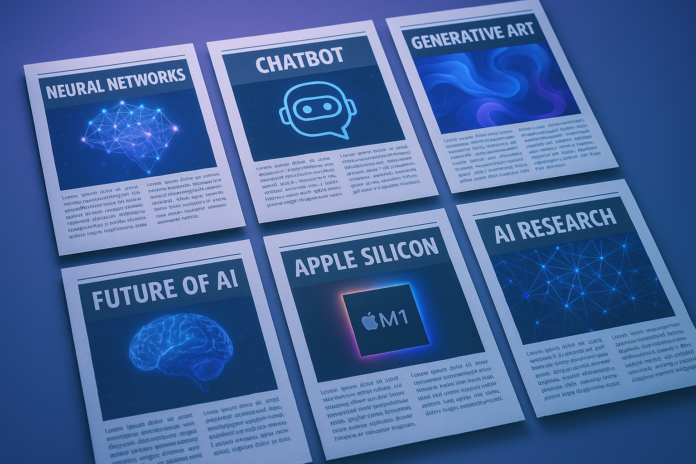
Today on TSN: 6 New AI Guides Published—From Foundations to Breaking News
March 31, 2026 was a productive day at TSN Media. We published six comprehensive guides covering artificial intelligence from multiple angles—foundational concepts, practical applications, technical architectures, and breaking developments. Whether you’re new to AI or looking to deepen your expertise, today’s content has something for you.
Here’s what we published, organized from foundational to advanced:
1. The Complete Beginner’s Guide to AI
What it covers: Everything you need to know to understand AI, starting from zero. The three types of AI (only Narrow AI exists today). How machine learning differs from traditional programming. The three types of machine learning with real examples. Neural networks explained simply. Deep learning and why it matters. Ten everyday AI applications you already use. How AI transforms manufacturing, healthcare, finance, and retail.
Who it’s for: Anyone who wants to understand AI without jargon or math. Business leaders evaluating AI solutions. Professionals looking to upskill. Curious minds who want to separate hype from reality.
Key insight: AI isn’t future technology—it’s already embedded in your daily life dozens of times. Understanding how it works helps you leverage it and navigate its challenges.
Read the complete beginner’s guide →
2. The Complete Guide to AI Chatbots: From Simple Scripts to Digital Employees
What it covers: The evolution of chatbots from 1960s rule-based systems to today’s generative AI. How modern chatbots work (the five-step technical process). Major platforms compared—IBM Watson, OpenAI, Google, and more. Industry applications across customer service, e-commerce, healthcare, and education. Benefits, limitations, and implementation best practices. Future trends including sentiment analysis and multimodal capabilities.
Who it’s for: Business owners considering chatbot implementation. Customer service leaders exploring automation. Developers choosing chatbot platforms. Anyone curious about conversational AI.
Key insight: Chatbots have evolved from simple FAQ tools to digital employees capable of processing transactions, learning from interactions, and operating 24/7. The technology is mature—implementation strategy matters more than capability.
3. The Generative AI Toolkit: How Machines Learned to Create
What it covers: The generative AI landscape across five domains—text, image, voice, music, and video. Large language models (GPT, Gemini, Claude, Llama) and their evolution from text-only to multimodal. Image generation tools (DALL-E, Stable Diffusion) and their applications. Voice synthesis and music generation capabilities. Enterprise adoption statistics—55% of organizations already using generative AI. Real company implementations at Google, Salesforce, Adobe, and IBM.
Who it’s for: Creators exploring AI tools. Business leaders evaluating generative AI adoption. Professionals wanting to understand capabilities and limitations. Anyone tracking the AI creative revolution.
Key insight: Generative AI has moved from experimental to operational. The tools you use daily—ChatGPT, image generators, voice assistants—represent a $200 billion industry by 2029 that’s already transforming how content gets created.
Read the generative AI toolkit →
4. Machine Learning vs Deep Learning: The Complete Guide (With Pizza)
What it covers: The hierarchy—AI, machine learning, neural networks, deep learning. A practical example using pizza ordering to explain how neural networks make decisions. The key distinction: layer count (>3 layers = deep learning). The real difference: human-defined features vs automatic feature discovery. Supervised vs unsupervised learning explained. When to use ML vs deep learning with decision frameworks. Real-world applications of both approaches.
Who it’s for: Developers choosing between ML approaches. Data scientists explaining architecture choices. Business leaders evaluating technical solutions. Anyone who wants to understand what “deep” in deep learning actually means.
Key insight: The pizza example demonstrates that neural networks—whether shallow or deep—operate on the same fundamental principles: weighted inputs, thresholds, and decisions. The depth determines complexity of learnable patterns, not the basic mechanism.
Read the ML vs deep learning guide →
5. The 4 Types of AI That Create: How Machines Learned to Be Creative
What it covers: The four architectures powering generative AI—VAEs, GANs, autoregressive models, and transformers. How each works with accessible analogies (compression artists, forgery competitions, storytellers, language revolution). Real examples: Fashion MNIST VAE, Nvidia StyleGAN, Google WaveNet, ChatGPT/GPT-4. Unimodal vs multimodal models—why GPT-3 is text-only while DALL-E crosses modalities. When to use each architecture based on your needs.
Who it’s for: Technical practitioners choosing model architectures. AI researchers understanding the landscape. Developers building generative applications. Anyone curious about the engines behind AI creativity.
Key insight: Different creative tasks require different architectures. VAEs offer control, GANs deliver photorealism, autoregressive models capture sequence and flow, transformers dominate language. Understanding which to use separates effective practitioners from those following hype.
Read the 4 types of AI guide →
6. Ollama Just Made Apple Silicon the Fastest Platform for Local AI
What it covers: Breaking news—Ollama’s MLX integration for Apple Silicon. What changed: native optimization using Apple’s machine learning framework. Why this matters: unified memory architecture, Neural Engine utilization, Metal Performance Shaders. Use cases accelerated: personal assistants like OpenClaw, coding agents like Claude Code. Technical reality: MLX vs CUDA, model size considerations, performance trade-offs. Competitive landscape: LM Studio, llama.cpp, NVIDIA’s ecosystem. Implications for local AI development and platform choice.
Who it’s for: Mac users running local AI. Developers choosing hardware platforms. Privacy-conscious users avoiding cloud APIs. Anyone tracking the local AI vs cloud AI debate.
Key insight: The assumption that serious local AI requires NVIDIA GPUs is eroding. Apple Silicon with MLX optimization now offers competitive performance for inference workloads—challenging CUDA’s dominance in the local AI space.
How to Navigate This Content
If you’re new to AI: Start with the Complete Beginner’s Guide, then explore AI Chatbots for practical applications.
If you want to understand generative AI tools: Read the Generative AI Toolkit for the landscape, then The 4 Types of AI for technical foundations.
If you’re technical and want depth: Dive into Machine Learning vs Deep Learning for architecture decisions, then Ollama MLX for latest developments.
If you want everything: Browse the complete AI category—over 100 articles covering every aspect of artificial intelligence.
What’s Next
This content represents our commitment to practical, accessible AI education. No jargon without explanation. No hype without context. Real insights you can apply whether you’re a business leader, developer, or curious observer.
Coming next: deeper dives into specific AI applications, more technical guides for practitioners, and continued coverage of breaking developments as they happen.
Subscribe to the AI category for updates. Follow us on social media for real-time coverage. And let us know what topics you’d like us to explore next.
Published March 31, 2026. All guides are free to read and share.

