
Microsoft has invested more than 13 billion in OpenAI. It powers Copilot with GPT models. It hosts OpenAI’s training infrastructure on Azure. By any measure, the partnership has been the most consequential alliance in artificial intelligence.
So why is Microsoft building competing models?
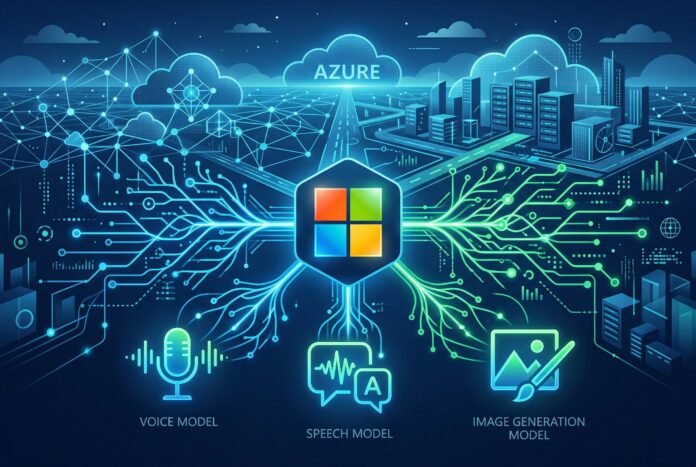
On April 2, 2026, Microsoft released three proprietary AI models — MAI-Transcribe-1, MAI-Voice-1, and MAI-Image-2 — exclusively through its Foundry platform. These are not experimental research projects. They are production-ready systems competing directly with OpenAI’s Whisper, text-to-speech, and DALL-E.
The move signals something deeper than product expansion. Microsoft is executing a strategy to become self-sufficient in AI. And it is doing so while maintaining the OpenAI partnership that made its AI ambitions possible in the first place.
The Three Models
MAI-Transcribe-1 is a speech-to-text system supporting 25 languages. Microsoft claims it is 2.5 times faster than its previous Azure Fast offering and the most accurate transcription model in the world. At /bin/bash.36 per hour, it is priced to undercut competitors.
MAI-Voice-1 generates natural-sounding speech. The model can produce 60 seconds of audio in one second and supports custom voice creation. Microsoft says it sets a new standard for natural speech. Pricing starts at 2 per million characters.
MAI-Image-2 handles image generation. Originally released March 19 on MAI Playground, it is now available through Foundry. The model costs per million tokens for text input and 3 per million tokens for image output.
These are not niche capabilities. They are core multimodal functions that power everything from voice assistants to content creation tools. And Microsoft is offering them directly, bypassing the OpenAI models that currently handle similar tasks in Copilot.
The Strategic Pivot
The MAI models represent the culmination of a strategy that began in November 2025, when Mustafa Suleyman formed the MAI Superintelligence team. Suleyman, who joined Microsoft from Inflection AI, was given a clear mandate: build frontier models that reduce dependence on external providers.
We are building Humanist AI, Suleyman wrote in the announcement. We have a distinct view when creating our AI models — putting humans at the center, optimizing for how people actually communicate, training for practical use.
The subtext is unmistakable. Microsoft wants its own models, trained on its own data, running on its own infrastructure, delivered through its own platforms.
This is not theoretical. The October 2025 restructuring of Microsoft’s OpenAI partnership explicitly allowed both companies to independently pursue AGI alone or in partnership with third parties. The legal framework for competition was established before the products were ready.
Why Now?
Three converging factors explain the timing.
First, the economics of dependency. Every API call to OpenAI’s models represents margin flowing out of Microsoft and into its partner. For a company operating at Microsoft’s scale — with hundreds of millions of Office 365 users and Azure customers — those margins compound into billions. Owning the models means capturing that value.
Second, the platform imperative. Microsoft has always been a platform company. Windows. Office. Azure. The company succeeds when it owns the layer that customers build on. Relying on OpenAI for core AI capabilities leaves Microsoft one layer removed from its customers. The MAI models restore that direct relationship.
Third, the risk of single-sourcing. OpenAI’s recent turbulence — from leadership changes to competitive pressure from Anthropic’s own unreleased AI hacker — leadership changes, governance disputes, competitive pressure from Anthropic — has demonstrated the fragility of relying on a single partner for mission-critical technology. Microsoft’s 3 billion investment bought influence, but it did not buy control. Building internal capabilities hedges that risk.
The Competitive Landscape
The MAI models enter a crowded market. OpenAI’s Whisper dominates transcription. Google’s text-to-speech powers millions of applications. Midjourney and Stable Diffusion have carved out strong positions in image generation.
Microsoft’s advantage is not model quality — at least not yet. It is distribution.
Microsoft Foundry is not just a model marketplace. It is integrated into Azure, the cloud platform that already serves millions of enterprise customers. Developers building on Azure can now access MAI models without setting up separate accounts, managing different API keys, or navigating unfamiliar documentation.
The pricing reinforces this advantage. Microsoft claims the MAI models are cheaper than those from Google and OpenAI. This is not charity. Microsoft owns the infrastructure. It can afford lower margins because it is not paying cloud providers for compute. Competitors using AWS or Google Cloud cannot match those economics without sacrificing profitability.
The Partnership Paradox
The most interesting aspect of this launch is what it reveals about the Microsoft-OpenAI relationship. The two companies remain partners. OpenAI still trains on Azure. Copilot still uses GPT models. The 3 billion investment has not been withdrawn.
But the nature of the partnership has shifted. It is becoming more transactional, less strategic. Microsoft is treating OpenAI as one vendor among many — albeit a preferred one — rather than the exclusive source of AI capabilities.
This is sustainable as long as both companies benefit. OpenAI needs Azure’s compute infrastructure. Microsoft needs OpenAI’s frontier models for applications where MAI has not caught up. The relationship becomes a marketplace rather than a marriage.
What This Means for the AI Industry
Microsoft’s move has implications beyond its own product roadmap.
For enterprises, it means more choice and potentially lower costs. Competition between Microsoft and OpenAI — even if they are nominally partners — should drive innovation and pricing pressure.
For startups, it complicates the landscape. Building on OpenAI’s API once meant betting on the dominant platform. Now that platform’s largest partner is building alternatives. The safe choice becomes less clear.
For the AI labs, it is a signal that customer concentration is a risk. OpenAI built its business on Microsoft’s distribution. Now that distribution is being used to promote competing products. Other labs should take note.
The Long Game
Microsoft’s strategy extends beyond these three models. Suleyman’s announcement promised more models from us soon in Foundry and directly in Microsoft products and experiences.
The endgame is a full-stack AI platform: infrastructure through Azure and the massive data center buildout, models through MAI, applications through Office and Copilot, distribution through enterprise sales. Each layer reinforces the others. Each layer locks in customers.
Whether Microsoft can execute this vision remains to be seen. Building frontier models is expensive and uncertain. The MAI models are competitive but not clearly superior to alternatives. And the OpenAI partnership, while evolving, still provides capabilities Microsoft has not replicated.
But the direction is clear. Microsoft spent 3 billion to buy a seat at the AI table. Now it is building its own chips, training its own models, and constructing its own path to artificial general intelligence.
The partnership that defined the AI era is becoming a footnote. The company that enabled OpenAI’s rise is preparing for a future where it does not need OpenAI at all.
That is either prudent diversification or the beginning of a messy divorce. Either way, the 3 billion bet is paying for a front-row seat to watch the transformation.
Sources
- TechCrunch: Microsoft takes on AI rivals with three new foundational models — Technical details and pricing
- Business Insider: Microsoft released 3 new AI models — Strategic context and OpenAI relationship
- Microsoft AI Blog: Announcing 3 new world class MAI models — Official announcement and model specifications
- Microsoft Tech Community: Introducing MAI models in Foundry — Platform integration details
- CNBC: Microsoft forms superintelligence team — Background on MAI Superintelligence team formation
This article was produced with AI assistance for research and drafting. All sources verified and cited.
