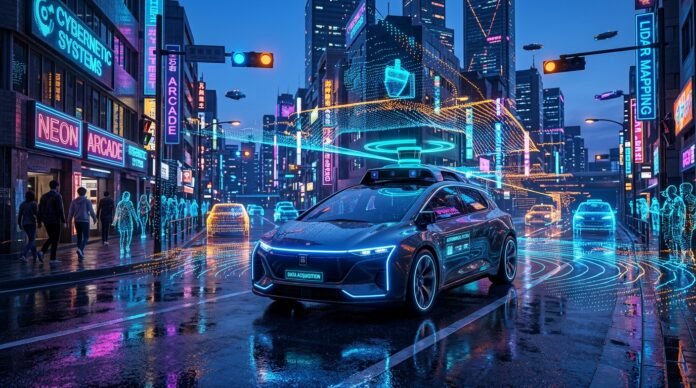
From DARPA challenges to robotaxis on city streets—the journey, the technology, and what comes next.
In 2004, the Defense Advanced Research Projects Agency (DARPA) offered a $1 million prize to any vehicle that could complete a 150-mile desert course autonomously. None made it past the first few miles. The farthest any competitor traveled was 7.4 miles before getting stuck on a rock.
Nineteen years later, you can hail a fully autonomous vehicle in San Francisco, Phoenix, or Austin. No safety driver. No steering wheel intervention. The car arrives, picks you up, and navigates city traffic while you scroll through your phone.
The transformation from that 2004 failure to 2024’s commercial deployments represents one of the most significant engineering achievements of the 21st century. But the road to full autonomy remains longer and more complex than early predictions suggested.
The Evolution: From Desert Failures to City Streets
The DARPA Era: Proving It Was Possible
The 2004 DARPA Grand Challenge was a humbling experience for the robotics community. But the following year, five vehicles completed a 132-mile desert course. Stanford’s Stanley won in just under seven hours.
What changed in one year:
- Better sensor technology (LiDAR became commercially viable)
- Machine learning approaches replaced hand-coded rules
- Teams learned from the first competition’s failures
- Investment and talent flooded into the field
The Google/Waymo Era: Scaling Up
In 2009, Google launched its Self-Driving Car Project. The approach was different: instead of racing, they focused on accumulating miles. Lots of miles.
Waymo’s progress by the numbers:
- 2015: First fully autonomous ride on public roads
- 2018: First commercial robotaxi service (Waymo One in Phoenix)
- 2020: Removed safety drivers from some Phoenix operations
- 2023: Expanded to San Francisco and Austin
- 2024: Over 20 million autonomous miles driven
The Tesla Era: Scale First, Perfect Later
Tesla took a different approach. Instead of building autonomy through careful mapping and controlled deployment, they deployed driver-assistance features to hundreds of thousands of customers and collected data from real-world usage.
Tesla’s Full Self-Driving (FSD) evolution:
- 2015: Autopilot launched (lane keeping, adaptive cruise)
- 2019: FSD computer with dedicated AI chips
- 2020: FSD Beta released to select customers
- 2024: FSD v12 with end-to-end neural networks
The Technology: How Self-Driving Cars Actually Work
Perception: Seeing the World
Modern autonomous vehicles combine multiple sensors to perceive their environment:
- LiDAR: 3D mapping with laser pulses; precise distance measurement
- Cameras: Visual recognition; color and texture; sign reading
- Radar: Velocity and distance; works in all weather
- Ultrasonic: Close-range detection for parking
Sensor Fusion: No single sensor is sufficient. Autonomous vehicles combine data from all sensors to build a comprehensive understanding of their environment.
Planning: Deciding What to Do
Once a vehicle understands its environment, it must decide how to navigate through it:
- Route Planning: Determines overall path from origin to destination
- Behavioral Planning: Decides high-level actions (change lanes, overtake)
- Motion Planning: Generates precise trajectories and control commands
Control: Executing the Plan
The final step converts planned trajectories into vehicle commands: steering wheel angle, accelerator position, brake pressure. Modern control systems operate at 50-100 Hz, making adjustments dozens of times per second.
The Current State: Where We Are in 2024
Level 4 Deployments: Robotaxis in Select Cities
Waymo:
- Operates in Phoenix, San Francisco, and Austin
- Over 100,000 paid trips per week
- No safety driver in most operational areas
- Limited to mapped geofenced regions
Cruise: Suspended operations in late 2023 following a serious incident; under regulatory review.
Baidu Apollo: Large-scale operations in Wuhan, China; over 5 million autonomous rides.
Level 2/3: Driver Assistance Everywhere
While full autonomy remains limited, advanced driver assistance systems (ADAS) are now standard on most new vehicles:
- Tesla FSD: Available to most North American customers; handles highways and city streets
- Mercedes Drive Pilot: First Level 3 system certified for highway use
- GM Super Cruise: Hands-free highway driving on mapped roads
The Gap: Why Level 5 Remains Elusive
Level 5 autonomy—vehicles that can drive anywhere, anytime—remains unsolved:
- Edge Cases: Millions of rare scenarios require specific handling
- Weather: Rain, snow, and fog degrade sensor performance
- Maps: Most systems rely on expensive, detailed maps
- Social Interaction: Complex negotiation with other road users
- Verification: Proving safety requires billions of miles of testing
The Business Models: Who Makes Money and How
Robotaxis: The Endgame
The most commonly discussed business model is robotaxi services—Uber without drivers:
- Human-driven ride-hail: $2-3 per mile
- Autonomous vehicle (estimated): $0.50-1.00 per mile
Consumer Vehicles: ADAS Subscriptions
Tesla’s approach of selling advanced driver assistance as a premium feature has proven profitable:
- Tesla FSD: about $99/month subscription in the US (one-time purchases ended February 2026)
- Mercedes Drive Pilot: $2,500 annual subscription
- GM Super Cruise: $25/month after trial
Logistics and Freight: The Near-Term Opportunity
Highway trucking may achieve autonomy before complex urban driving:
- Highway driving is more structured than urban
- Driver shortage creates immediate demand
- Hub-to-hub model (autonomous highways, human cities)
The Implications: How Autonomous Vehicles Reshape Society
Safety: The Primary Promise
Human drivers cause approximately 1.35 million deaths globally each year. Autonomous vehicles promise to reduce this dramatically—if they can achieve better-than-human safety.
Urban Transformation: Rethinking Cities
If transportation becomes a service rather than a product:
- Parking: Structures become obsolete; spaces convert to other uses
- Traffic: Optimized vehicles could reduce congestion
- Land Use: Reduced parking requirements free urban land
- Transit: Complement or compete with public transit
Employment: Disruption and Transition
The transportation sector employs millions: truck drivers, taxi drivers, delivery workers. The transition creates economic and social challenges requiring policy responses.
Accessibility: Mobility for All
Autonomous vehicles offer particular benefits for underserved populations:
- Elderly drivers maintaining independence
- Disabled individuals with door-to-door service
- Low-income communities with reduced costs
- Rural areas where public transit is uneconomical
The Road Ahead: What Comes Next
Near-Term (2024-2027): Expansion and Consolidation
- Waymo expands to more cities
- Tesla FSD improves but remains supervised
- Mercedes and others deploy Level 3 on highways
- Trucking pilots expand
- Consolidation among startups
Medium-Term (2027-2035): Mainstream Adoption
- Level 4 robotaxis in most major cities
- Level 3 highway autonomy standard on premium vehicles
- Autonomous trucking handles significant freight volume
Long-Term (2035+): Transformation
- Personal car ownership declines in urban areas
- Transportation-as-a-service becomes dominant
- Urban landscapes transform
- New industries emerge
Conclusion
The journey from DARPA’s 2004 failure to 2024’s commercial robotaxis represents extraordinary progress. Engineers have solved problems that seemed insurmountable: interpreting complex urban environments, predicting human behavior, making split-second safety decisions.
Yet the full promise of autonomous vehicles—safe, convenient, accessible transportation for everyone, everywhere—remains distant. The last 10% of capability requires solving edge cases that are individually rare but collectively numerous.
The self-driving car is no longer science fiction. It’s a technology in active deployment, improving continuously, and gradually expanding its reach. The question is no longer whether autonomous vehicles will transform transportation, but how quickly, how completely, and who will shape that transformation.
Correction, 12 October 2026: this article originally said $12,000 one-time or $199 a month; in the US it is now subscription-only at about $99 a month.
Related Reading
- AI, Machine Learning, and Foundation Models — The AI technologies powering autonomous vehicles
- The Voice AI Revolution — Natural language interfaces for vehicle control
- NVIDIA’s “Physical AI” Play — AI systems that interact with the physical world
- Tesla FSD Gets European Approval — Regulatory developments in autonomous driving
- The AI Infrastructure Stack — Technical foundations for autonomous systems
Sources
- IBM Training: “Self-Driving Cars”
- DARPA Grand Challenge Archives (2004-2007)
- Waymo Safety Reports and Public Road Testing Data
- SAE International: Taxonomy and Definitions for Driving Automation
- National Highway Traffic Safety Administration (NHTSA)
- California DMV Autonomous Vehicle Disengagement Reports
Follow @tsnmediahub on X for breaking AI news as it happens.
Follow on X