
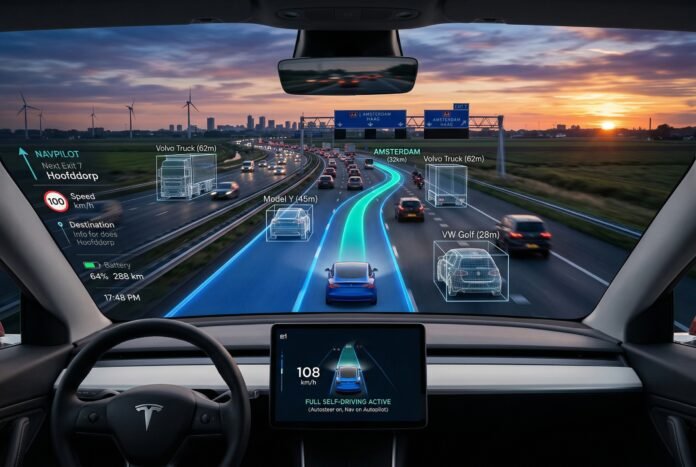
Tesla is Full Self-Driving just cleared its biggest regulatory hurdle yet — and it is not in America.
On April 10, 2026, Dutch regulators granted Tesla type approval for FSD Supervised under UN R-171 regulation. The Netherlands becomes the first European country to officially approve Tesla is driver-assist technology, opening the door for a broader European rollout as early as this summer.
This is not just another market entry. It is a breakthrough that could reshape the autonomous vehicle landscape across an entire continent.
Update, 8 October 2026
Spotted via Sawyer Merritt (@SawyerMerritt) on X. His post says the rename covers “all of Europe”; TSN’s checks found it on most, not all, of Tesla’s European sites.
A new name on most of Tesla’s European sites. Tesla’s websites for many European markets now present the system as “Tesla Assisted Driving” instead of “Full Self-Driving (Supervised)” [1]. When TSN checked on the evening of 8 October, the old FSD address redirected to a new “Tesla Assisted Driving” page in Germany, the UK, France, Italy, Spain, Poland, Austria, Dutch-language Belgium, Norway and Tesla’s “Other Europe” site. The French and Norwegian pages use translations (“Tesla Conduite Assistée”, “Tesla Assistert kjøring”) [1].
The rollout is partial. On the same check, the FSD pages for Ireland, Denmark, Sweden and French-language Belgium still used the old name, as did Switzerland (“Voll-Selbstständiges Fahren (Überwacht)”). The Netherlands, where the system was first approved, still showed “Full Self-Driving (Supervised)” at its FSD address, although a separate “Tesla Assisted Driving” page also existed [1]. Results changed between checks, so the switch appears to be still under way. TSN found no Tesla press release. A widely shared post saying Tesla had renamed the system “across all of Europe” overstated what the sites showed [1][5].
What Germany said. On 6 October Germany’s Federal Ministry for Transport (BMV) said the current name “FSD” is “etwas irreführend” (“somewhat misleading”). It said the system does not take over the whole driving task but assists with accelerating, braking and steering, and that the driver must stay attentive at all times. “Tesla hat angeboten, das System in ‘Tesla Assisted Driving’ umzubenennen” (“Tesla has offered to rename the system ‘Tesla Assisted Driving'”) [2].
According to the statement, Minister Steffen Bilger met Tesla in September. The two sides agreed the system may exceed the speed limit “um maximal zehn Prozent” (“by a maximum of ten percent”), and the driver remains “zu 100 Prozent verantwortlich” (“100 percent responsible”). Bilger said: “Wir haben schnell ein gemeinsames Verständnis gefunden und eine konstruktive Einigung erzielt” (“We quickly found a common understanding and reached a constructive agreement”). Germany says it will support a prompt continuation of the EU approval process [2].
Why a name matters. “Full Self-Driving” suggests the car drives itself. Regulators classify the system as driver assistance, the kind usually called Level 2, where the human must supervise at all times. The Dutch RDW has said the same [3]. A name that matches that role is easier for regulators to accept.
Where approval stands. heise reports that the RDW’s 10 April approval is a provisional one under Article 39 of EU Regulation 2018/858. It applies in the Netherlands, other member states can recognise it individually, and EU-wide validity needs a qualified majority of member states. The 6 October committee agenda did not include a vote, so heise did not expect a decision before December [3]. Germany has not recognised the approval itself; its vehicle authority, the KBA, is still assessing it [3]. Tesla has used the “Tesla Assisted Driving” name in China since May, according to Electric Vehicles [4].
What this does not prove
- That the system has changed. Only the name changed, on Tesla’s sites. Neither Germany nor Tesla describes any new capability, and the driver remains responsible [1][2].
- That it is approved in Germany or across the EU. Germany’s statement backs the EU process. It is not a German approval, and no EU vote has taken place [2][3].
- That the rename covers all of Europe. Several Tesla sites still used the old name when TSN checked [1].
The Bottom Line
Tesla is dropping “Full Self-Driving” from most of its European websites after Germany called the name misleading. This is about the label, not new capability or approval. The next real test is whether EU member states vote to approve the system, which heise expects no earlier than December [2][3].
Sources (update)
- Tesla, regional FSD / Tesla Assisted Driving pages (e.g. https://www.tesla.com/de_de/tesla-assisted-driving, https://www.tesla.com/en_gb/tesla-assisted-driving, https://www.tesla.com/fr_fr/tesla-assisted-driving, https://www.tesla.com/en_ie/fsd, https://www.tesla.com/da_dk/fsd, https://www.tesla.com/sv_se/fsd, https://www.tesla.com/nl_nl/fsd), checked 21:25–21:27 BST, 8 October 2026.
- Bundesministerium für Verkehr, “Aktueller Stand bei der Genehmigung eines Tesla-Assistenzsystems”, 6 October 2026. https://www.bmv.de/SharedDocs/DE/Artikel/StV/Digitalisierung-der-Mobilitaet/aktueller-stand-tesla-assistenzsysteme.html
- Florian Pillau, “Tesla FSD: Transport Minister Bilger calls for EU approval of assistance system”, heise autos, 6 October 2026. https://www.heise.de/en/news/Tesla-FSD-Transport-Minister-Bilger-calls-for-EU-approval-of-assistance-system-11477430.html
- Cláudio Afonso, “Tesla Reached Deal With Germany on FSD Speed and Liability, Ministry Says”, EV (eletric-vehicles.com), 6 October 2026. https://eletric-vehicles.com/tesla/tesla-reached-deal-with-germany-on-fsd-speed-and-liability-ministry-says/
- Sawyer Merritt (@SawyerMerritt), X post, 8 October 2026, 20:03 BST. https://x.com/SawyerMerritt/status/2108272012514967787
Update, 9 October 2026: Slovakia says it will recognise the Dutch approval
Reported; not yet approved. Slovakia’s transport minister, Jozef Ráž, says his ministry plans to recognise the Dutch approval of Tesla’s system within days. According to Pravda.sk, Ráž announced in a video published on Wednesday 7 October that the ministry has held talks with Tesla and plans “v najbližších dňoch” (“in the coming days”) to send the Netherlands the document needed to recognise the Dutch approval [6]. Investing.com, which also reports the video was posted on LinkedIn, quotes him: “Once this letter is delivered, the FSD system will be available for use here as well. But remember: you’re still the driver, and you’re responsible for the car” [7]. TSN has not viewed the video itself.
How recognition works. As this post’s 8 October update explains, the RDW’s approval is provisional and applies in the Netherlands. Other EU states can choose to recognise it one by one. Slovakia’s letter would be that kind of national recognition, not an EU-wide decision. Pravda says the joint EU vote is not expected before December because member states disagree [6].
The safety claim. Investing.com quotes Ráž: “Data shows that these cars reduce the accident rate and that’s exactly what we’re aiming for” [7]. That is the minister’s statement. Pravda notes that Reuters reported on 7 October that seven experts had doubts about parts of the evidence Tesla has given European authorities. Pravda adds that the criticism centres on proxy risk measures, such as hard braking, rather than data on actual crashes [6]. TSN has not reviewed the underlying data.
How many countries? Both outlets say Slovakia would become the ninth EU country to allow the system [6][7]. That is their count. TSN has not checked each country’s status.
What this does not prove
- That FSD (Supervised) is approved in Slovakia. The letter had not been sent in the reports TSN read; the ministry says it plans to send it [6][7].
- That the system reduces crashes. That is the minister’s claim, and independent experts have questioned parts of Tesla’s evidence, according to Pravda’s summary of Reuters [6][7].
- That an EU-wide approval is close. Pravda says no vote is expected before December [6].
The Bottom Line
Slovakia says it will send the Netherlands a letter recognising the Dutch approval “in the coming days”, which would let drivers there use the system under supervision. Until the letter is sent and acted on, it is a stated plan. The EU-wide vote is still not expected before December [6][7].
Sources (update, 9 October)
- Martin Domček, “Slovensko onedlho povolí autonómne riadenie Tesla FSD, vyhlásil minister dopravy” (“Slovakia will soon allow Tesla FSD autonomous driving, transport minister says”), Pravda.sk, 8 October 2026 (reported; in Slovak, TSN translation; cites the minister’s video and Reuters). https://www.pravda.sk/auto/magazin/clanok/2055389-slovensko-onedlho-povoli-autonomne-riadenie-tesla-fsd-vodic-vsak-zodpovednost-neodovzda-autu
- Investing.com, “Slovakia to approve Tesla FSD system within days”, 8 October 2026 (reported; the outlet says the article was AI-assisted and editor-reviewed; quotes the minister’s LinkedIn video). https://www.investing.com/news/stock-market-news/slovakia-to-approve-tesla-fsd-system-within-days-93CH-4938399
The Approval: What Actually Happened
The Dutch vehicle authority RDW (Rijksdienst voor het Wegverkeer) issued a formal type approval for Tesla is Full Self-Driving Supervised system after more than 18 months of testing and regulatory review.
Key details:
- Approval falls under UN R-171 regulation for Driver Control Assistance Systems
- Valid only in the Netherlands initially
- Other EU member states can choose to recognize it nationally (not automatic)
- Tesla described the system as trained on billions of kilometers of real-world driving data
The RDW was careful to stress that FSD Supervised is a driver assistance system, not an autonomous or self-driving system. The driver must remain engaged and ready to take control at all times.
Why Europe Was the Hard Problem
Tesla has had FSD available in the US for years. Europe was always the tougher nut to crack.
The challenges:
Regulatory fragmentation. The US has federal standards with state-by-state variations. Europe has 27 different countries, each with their own interpretation of EU regulations, plus the UK doing its own thing post-Brexit.
Stricter safety standards. European regulators have historically taken a more cautious approach to autonomous driving. The burden of proof for safety is higher.
Different road environments. Narrow European streets. Roundabouts everywhere. Different signage. Different driving cultures. What works in Texas does not necessarily work in Tuscany.
Why the Netherlands Matters
The Dutch approval is not just symbolic. It is strategic.
The RDW is respected. The Netherlands vehicle authority is known for thorough, credible technical evaluations. Other EU regulators often look to RDW assessments when making their own decisions.
UN R-171 is the pathway. By getting approval under this United Nations regulation, Tesla has created a template that other countries can follow.
Tesla has a factory in Berlin. The company is European manufacturing hub is in Germany. Getting FSD approved in neighboring Netherlands creates pressure for German regulators to follow suit.
What This Means for Tesla is Ambitions
Elon Musk has been promising full self-driving for nearly a decade. This approval matters for several reasons:
Regulatory credibility. Getting through the RDW process proves Tesla can meet stringent third-party safety standards.
Revenue potential. In the US, Tesla now sells FSD mainly as a subscription (about $99 a month); the one-time purchase option ended in February 2026. European customers have been unable to buy it. That is a massive untapped revenue stream now potentially unlocked.
Data advantage. Every kilometer driven in Europe improves the system. European roads, European signage, European driving patterns — all become training data.
Competitive positioning. While Tesla races toward Optimus production and autonomous driving, traditional automakers are still struggling to match Tesla is driver-assist capabilities.
The Bigger Picture: Autonomous Driving in Europe
This approval comes at a critical moment for autonomous vehicles globally.
The technology is maturing. Systems that were experimental five years ago are now robust enough for regulatory approval.
The regulatory frameworks are evolving. UN R-171 provides a standardized approach that multiple countries can adopt.
The economics are shifting. The 5 billion pouring into AI infrastructure includes massive investments in autonomous vehicle compute, sensors, and training data.
The Counter-Arguments: Reasons for Skepticism
Before declaring victory, it is worth noting the limitations:
Supervised is doing a lot of work. This is not full self-driving. The driver must remain engaged. The system can fail.
The approval is provisional and limited. Only the Netherlands. Only certain road types. This is a beachhead, not a conquest.
Other regulators may not follow. Just because the Dutch approved it does not mean Germany, France, or the UK will.
What Happens Next
Short term (2026): Tesla begins rolling out FSD Supervised in the Netherlands. Other EU countries watch closely. Germany likely follows within months.
Medium term (2027-2028): Broader European rollout if the Dutch deployment goes smoothly. UK makes its own decision post-Brexit.
Long term (2029+): True autonomous driving — no supervision required — becomes technically and legally feasible.
The Bottom Line
Tesla is FSD approval in the Netherlands is more than a regulatory checkbox. It is proof that autonomous driving technology is crossing the threshold from experimental to operational.
The road to full self-driving remains long. But the Dutch approval shows it is not infinite. Milestones are being reached. Barriers are falling.
For Tesla, it is a validation of years of investment in AI and neural networks. For the autonomous vehicle industry, it is a signal that European markets are opening.
The breakthrough happened in the Netherlands. But the implications are global.
Correction, 12 October 2026: this article originally said Tesla charged up to 5,000 for FSD in the US; it is now sold mainly as a subscription at about $99 a month.
Related Reading
Tesla is Put-Up-or-Shut-Up Year for Optimus Production — While Tesla pushes FSD forward, they are also racing to deliver humanoid robots.
NVIDIA is Physical AI Play — The AI infrastructure powering the next generation of autonomous systems
The 5 Billion Tech Deal Spree — The massive investment flowing into AI, including autonomous vehicle compute
AI is Second Wind — How AI is moving from demos to profitable deployment
Follow @tsnmediahub on X for breaking AI news as it happens.
Follow on X



. Tesla's European sites are switching to 'Tesla Assisted Driving'.)