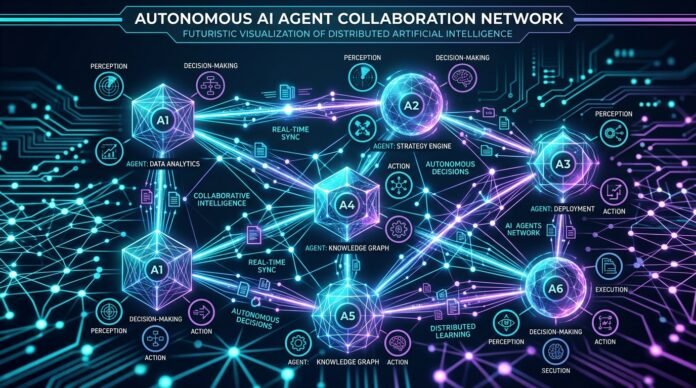
From simple chatbots to autonomous systems that plan, decide, and execute—how AI agents are reshaping work and technology.
In 1997, Deep Blue defeated Garry Kasparov at chess. The victory was impressive but limited: Deep Blue could play chess brilliantly and nothing else. It was a specialized tool, not a general problem-solver.
Twenty-seven years later, AI systems can write code, analyze legal documents, manage supply chains, and negotiate on our behalf. The shift from narrow tools to autonomous agents represents one of the most significant developments in artificial intelligence—and one with profound implications for how we work, make decisions, and interact with technology.
What Are AI Agents? Beyond Simple Automation
An AI agent is software that perceives its environment, makes decisions, and takes actions to achieve specific goals—operating with varying degrees of autonomy.
The Agent Cycle
Modern AI agents operate through a continuous loop:
Perception: Sensors or data inputs gather information about the environment
Understanding: AI processes raw data into meaningful representations
Decision: The agent selects actions based on goals and constraints
Action: Effectors execute decisions in the environment
Learning: Outcomes feed back to improve future performance
The Autonomy Spectrum
- Assistance: Suggests actions; human decides (Grammar checking, code completion)
- Supervised: Acts within constraints; human monitors (Semi-autonomous vehicles)
- Conditional: Autonomous in defined situations (Warehouse robots)
- Fully Autonomous: Independent operation; human sets goals only (Algorithmic trading)
The Anatomy of an Agent: Key Characteristics
1. Autonomy: Operating Without Constant Direction
Definition: The ability to make decisions and take actions without continuous human oversight.
Real-world example: Modern algorithmic trading systems execute thousands of trades per day based on market conditions, risk parameters, and profit targets. They do not ask permission for each trade; they operate within defined boundaries.
2. Reactiveness: Responding to Change
Definition: The capacity to perceive environmental changes and respond appropriately in real-time.
Real-world example: Smart building systems adjust heating, cooling, and lighting based on occupancy sensors, weather data, and energy prices. When a conference room fills with people, the system reacts immediately—increasing ventilation and adjusting temperature.
3. Proactiveness: Pursuing Goals
Definition: The ability to take initiative, anticipate future states, and act to achieve objectives rather than merely reacting to events.
Real-world example: Predictive maintenance systems do not wait for equipment to fail. They analyze sensor data, predict failures before they occur, and schedule maintenance proactively.
4. Social Ability: Collaborating with Others
Definition: The capacity to communicate, coordinate, and collaborate with other agents (software or human) to achieve individual or shared goals.
Real-world example: In modern supply chains, multiple agents represent different parties: supplier agents, logistics agents, warehouse agents, retailer agents. They negotiate prices, coordinate deliveries, and resolve conflicts.
Multi-Agent Systems: When Agents Collaborate
The real power of agent technology emerges when multiple agents work together. Multi-agent systems (MAS) enable distributed problem-solving at scales impossible for individual agents.
Coordination Mechanisms
- Market-based coordination: Agents negotiate prices for goods and services
- Contract net protocol: Agents announce tasks, receive bids, and award contracts
- Organizational structures: Agents adopt roles with defined relationships
- Emergent coordination: Simple rules produce complex coordinated behavior
Applications of Multi-Agent Systems
Smart Grids: Thousands of agents represent power generators, consumers, storage systems, and grid infrastructure. They negotiate prices, balance loads, and respond to outages in real-time.
Traffic Management: Vehicle agents communicate with infrastructure agents and each other to optimize routes, reduce congestion, and improve safety.
E-commerce: Buyer agents and seller agents negotiate on behalf of users, automating commerce at scale.
The 2023-2024 Agent Revolution: LLMs as Agents
The emergence of large language models (LLMs) has transformed what is possible with AI agents.
From Tools to Agents: The LLM Shift
Traditional software tools execute specific functions. LLM-based agents can:
- Understand goals expressed in natural language
- Break complex tasks into subtasks
- Use tools (search, email, spreadsheets, booking)
- Adapt to feedback
- Learn from experience
Notable LLM Agent Frameworks
- AutoGPT (2023): Open-source autonomous LLM agent
- LangChain (2023): Framework for building LLM applications with agent capabilities
- LangGraph (2024): Multi-agent workflows with explicit state management
- CrewAI (2024): Multi-agent systems with defined roles
- Microsoft AutoGen (2023): Conversational agents that collaborate
The Reality Check: Capabilities and Limitations
Despite impressive demos, LLM-based agents face challenges:
- Reliability: LLMs hallucinate—generate plausible but incorrect information
- Planning: Struggle with complex planning requiring long sequences of dependent actions
- Tool use: Small errors in tool calls cause failures
- Cost: Many LLM API calls become expensive at scale
- Safety: Autonomous agents with tool access can cause harm
Real-World Deployments: Where Agents Work Today
Customer Service: The $80 Billion Opportunity
Gartner estimates AI agents will save companies $80 billion in customer service costs.
Real-world implementations:
- Klarna’s AI assistant handles two-thirds of customer service chats
- Intercom’s Fin resolves 50% of customer queries without human intervention
- Ada powers automated support for Meta, Verizon, and AirAsia
Algorithmic Trading: Agents in Finance
Financial markets were early adopters of agent technology:
- Market-making agents quote buy and sell prices continuously
- Arbitrage agents identify price discrepancies across markets
- Execution agents break large orders to minimize market impact
- Risk management agents monitor portfolios and ensure compliance
Content Moderation: Agents at Scale
Social media platforms use agent systems to moderate billions of posts:
- Detection agents identify content violating platform rules
- Escalation agents route borderline cases to human reviewers
- Response agents take automated actions
- Adaptation agents learn from human decisions
Supply Chain and Logistics
Modern supply chains rely on agent coordination:
- Demand forecasting agents predict future demand
- Inventory agents monitor stock levels and optimize warehouses
- Routing agents plan delivery routes considering multiple factors
- Supplier negotiation agents manage relationships automatically
Building Agent Systems: Architecture and Design
Agent Architectures
- Reactive agents: Simple condition-action rules
- Deliberative agents: Maintain internal world models and plan actions
- Hybrid agents: Combine reactive and deliberative components
- BDI (Belief-Desire-Intention): Agents maintain beliefs, desires, and intentions
Tool Use and Function Calling
Modern agents extend LLM capabilities through tool use:
Available tools might include:
- Web search
- Code execution
- Database queries
- API calls
- File system operations
- Calculator
- Calendar scheduling
Memory and State
Agents need memory to maintain context:
- Short-term memory: Current conversation context
- Long-term memory: Persistent knowledge about users
- Episodic memory: Specific past experiences
- Semantic memory: General knowledge about the world
The Future: Where Agents Are Heading
From Single to Multi-Agent
Current systems typically involve one agent. Future systems will involve multiple agents collaborating:
- Specialized agents: Research, writing, fact-checking, formatting—collaborating on tasks
- User proxy agents: Represent users in negotiations and routine decisions
- Organizational agents: Represent departments or companies, coordinating across boundaries
From Assistants to Colleagues
The relationship between humans and agents will evolve:
- Current: Agents assist with tasks humans direct
- Emerging: Agents collaborate as team members with defined roles
- Future: Agents act as autonomous participants in organizations
Trust and Verification
As agents take more autonomous actions, trust becomes critical:
- Explainability: Agents must explain their decisions
- Verification: Mechanisms to check agent actions
- Accountability: Clear responsibility when agents make mistakes
- Alignment: Agents must pursue goals humans actually want
Implications and Considerations
Employment and Labor Markets
Agent automation will displace some jobs while creating others:
At risk: Routine cognitive tasks—data entry, basic analysis, routine customer service, simple programming.
Growing demand: Agent supervision, agent training, complex problem-solving, creative work, human connection.
Concentration of Power
Agent capabilities may concentrate economic power:
- Organizations with more data can train better agents
- Training sophisticated agents requires expensive infrastructure
- Relatively few people understand how to build reliable agent systems
Safety and Control
Autonomous agents pose safety challenges:
- Accidents: Agents making wrong decisions in safety-critical contexts
- Misuse: Bad actors using agents for fraud, disinformation, or attacks
- Loss of control: Agents pursuing goals in ways humans did not intend
- Value alignment: Ensuring agent goals align with human values
Conclusion
AI agents represent a fundamental shift in how we interact with software. From tools that execute commands to systems that pursue goals, the change is as significant as the shift from command-line interfaces to graphical user interfaces.
The technology is maturing rapidly. LLM-based agents have democratized agent development, enabling applications that seemed impossible just years ago. Yet significant challenges remain: reliability, safety, cost, and control.
The age of autonomous software is here. The question is how we shape it.
Related Reading
- AI, Machine Learning, and Foundation Models — The foundational AI technologies powering modern agents
- Natural Language Processing — How NLP enables agent communication
- The Voice AI Revolution — Voice interfaces for agent interaction
- NVIDIA’s “Physical AI” Play — Agents that interact with the physical world
- The AI Infrastructure Stack — Technical foundations for deploying agents
Sources
- IBM Training: “AI Agents”
- Wooldridge, M. (2009): “An Introduction to MultiAgent Systems”
- Russell & Norvig (2021): “Artificial Intelligence: A Modern Approach”
- Gartner Research: AI in Customer Service Market Analysis
- AutoGPT, LangChain, LangGraph, CrewAI documentation
- OpenAI: Function calling and tool use documentation
Follow @tsnmediahub on X for breaking AI news as it happens.
Follow on X