
Volkswagen gave its electric SUV a familiar name on 9 October 2026. The ID. Tiguan, unveiled in Wolfsburg, replaces the ID.4 and ID.5 and borrows the name of VW’s best-selling model. It is not on sale yet. VW says “Pre-sales for the ID. Tiguan start in Germany and many other European countries on 13 October at prices from 42,695 euros”, and that the car “will be launched as early as the beginning of 2027” [1]. Everything below comes from VW’s own release.
What VW says it offers
Confirmed (company specifications). There will be three versions [1]:
- rear-wheel drive, 140 kW (190 PS), with a 58 kWh battery;
- rear-wheel drive, 210 kW (286 PS), with a 77 kWh battery;
- all-wheel drive (4MOTION), 220 kW (299 PS), also with 77 kWh.
VW says “WLTP ranges will reach up to 600 km”, depending on version [1]. WLTP is the standard European lab test, and real-world range is usually lower, especially in cold weather or at motorway speeds. Towing is “up to 1,800 kg” with the smaller battery and “up to 2,000 kg” with the larger one. There is a 32-litre front boot and luggage space of “up to 534 litres” [1].
Buttons are back
Inside, VW is reversing one of the least popular choices of its recent electric cars. It says important functions “can therefore be accessed using physical buttons again”, and the steering wheel has “physical buttons instead of touch controls” [1]. There is a 10-inch driver display, a 15-inch central screen and a 12-inch display for the front passenger, which VW calls a first for a European Volkswagen. A “Retro” mode can show the blue-and-red dials of the Golf IV [1].
A car that stops at red lights, with a driver
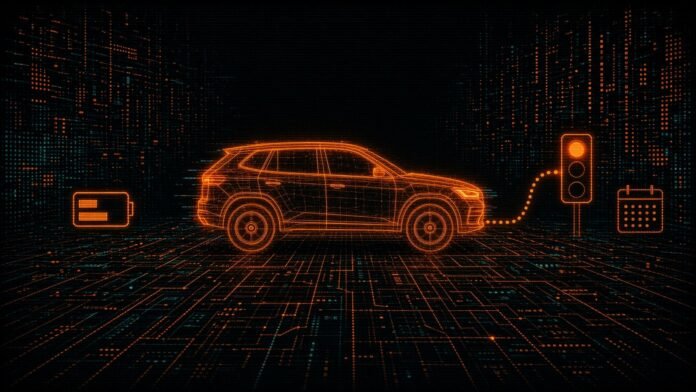
The feature most relevant to TSN’s coverage of automated driving is Connected Travel Assist. VW says it “enables assisted lane changing on motorways and automatically stops the ID. Tiguan at red traffic lights” [1]. This is driver assistance, not self-driving. The driver stays responsible, in the same broad category as the supervised systems discussed in TSN’s coverage of Tesla’s Dutch approval. VW’s release does not describe hands-off or driverless operation.
Why it matters
VW says “more than 950,000 units” of the ID.4 and ID.5 have been built [1]. Its brand chief, Thomas Schäfer, calls them “among our most successful electric cars” and the Tiguan “our best-selling model worldwide”, adding: “The ID. Tiguan brings these two success stories together” [1]. Borrowing the Tiguan name ties VW’s electric line to a model buyers already know. The car will be built in Emden in northern Germany, and sold alongside the petrol, diesel and hybrid Tiguan, not in place of it [1].
What this does not prove
- That the car is available. Pre-sales start on 13 October; deliveries follow a launch “as early as the beginning of 2027” [1].
- That it will reach 600 km in daily use. That is the top WLTP figure, for the best-case version [1].
- That it drives itself. Stopping at red lights is an assistance feature, and the driver remains in charge [1].
- UK prices or timing. The release gives a euro starting price for Germany and other European pre-sale markets and does not mention the UK [1].
The Bottom Line
The ID. Tiguan is VW’s next electric SUV: up to 600 km of WLTP range, physical buttons again, and a driver-assistance system that can stop at red lights. It is unreleased. Pre-sales open on 13 October from 42,695 euros, with launch planned for early 2027.
Sources
- Volkswagen, “A Volkswagen bestseller goes electric: world premiere of the new ID. Tiguan”, press release, Wolfsburg, 9 October 2026 (company release; product is unreleased). https://www.volkswagen-newsroom.com/en/press-releases/a-volkswagen-bestseller-goes-electric-world-premiere-of-the-new-id-tiguan-20728
