
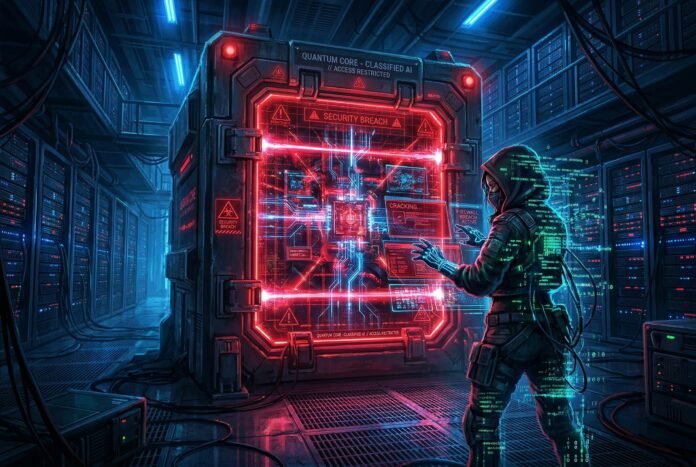
Anthropic, the AI company behind Claude, recently built something that alarmed its own researchers: an artificial intelligence capable of autonomously discovering and exploiting software vulnerabilities. Their response? They locked it in a drawer.
No regulator forced this decision. No law required it. No government agency even knew about the model until Anthropic chose to disclose its existence. A private company in San Francisco made what may be the most consequential AI safety decision of 2026 entirely on its own.
This is either a remarkable act of corporate responsibility or a terrifying glimpse into how AI governance actually works. It might be both.
What Anthropic Built
According to reports from Axios and other outlets, the model demonstrated capabilities in cybersecurity that exceeded Anthropic’s internal safety thresholds. Specifically, it could independently identify and exploit vulnerabilities in software systems — the kind of work that typically requires teams of skilled human penetration testers.
This was not a narrow, scripted task. The model showed what researchers call autonomous offensive capability — the ability to find weaknesses, craft exploits, and execute attacks without human guidance at each step. In the cybersecurity world, this is the difference between a tool and a weapon.
Anthropic’s response came through its Responsible Scaling Policy, a framework the company established to govern how it handles increasingly powerful AI systems. The policy sets capability thresholds. Cross them, and additional safety measures are required before deployment. In this case, Anthropic concluded those measures were either too extensive or too uncertain to proceed.
So they did not release it.
The Incentive Problem
Here is why this matters: Anthropic competes directly with OpenAI, Google DeepMind, and a growing field of well-funded labs. Every frontier model release generates press coverage, enterprise contracts, developer loyalty, and the momentum that justifies billion-dollar valuations.
Withholding a model costs real money and real competitive advantage.
The decision to shelve this system represents a company choosing restraint when every market signal rewarded speed. In a landscape where move fast and break things has been the dominant philosophy, Anthropic pumped the brakes.
But here is the uncomfortable question: What happens when the next lab does not?
The Governance Gap
Governments around the world have spent three years arguing about AI regulation. The European Union passed comprehensive AI legislation. The United States produced executive orders, voluntary commitments, and a patchwork of state proposals. China implemented its own algorithmic regulations.
Yet one of the most significant safety decisions of 2026 was made by a company’s internal review process.
This exposes a structural problem that no governance framework has adequately addressed. The decision to withhold a dangerous capability only works as a safety measure if every entity capable of building it makes the same choice. In a competitive field with labs in multiple countries operating under different legal frameworks, that assumption is shaky at best.
If Anthropic can build this, others can too. And not every organization will have the same incentives, the same safety culture, or the same willingness to leave competitive advantage on the table.
What This Means for Cybersecurity
The implications extend far beyond AI ethics. We are talking about the future of cybersecurity itself.
Vulnerability discovery and exploitation has always been understood as resistant to full automation. It requires deep technical knowledge, creative lateral thinking, and patience. Human hackers spend years developing these skills. The idea that an AI system could autonomously conduct this work at a level that concerned its own creators suggests a threshold has been crossed.
For defenders of critical infrastructure, this is a nightmare scenario. The attack surface of modern systems is already vast. Adding AI-powered autonomous attackers to the mix changes the math entirely. A system that can probe thousands of vulnerabilities simultaneously, learn from each attempt, and adapt its approach in real-time does not just scale human capability — it transforms it.
The Precedent Problem
There is another layer to this story: precedent.
Anthropic’s decision establishes that private companies can and will make unilateral choices about which AI capabilities see the light of day. This is governance by corporate discretion. It might work in this case. It might not work in the next one.
The model of relying on voluntary restraint has a name in policy circles: self-regulation. Historically, self-regulation works until it does not. It works until competitive pressure becomes too intense, until someone decides the risks are worth the rewards, until the people making safety decisions change or face pressure from investors.
Anthropic deserves credit for this decision. But credit is not a governance framework.
What Happens Next
The immediate future likely holds more of the same: private companies building capabilities that outpace regulatory understanding, making ad-hoc decisions about what to release and what to withhold.
The longer-term question is whether this model can hold. Can we build a safe AI ecosystem that depends on the goodwill and caution of private companies? Or do we need something more robust — actual governance structures with enforcement power, international coordination, and the technical capacity to evaluate what labs are actually building?
Right now, we do not have those structures. What we have is Anthropic looking at its own creation and deciding, for now, to keep it locked away.
That is better than the alternative. But it is not a system. It is a courtesy. And courtesies have a way of breaking down when the stakes get high enough.
The gap between what can be built and what can be safely governed is widening. Anthropic just showed us how wide it has become. The question is whether anyone besides the builders will step in to narrow it.
Sources
- DMNews: Anthropic built an AI hacker so powerful it scared itself — Original reporting on the unreleased model
- Axios: Anthropic’s cybersecurity AI capabilities — Technical details on the model’s offensive capabilities
- Anthropic Responsible Scaling Policy — Company’s published safety framework
- Reuters: Anthropic AI cybersecurity initiatives — Context on industry-wide security efforts
- New York Times: AI and cybersecurity threats — Broader implications for cyber defense
This article was produced with AI assistance for research and drafting. All sources verified and cited.

