
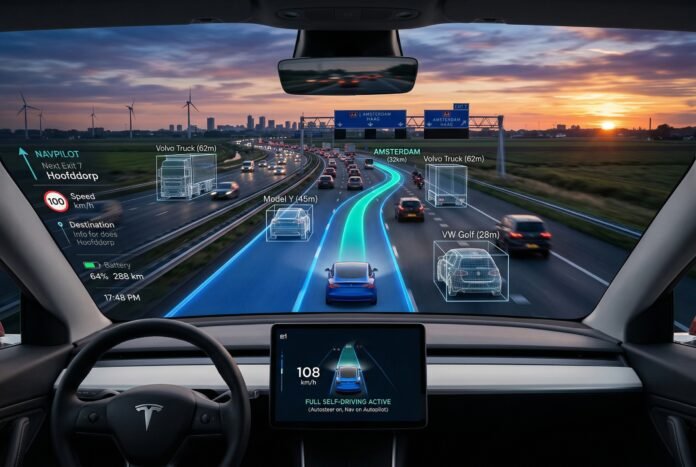
Tesla is Full Self-Driving just cleared its biggest regulatory hurdle yet — and it is not in America.
On April 10, 2026, Dutch regulators granted Tesla type approval for FSD Supervised under UN R-171 regulation. The Netherlands becomes the first European country to officially approve Tesla is driver-assist technology, opening the door for a broader European rollout as early as this summer.
This is not just another market entry. It is a breakthrough that could reshape the autonomous vehicle landscape across an entire continent.
The Approval: What Actually Happened
The Dutch vehicle authority RDW (Rijksdienst voor het Wegverkeer) issued a formal type approval for Tesla is Full Self-Driving Supervised system after more than 18 months of testing and regulatory review.
Key details:
- Approval falls under UN R-171 regulation for Driver Control Assistance Systems
- Valid only in the Netherlands initially
- Other EU member states can choose to recognize it nationally (not automatic)
- Tesla described the system as trained on billions of kilometers of real-world driving data
The RDW was careful to stress that FSD Supervised is a driver assistance system, not an autonomous or self-driving system. The driver must remain engaged and ready to take control at all times.
Why Europe Was the Hard Problem
Tesla has had FSD available in the US for years. Europe was always the tougher nut to crack.
The challenges:
Regulatory fragmentation. The US has federal standards with state-by-state variations. Europe has 27 different countries, each with their own interpretation of EU regulations, plus the UK doing its own thing post-Brexit.
Stricter safety standards. European regulators have historically taken a more cautious approach to autonomous driving. The burden of proof for safety is higher.
Different road environments. Narrow European streets. Roundabouts everywhere. Different signage. Different driving cultures. What works in Texas does not necessarily work in Tuscany.
Why the Netherlands Matters
The Dutch approval is not just symbolic. It is strategic.
The RDW is respected. The Netherlands vehicle authority is known for thorough, credible technical evaluations. Other EU regulators often look to RDW assessments when making their own decisions.
UN R-171 is the pathway. By getting approval under this United Nations regulation, Tesla has created a template that other countries can follow.
Tesla has a factory in Berlin. The company is European manufacturing hub is in Germany. Getting FSD approved in neighboring Netherlands creates pressure for German regulators to follow suit.
What This Means for Tesla is Ambitions
Elon Musk has been promising full self-driving for nearly a decade. This approval matters for several reasons:
Regulatory credibility. Getting through the RDW process proves Tesla can meet stringent third-party safety standards.
Revenue potential. Tesla charges up to 5,000 for FSD in the US. European customers have been unable to buy it. That is a massive untapped revenue stream now potentially unlocked.
Data advantage. Every kilometer driven in Europe improves the system. European roads, European signage, European driving patterns — all become training data.
Competitive positioning. While Tesla races toward Optimus production and autonomous driving, traditional automakers are still struggling to match Tesla is driver-assist capabilities.
The Bigger Picture: Autonomous Driving in Europe
This approval comes at a critical moment for autonomous vehicles globally.
The technology is maturing. Systems that were experimental five years ago are now robust enough for regulatory approval.
The regulatory frameworks are evolving. UN R-171 provides a standardized approach that multiple countries can adopt.
The economics are shifting. The 5 billion pouring into AI infrastructure includes massive investments in autonomous vehicle compute, sensors, and training data.
The Counter-Arguments: Reasons for Skepticism
Before declaring victory, it is worth noting the limitations:
Supervised is doing a lot of work. This is not full self-driving. The driver must remain engaged. The system can fail.
The approval is provisional and limited. Only the Netherlands. Only certain road types. This is a beachhead, not a conquest.
Other regulators may not follow. Just because the Dutch approved it does not mean Germany, France, or the UK will.
What Happens Next
Short term (2026): Tesla begins rolling out FSD Supervised in the Netherlands. Other EU countries watch closely. Germany likely follows within months.
Medium term (2027-2028): Broader European rollout if the Dutch deployment goes smoothly. UK makes its own decision post-Brexit.
Long term (2029+): True autonomous driving — no supervision required — becomes technically and legally feasible.
The Bottom Line
Tesla is FSD approval in the Netherlands is more than a regulatory checkbox. It is proof that autonomous driving technology is crossing the threshold from experimental to operational.
The road to full self-driving remains long. But the Dutch approval shows it is not infinite. Milestones are being reached. Barriers are falling.
For Tesla, it is a validation of years of investment in AI and neural networks. For the autonomous vehicle industry, it is a signal that European markets are opening.
The breakthrough happened in the Netherlands. But the implications are global.
Related Reading
Tesla is Put-Up-or-Shut-Up Year for Optimus Production — While Tesla pushes FSD forward, they are also racing to deliver humanoid robots.
NVIDIA is Physical AI Play — The AI infrastructure powering the next generation of autonomous systems
The 5 Billion Tech Deal Spree — The massive investment flowing into AI, including autonomous vehicle compute
AI is Second Wind — How AI is moving from demos to profitable deployment

