In a world where data has become humanity’s most precious resource, we face an ironic crisis: we generate more information than ever, yet our ability to preserve it has never been more fragile.
Magnetic tapes degrade within decades. Hard drives fail after a few years of use. Solid-state drives lose data if left unpowered. Even the vaunted “cloud” is ultimately just someone else’s computer—computers that require constant maintenance, electricity, and replacement.
Microsoft Research has spent years pursuing an answer that sounds almost mythical: a storage medium that could preserve digital information not for years or decades, but for millennia. A medium that requires no electricity to maintain, is impervious to water, heat, and electromagnetic interference, and stores data at densities that rival or exceed today’s best technologies.
That medium is glass. Not just any glass—borosilicate glass, the same material found in your kitchen cookware and oven doors. And in February 2026, Microsoft announced a breakthrough that brought this technology from laboratory curiosity to the threshold of commercial reality.
This is Project Silica.
The Crisis of Digital Preservation
To understand why Project Silica matters, we must first understand the scale of the problem it addresses. Humanity is generating data at a rate that defies comprehension. By some estimates, we create 2.5 quintillion bytes of data every single day. Every photo uploaded, every email sent, every sensor reading collected, every transaction recorded—it all accumulates into an ever-growing mountain of digital information.
But here’s the uncomfortable truth: most of this data is stored on media with shockingly short lifespans.
Magnetic tape, the workhorse of archival storage, typically lasts 10-30 years before degradation becomes a serious concern. Hard drives average 3-5 years of active use before failure rates spike. Solid-state drives, while more durable in operation, can lose data within months if left without power. Optical media like DVDs and Blu-rays promised longer lifespans but have proven vulnerable to disc rot and manufacturing defects.
The cloud, for all its convenience, doesn’t solve this problem—it merely obscures it. When you store data in Amazon S3, Microsoft Azure, or Google Cloud, you’re trusting that these companies will continuously migrate your data from aging hardware to new hardware, forever. It’s a process called “data refresh,” and it’s expensive, error-prone, and fundamentally unsustainable at the scale modern data generation demands.
Archivists and librarians have long understood this problem. The Library of Congress, the Internet Archive, and countless institutions worldwide face the nightmare of “digital dark age”—a future where vast swaths of human knowledge are lost not because we didn’t record them, but because we couldn’t preserve the media they were stored on.
This is the problem Project Silica was born to solve.
The Science of Writing in Glass
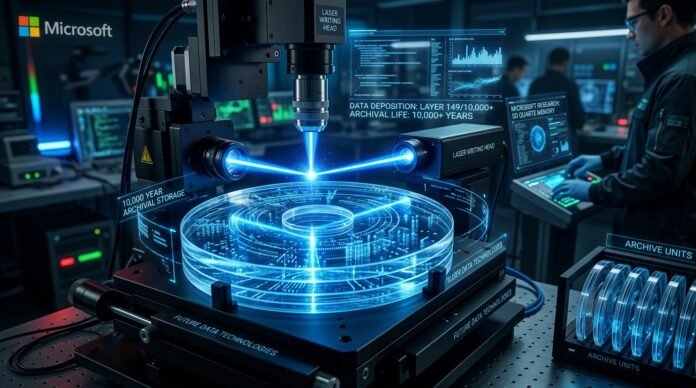
At its core, Project Silica represents a fundamentally different approach to data storage. Instead of encoding information in magnetic orientations (hard drives), electrical charges (flash memory), or dye layers (optical discs), Silica stores data by physically altering the structure of glass itself.
The technology relies on femtosecond lasers—lasers that emit pulses lasting just 10^-15 seconds, or one quadrillionth of a second. To put that in perspective, a femtosecond is to a second what a second is to about 32 million years. These lasers are so fast that they can deposit enormous energy into an incredibly small space without generating significant heat in the surrounding material.
When a femtosecond laser pulse is focused inside a piece of glass, it creates what’s called a “voxel”—a three-dimensional pixel. The intense energy of the laser pulse fundamentally alters the glass structure at that point, creating a tiny feature that can be read back later. By carefully controlling the laser’s position and polarization, Microsoft researchers can create voxels with different optical properties, effectively encoding binary data in three-dimensional space.
The result is a piece of glass that contains hundreds of layers of data, stacked vertically like floors in a skyscraper. A single 2mm-thin glass platter smaller than a DVD can store 4.8 to 7+ terabytes of data—densities exceeding one gigabit per cubic millimeter.
Reading this data back requires equally sophisticated technology. Silica uses polarization-sensitive microscopy—essentially, a system that shines light through the glass and analyzes how the polarization of that light changes as it passes through each voxel. Different voxel structures alter the light in different ways, allowing the system to distinguish between the binary states that represent data.
Critically, this reading process uses regular light at power levels far too low to modify the glass. This creates what Microsoft calls “true airgap by design”—it’s physically impossible to accidentally overwrite or modify data during the reading process. The storage medium is inherently immutable once written.
The Borosilicate Breakthrough
Project Silica has been under development at Microsoft Research for years, but the February 2026 announcement represented a genuine breakthrough. In a paper published in the prestigious journal Nature, Microsoft researchers revealed they had extended the technology beyond its original constraints in ways that fundamentally change its commercial viability.
The original Silica demonstrations used fused silica glass—a highly pure form of glass with excellent optical properties, but also expensive and difficult to manufacture. Fused silica is available from only a handful of suppliers worldwide, and its cost would make large-scale deployment economically challenging.
The breakthrough was adapting the technology to work with borosilicate glass—the same material used in Pyrex cookware, laboratory glassware, and countless industrial applications. Borosilicate is cheap, widely available, and manufactured by dozens of companies worldwide. If Silica could work with borosilicate, it could work at scale.
Achieving this required solving several fundamental scientific challenges. Borosilicate has different optical properties than fused silica, meaning the laser parameters and reading systems had to be completely rethought. The Microsoft team developed what they call the “phase voxel” method—a new approach to creating data voxels that works specifically with borosilicate’s properties.
The phase voxel method offers additional advantages beyond material compatibility. It requires only a single laser pulse to write each voxel, significantly reducing writing complexity and cost. The reading system was also simplified—from requiring three or four cameras in earlier designs to needing just one camera in the new system. These simplifications cascade through the entire system, making manufacturing easier, reducing calibration requirements, and enabling faster parallel writing operations.
Perhaps most importantly, the researchers developed techniques for accelerated aging tests that suggest the data should remain intact for at least 10,000 years. This isn’t theoretical projection—it’s based on subjecting written glass samples to extreme conditions (high temperatures, radiation, chemical exposure) and measuring how the data voxels degrade, then extrapolating backward to normal storage conditions.
Ten thousand years. That’s longer than human civilization has existed in its current form. It’s a timescale that challenges our intuition about permanence.
The Flight Simulator Proof
Technical specifications are impressive, but what matters is whether the technology works in practice. Microsoft provided a compelling demonstration: they wrote the entire map data for Microsoft Flight Simulator onto a piece of glass.
Flight Simulator is famous for its massive dataset—petabytes of satellite imagery, terrain data, 3D models of cities and airports, weather patterns, and navigation information. It’s exactly the kind of large, complex dataset that benefits from long-term archival storage.
The demonstration served multiple purposes. It proved that Silica could handle real-world data volumes and complexity. It showed that the reading systems could reliably extract data after writing. And it provided a tangible example of the kind of information that might be preserved using this technology—cultural heritage, scientific data, historical records, creative works.
Imagine, for a moment, what this means for preservation. The Library of Congress could store its entire digital collection on glass platters that would outlast the institution itself. Museums could preserve high-resolution scans of artworks with guaranteed fidelity for future generations. Scientific datasets—climate records, genomic sequences, astronomical observations—could be archived with confidence that they would remain accessible not just for decades, but for millennia.
The Architecture of Immortality
Project Silica isn’t just about the storage medium—it’s about rethinking the entire architecture of archival storage. Microsoft has designed a complete system around the glass platters that addresses the practical challenges of managing massive amounts of data over indefinite timescales.
The storage system uses robotic retrieval mechanisms similar to tape libraries, but with important differences. Because glass platters don’t require specific environmental conditions (beyond reasonable temperature and humidity), the storage library can be simpler and more energy-efficient than tape libraries. The platters can be stored in ordinary warehouse conditions, retrieved by robots when needed, and read using the optical microscopy system.
This design creates what might be called “cold storage taken to its logical extreme.” Traditional cold storage—tape archives, for instance—still requires climate-controlled facilities, periodic data refresh, and significant energy consumption for the storage environment. Silica glass requires none of this. Once written, a glass platter can sit on a shelf in ambient conditions for thousands of years without degradation.
The energy implications are profound. Data centers currently consume about 1% of global electricity, and that percentage is growing as data generation accelerates. Much of this energy goes not to computation, but to storage—spinning hard drives, cooling facilities, powering tape libraries. A storage medium that requires zero energy to maintain would represent a fundamental shift in the economics and environmental impact of data preservation.
The Competition and the Market
Microsoft is not alone in pursuing long-term archival storage. The market has seen growing interest in technologies that promise to solve the durability problem through different approaches.
DNA storage, championed by companies like Catalog and Twist Bioscience, encodes data in synthetic DNA molecules. DNA offers incredible density—a single gram could theoretically store all the world’s data—and stability over centuries if properly preserved. However, DNA storage currently faces challenges with writing speed, reading accuracy, and cost that have limited it to specialized applications.
Cerabyte, a startup that has emerged as a direct competitor to Silica, is also developing glass-based storage using different technical approaches. Their system uses ceramic-coated glass and different writing mechanisms, claiming advantages in write speed and cost.
Traditional storage vendors haven’t stood still either. Tape manufacturers continue to improve their products, with modern LTO (Linear Tape-Open) cartridges offering 18+ terabytes of capacity and improved durability. New optical disc formats promise longer lifespans than previous generations.
Microsoft’s bet is that Silica’s combination of extreme durability, high density, and zero-maintenance operation will prove compelling for specific use cases: long-term archival of irreplaceable data, compliance storage for regulated industries, and preservation of cultural and scientific heritage. The company has been careful to note that Silica is not intended to replace active storage—it’s designed for data that needs to be preserved, not data that needs to be constantly accessed.
The Implications of Immortal Data
The development of truly long-term storage raises profound questions that extend beyond technology into ethics, law, and society.
If data can last 10,000 years, what should we preserve? Our current approach to digital preservation is largely reactive—we save what seems important now, often without systematic consideration of what future generations might value or need. A technology like Silica forces us to think more carefully about curation and selection.
There are privacy implications as well. Data that lasts forever includes data that perhaps shouldn’t last forever—personal information, embarrassing moments, records of youthful indiscretions. Right to be forgotten laws in Europe and elsewhere assume that data can eventually be deleted. What happens when deletion is technically impossible?
There are also questions of access and interpretation. A glass platter might preserve data for millennia, but will future generations have the technology to read it? Microsoft is aware of this challenge and has discussed the need to preserve not just the data, but the knowledge of how to access it—documentation, specifications, perhaps even working reading devices stored alongside the data they preserve.
These are not new questions—archivists have grappled with them for centuries as they preserved manuscripts, scrolls, and printed books. But digital preservation adds new dimensions. A medieval manuscript can be read by anyone who knows the language, regardless of whether they understand how it was made. Digital data requires both the storage medium and the technical infrastructure to interpret it.
The Road Ahead
As of early 2026, Project Silica remains in the research phase. Microsoft has not announced commercial availability or pricing, and the technology requires further development before it can be deployed at scale.
The challenges that remain are primarily engineering and manufacturing rather than fundamental science. How do you build femtosecond laser writing systems that are reliable, cost-effective, and capable of operating continuously in production environments? How do you design robotic retrieval systems that can handle fragile glass platters without damage? How do you integrate Silica storage into existing data center workflows and software stacks?
These are solvable problems, but they require time and investment. Microsoft’s history suggests they are willing to make such investments when they see strategic value—the company’s development of custom AI chips, HoloLens, and other research projects demonstrate a willingness to pursue long-term technical bets.
The strategic value of Silica, if it succeeds, would be substantial. Azure could offer archival storage services with durability guarantees unmatched by any competitor. Microsoft could position itself as the guardian of humanity’s digital heritage—a role with both commercial and reputational benefits.
More broadly, successful development of glass storage would represent a milestone in humanity’s relationship with information. For the first time, we would have a storage technology that approaches the durability of the information it preserves. Stone inscriptions have lasted millennia, but at low density and with great difficulty. Books can preserve knowledge for centuries, but require specific conditions and careful handling. Digital storage has offered unprecedented capacity and accessibility, but at the cost of fragility.
Glass storage promises to combine the best of these worlds: the density and accessibility of digital, with the durability of stone. It’s a promise that, if fulfilled, could change how we think about preservation, memory, and our obligation to the future.
Conclusion: Writing for the Ages
Project Silica sits at the intersection of multiple trends: the exponential growth of data, the growing recognition of digital fragility, advances in laser and optical technology, and Microsoft’s strategic positioning in cloud computing. It’s a project that would have seemed like science fiction just decades ago, yet now stands on the threshold of practical reality.
The technology is not without challenges and uncertainties. Competition from other approaches, engineering hurdles in manufacturing, questions about cost and scalability—all of these could delay or derail commercial deployment. The fundamental science is sound, but the path from laboratory demonstration to widespread adoption is rarely straightforward.
Yet even as a research project, Silica serves an important purpose. It reminds us that the problems we face in digital preservation are solvable, given sufficient will and investment. It demonstrates that thinking on timescales of millennia, while unusual in our fast-paced technological culture, is both possible and valuable. And it offers a vision of a future where humanity’s accumulated knowledge—its science, its art, its history—might be preserved not for decades or centuries, but for geological time.
In a world increasingly defined by ephemeral digital experiences—stories that disappear after 24 hours, tweets that vanish into the feed, content designed for immediate consumption and rapid obsolescence—there is something profoundly hopeful about a technology designed for permanence. Project Silica represents a bet that some things are worth preserving, that the future matters, and that we have an obligation to ensure that what we create and discover doesn’t vanish with the next hardware refresh cycle.
The 10,000-year hard drive is coming. What we choose to write on it will define what the future knows of us.
Sources
- Microsoft Research: Project Silica advances in glass storage technology (Nature publication, February 2026)
- Ars Technica: Microsoft’s new 10,000-year data storage medium: glass
- IEEE Spectrum: Microsoft’s Project Silica develops glass data storage
- Microsoft Unlocked: Sealed in glass
- Help Net Security: Microsoft signals breakthrough in data storage
- Blocks and Files: Project Silica’s glass storage archive tech progress
Follow @tsnmediahub on X for breaking AI news as it happens.
Follow on X