
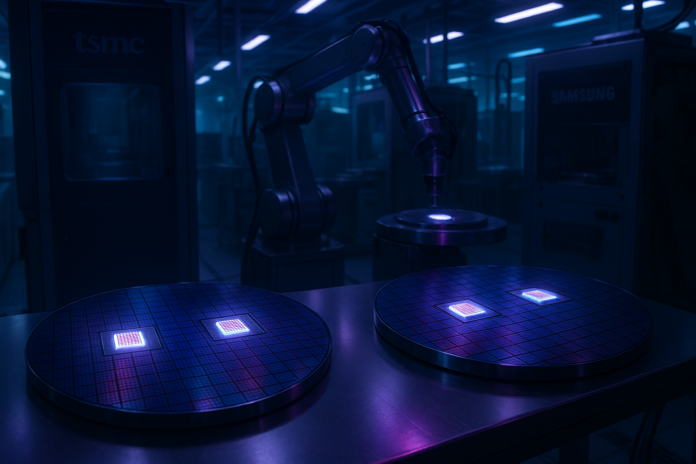
TSMC’s 2nm Crisis: The Chip War That Could Reshape AI
TSMC, the world’s most advanced chip manufacturer, just hit a wall. Their 2nm production lines—where the most powerful AI chips are made—are fully booked through 2028. For NVIDIA, Google, Amazon, and every company building AI accelerators, this isn’t a minor inconvenience. It’s an existential constraint.
The bottleneck creates an opening for Samsung, TSMC’s perennial also-ran. With 7% market share to TSMC’s 72%, Samsung has never been a serious threat at the leading edge. Until now. When customers can’t get capacity from the market leader, they have no choice but to consider alternatives.
This isn’t just a supply chain story. It’s about who controls the infrastructure powering artificial intelligence—and what happens when that control becomes a constraint.
The 2nm Bottleneck
What “Fully Booked Through 2028” Means
TSMC’s 2nm manufacturing capacity—every wafer, every production slot, every tool—is committed for the next four years. Customers wanting to build chips on this node face three options:
- Book years in advance—commit to production schedules far into the future
- Accept delays—wait until capacity opens, missing market windows
- Go to Samsung—the only other foundry with viable 2nm technology
For AI chip companies, none of these options are attractive. But the third—Samsung—represents a calculated risk that some are now willing to take.
Why 2nm Specifically Matters
Not all chip manufacturing nodes are created equal. Each generation—7nm, 5nm, 3nm, 2nm—represents a leap in what’s possible. The numbers refer to transistor dimensions, but the implications extend far beyond size.
At 2nm:
- Speed increases: Transistors switch faster, enabling higher clock rates
- Power efficiency improves: Less energy per computation, critical for data center economics
- Density jumps: More transistors per square millimeter, enabling more complex designs
For AI chips—GPUs, TPUs, custom accelerators—these improvements compound. Faster training. Lower operating costs. More capable models. The difference between 3nm and 2nm isn’t incremental; it’s the difference between leading and following.
The AI Chip Imperative
Modern AI systems require massive computational resources. Training GPT-4-class models demands thousands of specialized chips running for weeks. Inference at scale requires efficient, high-throughput processors. Both depend on the most advanced manufacturing available.
As one industry analyst noted: “The most advanced chips now need the best manufacturing nodes, and 2nm is where speed, power efficiency, and transistor density improve enough to matter for training and running large AI systems.”
This isn’t about marginal gains. At the scale AI operates, manufacturing advantages translate directly into competitive advantages. The company with better chips trains models faster, serves customers cheaper, and pushes the frontier further.
Samsung’s Moment
The Market Share Gap
| Foundry | Market Share | Leading Edge Status |
|---|---|---|
| TSMC | 72% | Dominant at 3nm, 2nm |
| Samsung | 7% | Viable at 3nm, developing 2nm |
| Intel | <5% | Catching up at Intel 18A |
| Others | ~16% | Trailing edge only |
Samsung’s 7% share understates its importance. The company is one of only three foundries globally capable of leading-edge manufacturing. But “capable” and “competitive” are different things. Until now, Samsung’s advanced nodes lagged TSMC in performance, yield, and customer confidence.
The Opportunity Window
TSMC’s capacity constraint creates demand Samsung has never had before. Customers who would never have considered Samsung—NVIDIA, Google, hyperscalers with exacting standards—now face a choice: wait for TSMC or try Samsung.
This is Samsung’s chance to prove itself. If the company can deliver:
- Acceptable yields (percentage of functional chips per wafer)
- Competitive performance (speed, power, density)
- Reliable delivery (on time, at scale)
Then it becomes a viable alternative, not just an emergency backup.
The Yield Challenge
Manufacturing semiconductors at 2nm is extraordinarily difficult. Billions of transistors must be patterned with atomic precision. Defects measured in atoms can ruin chips. The percentage of working chips per wafer—the yield—determines economic viability.
TSMC’s advantage has always been yield. The company consistently achieves higher percentages of working chips than competitors. This translates to lower costs per functional chip, faster time to market, and predictable production schedules.
Samsung’s challenge: proving its 2nm yields are “stable enough for the biggest AI chips.” The biggest AI chips—NVIDIA’s H100 successors, Google’s TPUs, custom hyperscaler designs—are also the most complex. They stress manufacturing processes to their limits. If Samsung can produce these reliably, it can produce anything.
The Technical Landscape
GAA vs FinFET
Beyond market dynamics, a technical transition complicates the foundry competition. Samsung and TSMC are taking different approaches to transistor architecture at 2nm:
TSMC: Evolving FinFET (Fin Field-Effect Transistor) technology, the industry standard for the past decade. Proven, predictable, incremental improvement.
Samsung: Adopting GAA (Gate-All-Around) transistors at 2nm. Potentially superior performance—better control of current flow, reduced leakage—but less proven manufacturing maturity. Samsung already uses GAA at 3nm, giving it experience, but 2nm GAA is another step up in complexity.
This divergence matters. Customers familiar with FinFET behavior face uncertainty with GAA. Different electrical characteristics, different design rules, different failure modes. The learning curve is real.
The ASML Factor
Both TSMC and Samsung depend on ASML, the Dutch company that makes the only machines capable of 2nm patterning—EUV lithography systems costing $200+ million each. ASML’s production capacity constrains both foundries.
But TSMC’s scale gives it priority. The company orders more machines, gets earlier delivery, maintains manufacturing leadership. Samsung’s challenge isn’t just technical—it’s securing the equipment needed to compete.
If Samsung can’t get enough EUV scanners, it can’t expand capacity regardless of customer demand. This dependency on a single equipment supplier concentrates risk across the entire industry.
Who’s Affected
NVIDIA
The AI chip leader depends on TSMC for its most advanced GPUs. The H100, H200, and upcoming Blackwell architecture all use TSMC’s leading nodes. NVIDIA has no viable alternative at 2nm—Samsung’s technology isn’t qualified for these designs, and switching would require massive re-engineering.
If TSMC can’t deliver capacity, NVIDIA can’t deliver chips. The company’s market dominance depends on manufacturing access. This dependency creates vulnerability that competitors—AMD, custom hyperscaler silicon—might exploit.
Google (TPU)
Google’s Tensor Processing Units, custom-designed for AI workloads, also rely on TSMC. The company has more flexibility than NVIDIA—TPU designs can be modified more easily than GPUs—but still faces constraints.
Google’s scale gives it negotiating power with TSMC. But if capacity is truly exhausted, even the biggest customers can’t get unlimited wafers. Google may need to balance TPU production across nodes or accept Samsung for less critical designs.
Amazon (Trainium/Inferentia)
Amazon’s custom AI chips represent a different case. Inferentia (inference) and Trainium (training) are newer designs, less locked into specific manufacturing processes. Amazon has reportedly already engaged with Samsung for some production.
Cost sensitivity makes Amazon a natural Samsung customer. If Samsung offers competitive pricing—likely, given its need to win share—Amazon might diversify aggressively. This would validate Samsung’s technology and encourage other customers to follow.
AMD
AMD has historically been more willing than NVIDIA to multi-source manufacturing. The company’s experience with GlobalFoundries (before that foundry exited leading-edge competition) taught lessons about supply chain diversification.
AMD’s MI300 AI accelerators already use multiple chiplets, some manufactured by different foundries. This architecture might make AMD more agile in responding to TSMC constraints. The company could shift production to Samsung faster than integrated-chip competitors.
Startups and Custom Silicon
The companies most affected may be AI chip startups and hyperscalers building custom silicon. Without the scale to command TSMC priority, these customers already struggle for capacity. TSMC’s 2nm constraint pushes them toward Samsung by default.
For some, this is opportunity. Samsung, hungry for customers, may offer better terms, more hand-holding, faster ramp-up than TSMC’s bureaucratic processes. The foundry relationship matters as much as the technology.
Strategic Implications
Supply Chain Resilience
The TSMC constraint highlights concentration risk. One company, however capable, controlling 72% of advanced manufacturing creates systemic vulnerability. Geopolitical tensions, natural disasters, or operational failures could disrupt global AI development.
Samsung’s emergence as a viable alternative—if it succeeds—reduces this concentration. A dual-foundry world is more resilient than a single-foundry world. Customers gain leverage. Competition drives innovation.
But this resilience depends on Samsung actually delivering. If yields disappoint, if quality lags, if schedules slip, customers will retreat to TSMC despite constraints. The window for Samsung to prove itself is narrow.
Geopolitical Dimensions
TSMC is Taiwanese. Samsung is Korean. Both are US allies, but Taiwan’s geopolitical situation—pressures from China, questions about long-term stability—makes diversification strategically attractive.
The US CHIPS Act, allocating billions to domestic semiconductor manufacturing, reflects these concerns. Intel’s foundry ambitions, government subsidies for TSMC and Samsung fabs in Arizona and Texas—all aim to reduce geographic concentration.
But fabs take years to build. The 2nm constraint is happening now. For the next several years, TSMC Taiwan and Samsung Korea remain the only options. Geopolitical risk persists.
Pricing Power
Scarcity creates pricing power. TSMC, with more demand than capacity, can charge premium prices. This flows through to AI chip costs, data center economics, cloud pricing. The entire AI value chain feels the pressure.
Samsung’s entry, if successful, moderates this dynamic. Competition constrains pricing. Customers gain negotiating leverage. The economics of AI improve.
But this requires Samsung to actually compete—not just exist as a theoretical alternative, but deliver comparable technology at acceptable yields. The gap between theory and practice is where foundry battles are won or lost.
The Timeline
Near Term (2024-2025)
TSMC works to expand 2nm capacity, but equipment constraints limit how fast. Samsung captures overflow demand, customers needing production now who can’t wait for TSMC slots. Yield learning continues at both foundries.
NVIDIA and other TSMC-dependent customers face tough choices: accept delays, redesign for older nodes, or take the Samsung risk. Most will wait for TSMC, but some—especially cost-sensitive designs—will try Samsung.
Medium Term (2026-2027)
Samsung’s 2nm yields stabilize (or don’t). If successful, market share shifts measurably. If yields disappoint, customers retreat to TSMC, accepting constraints rather than risking production. The foundry hierarchy either loosens or solidifies.
TSMC responds to competition, accelerating capacity expansion, improving yields, maintaining technology leadership. The company has resources and motivation to defend its position.
Long Term (2028+)
Dual-sourcing becomes standard practice. Major AI chip companies qualify both foundries, allocate production based on capacity, pricing, and performance. TSMC maintains leadership but faces real competition. Samsung closes the gap, though perhaps not completely.
New entrants—Intel’s foundry services, potentially Chinese foundries if technology sanctions ease—add complexity. The foundry landscape diversifies beyond the TSMC-Samsung duopoly.
What to Watch
Several indicators will signal how this competition evolves:
Samsung Yield Reports: Unofficial industry chatter, customer confidence, eventually official announcements. Yield is everything in foundry competition.
Customer Wins: Which AI chip companies publicly commit to Samsung 2nm? NVIDIA would be the prize, but AMD, Google, Amazon, or major startups would validate Samsung’s technology.
TSMC Response: Capacity expansion announcements, pricing adjustments, customer accommodation. How TSMC responds to competition reveals its assessment of the threat.
Technology Roadmaps: 1.4nm, 1nm, and beyond. Which foundry maintains leadership at each node? The 2nm battle is one chapter in a longer competition.
Conclusion
TSMC’s 2nm capacity constraint is more than a supply chain hiccup. It’s a structural shift that could reshape semiconductor manufacturing and, by extension, artificial intelligence development.
For years, TSMC’s dominance seemed unchallengeable. The company’s manufacturing prowess, customer relationships, and scale created moats competitors couldn’t cross. But moats fill in when demand exceeds capacity. Customers who would never have considered alternatives now face choices they don’t want to make.
Samsung’s opportunity is real but not guaranteed. The company must prove its 2nm technology at scale, delivering yields and quality that satisfy the most demanding customers in the world. Success means becoming a viable alternative. Failure means reinforcing TSMC’s dominance, even with constraints.
The stakes extend beyond market share. Who controls advanced chip manufacturing influences who controls AI. The concentration of this capability in East Asia—Taiwan and Korea—creates geopolitical vulnerabilities that governments and companies are only beginning to address.
The 2nm battle is happening now, in cleanrooms and conference rooms, in yield reports and earnings calls. The outcome will shape the infrastructure of artificial intelligence for the next decade.
TSMC built the AI era on its manufacturing excellence. Whether it maintains that dominance, or shares the stage with Samsung, will be decided in the next few years. The chips—literally—are still being made.
Related: Learn about the 800G+ optical modules connecting these chips, or explore how AI systems actually work.
Sources
- Chosun Ilbo – “TSMC 2nm capacity fully booked through 2028”
- Semiconductor Industry Association – Foundry Market Report
- ASML Investor Relations – EUV Lithography Systems
- TSMC Technology Symposium 2026
- Samsung Foundry Forum – Advanced Process Roadmap

