
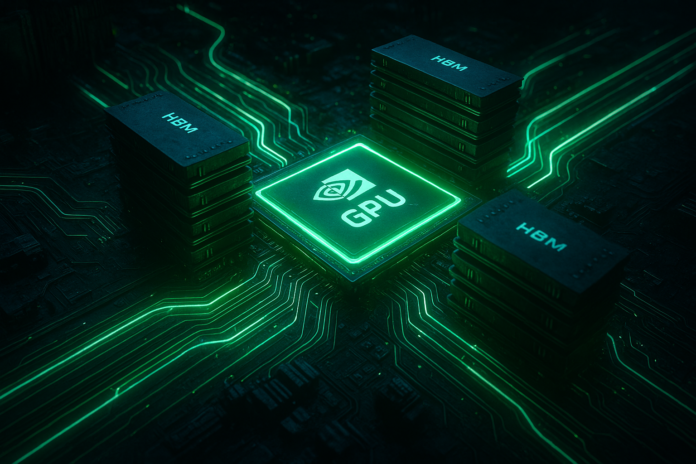
Nvidia’s latest AI chip requires 288GB of RAM. That’s +800% more memory than a high-end gaming PC. +2,300% more than a flagship smartphone. And it’s just the beginning.
While the AI industry celebrates open source software and democratised models, a quiet consolidation is happening at the hardware layer — and almost nobody is talking about it.
The Numbers
Nvidia’s Rubin architecture — the successor to Blackwell — requires 288GB of High Bandwidth Memory (HBM) per chip configuration. Compare that to:
- A high-end gaming PC: ~32GB RAM (288GB is +800% more)
- A flagship smartphone: ~12GB RAM (288GB is +2,300% more)
- Nvidia’s H100 (launched 2022): ~80GB HBM2e
Each generation of AI chip doesn’t just require more memory — it requires exponentially more memory. The scaling curve isn’t linear. It’s a wall that gets taller every two years.
What Is HBM and Why Does It Matter?
High Bandwidth Memory (HBM) is a specialised type of RAM designed to feed data to AI chips fast enough that the chip isn’t sitting idle waiting for data. Regular DRAM is too slow. HBM is stacked vertically on the chip package, providing massive throughput — but it’s extraordinarily expensive and difficult to manufacture.
Here’s the problem: two companies control approximately 90% of global HBM supply — Samsung and SK Hynix, both South Korean. A third player, Micron, is scaling up but remains a distant third.
Every AI chip Nvidia sells is dependent on memory that two companies make. As demand for HBM grows exponentially with each chip generation, that dependency becomes a structural vulnerability.
Who Can Actually Afford This?
A single Nvidia H100 costs approximately $25,000–$40,000. Rubin-class systems, with their vastly higher memory requirements, will cost significantly more. At that price point, the realistic buyers are:
- Microsoft (Azure)
- Google (GCP)
- Amazon (AWS)
- Meta
- A handful of sovereign wealth funds and national AI projects
The open source software layer is won. Llama, Mistral, DeepSeek — anyone can run these models. But running them at scale requires hardware that only a few organisations on Earth can afford to deploy.
The gatekeepers didn’t disappear. They moved up a layer.
The Pattern Playing Out
This follows a pattern we’ve been tracking across multiple sectors. Solutions don’t eliminate constraints — they shift bottlenecks to the next layer.
- Software layer: Open source won. Anyone can access state-of-the-art models.
- Chip layer: Nvidia dominates. Taiwan (TSMC) manufactures 90%+ of leading-edge chips.
- Memory layer: Samsung and SK Hynix control HBM. Constraint tightens each generation.
- Energy layer: AI data centres consume more power than many countries. China generates 33% of global electricity. The US is scrambling to catch up.
- Space layer: SpaceX’s orbital data centre ambitions suggest infrastructure escaping terrestrial constraints entirely.
Each time one layer opens up, the next one tightens. The AI agents everyone can now build for free are running on infrastructure that costs millions per rack to operate.
What This Means for Crypto and Decentralisation
DePIN (Decentralised Physical Infrastructure Networks) exists precisely because this centralisation is visible and predictable. Projects building distributed GPU networks, distributed compute, and distributed storage are betting that the infrastructure layer can be decentralised the same way software was.
The challenge: HBM chips aren’t something a distributed network of consumer hardware can replicate. A thousand gaming PCs cannot do what one H100 does for transformer model inference. The specialisation gap is widening, not narrowing.
That’s the tension at the heart of the AI infrastructure story: open at the top, increasingly concentrated at the bottom. The 288GB memory requirement is just the latest data point in a trend that has been building for years.
The Investment Signal
If the infrastructure constraint thesis holds, the clearest investment signals are:
- HBM manufacturers: SK Hynix (KRX: 000660), Samsung (KRX: 005930), Micron (NASDAQ: MU) — whoever scales HBM supply controls the AI bottleneck
- Power infrastructure: AI data centres need more energy each generation — utilities, nuclear, and energy infrastructure benefit
- Nvidia (NASDAQ: NVDA): Still the only viable supplier of leading-edge AI accelerators at scale
The constraint is real. The concentration is real. And it’s getting more pronounced, not less, with every chip generation.
Follow @tsnmediahub for daily AI and crypto signal analysis. Signal sourced from @KobeisiLetter.
