
The Cup and Handle Pattern: A Complete Trader’s Guide
The cup and handle pattern is one of the most reliable bullish continuation patterns in technical analysis. First identified by William O’Neil in 1988, this formation has helped traders spot some of the biggest winners in stock and crypto markets. Here’s everything you need to know to trade it effectively.
What Is the Cup and Handle Pattern?
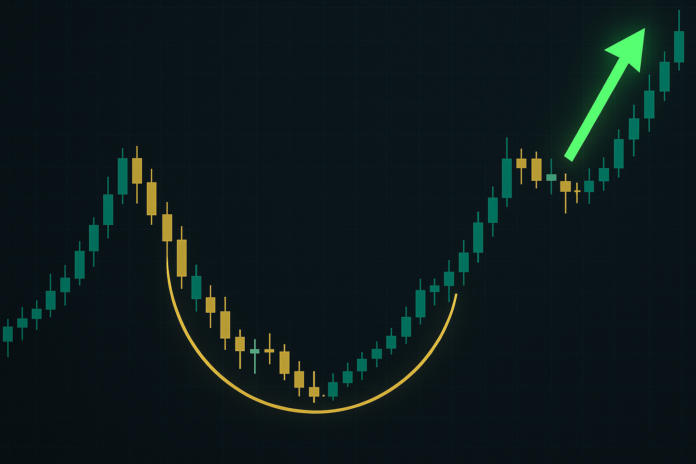
The cup and handle is a bullish continuation pattern that forms after a significant uptrend. It signals a brief consolidation period before the previous uptrend resumes—often with explosive momentum.
Visual Description
Imagine a coffee cup viewed from the side:
- The Cup: A U-shaped or rounded bottom formation that looks like a bowl or rounding bottom
- The Handle: A small downward drift or consolidation that forms on the right side of the cup
- The Breakout: Price breaks above the handle’s resistance, triggering the buy signal
The pattern resembles a tea cup with a small handle, hence the name.
Pattern Structure and Formation
The Cup Formation
Duration: 7 weeks to 65 weeks (ideal: 3-6 months)
Depth: 12% to 33% retracement from the high (deeper cups in crypto are acceptable)
Shape Characteristics:
- Rounded, U-shaped bottom (not V-shaped)
- Symmetrical left and right sides
- Volume should decrease during the cup formation
- Volume increases as price approaches the old high
Key Rules:
- The cup should form after a prior uptrend of at least 30%
- The bottom of the cup should not retrace more than 50% of the prior advance
- Sharp V-shaped bottoms are less reliable than rounded formations
The Handle Formation
Duration: 1 week to 4 weeks (ideal: 1-2 weeks)
Depth: 5% to 15% pullback from the cup’s right rim
Shape Characteristics:
- Small downward drift or sideways consolidation
- Forms in the upper half of the cup (never below 50% of cup depth)
- Lower volume than the cup formation
- Tight price action with reduced volatility
Key Rules:
- The handle must form in the upper half of the cup pattern
- A handle that drops into the lower half of the cup is invalid
- The handle should slope downward or move sideways (not upward)
Volume Profile
Ideal Volume Pattern
During Cup Formation:
- High volume at the start of the decline (left side)
- Decreasing volume as the cup bottom forms
- Increasing volume as price rises up the right side
During Handle Formation:
- Lower volume compared to the cup
- Tight, quiet trading action
- Volume dries up significantly
At Breakout:
- Volume should surge 50% above average
- Heavy institutional accumulation
- Confirms pattern validity
Entry and Exit Strategies
Entry Points
Primary Entry: The Breakout
- Buy when price breaks above the handle’s resistance
- Entry trigger: Close above the highest point of the handle
- Volume confirmation required (50%+ above average)
Alternative Entry: The Handle Low
- Aggressive traders can enter near handle support
- Risk: Pattern may fail to complete
- Reward: Better risk-reward ratio if pattern completes
Pyramiding Entry:
- Initial position at breakout
- Add on first pullback to the breakout level
- Second add on new highs
Stop Loss Placement
Conservative Stop: Below the handle low
- Risk: Pattern failure
- Typical placement: 5-8% below entry
Aggressive Stop: Below the cup’s right side
- For wider stops in volatile markets
- Typical placement: 10-15% below entry
Trailing Stop: Below the 20-day or 50-day moving average
- As trend develops, trail with key moving average
- Locks in profits while allowing room for normal corrections
Profit Targets
Measured Move Target:
- Measure depth of the cup (from rim to bottom)
- Add that distance to the breakout point
- Example: $100 rim, $80 bottom = $20 cup depth → $120 target
Fibonacci Extensions:
- 1.618 extension of the cup depth
- 2.618 extension for extended moves
Previous Resistance Levels:
- Look for overhead supply zones
- Round numbers and psychological levels
Pattern Variations
The High-Tight Flag Cup
- Extremely tight, shallow cup (8-12% depth)
- Forms after a powerful initial move
- Handle is very brief (3-5 days)
- Most bullish variation
- Often seen in crypto and growth stocks
The Deep Cup
- 30-50% retracement (more common in crypto)
- Longer formation period (6+ months)
- Requires more patience but can yield larger moves
- Must still have rounded bottom, not V-shaped
The Saucer With Handle
- Very shallow cup (10-15% depth)
- Extremely long formation (12+ months)
- Handle forms over weeks
- Seen in large-cap stocks and Bitcoin
Crypto-Specific Considerations
Adjustments for Crypto Markets
Deeper Cups Are Acceptable:
- 30-50% retracements are normal in crypto
- Volatility is higher than traditional markets
- Pattern still valid if formation is rounded
Shorter Timeframes:
- Crypto moves faster
- Cups can form in 4-8 weeks
- Handles may last only days
Volume Patterns:
- 24/7 trading affects volume analysis
- Weekend volume often lower
- Use 7-day or 30-day average volume
Leverage Considerations:
- Crypto leverage amplifies both gains and losses
- Tighter stops required when using leverage
- Position sizing critical
Common Mistakes to Avoid
Pattern Recognition Errors
V-Shaped Bottoms:
- Sharp drops and recoveries lack consolidation
- Less reliable than rounded bottoms
- Often fail at breakout
Handles That Are Too Deep:
- Handle dropping into lower half of cup
- Invalidates the pattern
- Shows weakness, not consolidation
Cups Forming in Downtrends:
- Pattern requires prior uptrend
- Bottom-fishing cups often fail
- Context matters
Trading Mistakes
Anticipating the Breakout:
- Entering before handle completes
- Pattern may never break out
- Wait for confirmation
Ignoring Volume:
- Breakouts on low volume often fail
- Volume confirms institutional interest
- Don’t trade volume-less breakouts
Moving Stops Too Tight:
- Normal handle volatility stops out traders
- Give pattern room to develop
- Use proper position sizing
Real-World Examples
Bitcoin 2020-2021
Bitcoin formed a classic cup and handle from August 2020 to February 2021:
- Cup depth: ~25% ($12,000 to $9,000)
- Handle duration: 3 weeks
- Breakout: February 2021 above $42,000
- Measured target: ~$65,000 (achieved)
Apple 2020
Apple’s post-split formation:
- Cup formed over 4 months
- Handle lasted 10 days
- Breakout led to 40% gain in 3 months
Ethereum 2023
ETH’s consolidation pattern:
- Deep cup (35% retracement)
- Brief 1-week handle
- Breakout resulted in 60% move
Risk Management Framework
Position Sizing
The 2% Rule:
- Never risk more than 2% of portfolio on single trade
- Calculate position size based on stop distance
- Example: $100k portfolio, 5% stop = $40,000 position
Volatility Adjustment:
- Reduce size in high-volatility environments
- Increase size in confirmed uptrends
- Crypto requires 30-50% smaller positions than stocks
Portfolio Considerations
Correlation Risk:
- Don’t hold multiple cup and handle patterns in same sector
- Crypto patterns often move together
- Diversify across uncorrelated assets
Market Environment:
- Patterns more reliable in bull markets
- Reduce exposure in bear markets
- Increase cash during distribution phases
Tools and Indicators
Charting Platforms
Recommended Features:
- Volume profile analysis
- Moving average overlays
- Fibonacci retracement tools
- Pattern recognition alerts
Popular Platforms:
- TradingView (best for crypto)
- ThinkorSwim (stocks)
- Coinigy (crypto-specific)
Complementary Indicators
Moving Averages:
- 20-day EMA for short-term trend
- 50-day SMA for intermediate trend
- Price above both = bullish alignment
Relative Strength:
- Compare to market index or BTC
- Leading stocks/assets make best cup and handles
- Lagging patterns often fail
Volume Indicators:
- On-Balance Volume (OBV)
- Volume Moving Average
- Confirm accumulation during cup formation
Advanced Techniques
Multiple Timeframe Analysis
Weekly Chart:
- Identify major cup and handle patterns
- Determine primary trend direction
- Set macro targets
Daily Chart:
- Fine-tune entry and exit points
- Monitor handle formation
- Manage position actively
4-Hour Chart (Crypto):
- Precise entry timing
- Intraday handle analysis
- Tight stop placement
Confluence Trading
Combine With:
- Support/resistance levels
- Moving average alignments
- Fibonacci retracements
- Volume profile nodes
Example Setup:
- Cup and handle breakout
- At 0.618 Fibonacci extension
- Above 20-day and 50-day MAs
- With volume 2x average
Key Takeaways
- Patience Required: The best cup and handles take time to form. Rushed patterns often fail.
- Volume Is Critical: Breakouts without volume confirmation have lower success rates.
- Handle Location Matters: Handles must form in the upper half of the cup. Lower handles invalidate the pattern.
- Rounded Bottoms Win: U-shaped cups outperform V-shaped formations consistently.
- Crypto Adaptations: Deeper cups and shorter timeframes are acceptable in crypto markets.
- Risk Management First: Never risk more than 2% of portfolio. Proper position sizing is essential.
- Context Matters: Patterns work best in bull markets with strong sector trends.
Related Reading
- The Rising Wedge Nobody’s Talking About — Understanding bearish reversal patterns
- How to Read a Crypto Chart (Beginner Guide) — Chart reading fundamentals
- Why $69K Resistance Matters — Technical analysis in practice
- Bitcoin ETF Flows Flip Positive — Institutional impact on price action
Sources
- William O’Neil: How to Make Money in Stocks — Original cup and handle research
- Investopedia: Cup and Handle Pattern — Pattern definition and examples
- TradingView Technical Analysis — Real-time pattern examples
- StockCharts.com Chart Patterns — Educational resources on chart patterns
- Bitcoin Historical Price Data — Pattern verification
*This guide is for educational purposes only. Trading involves substantial risk of loss. Past performance does not guarantee future results.*

