
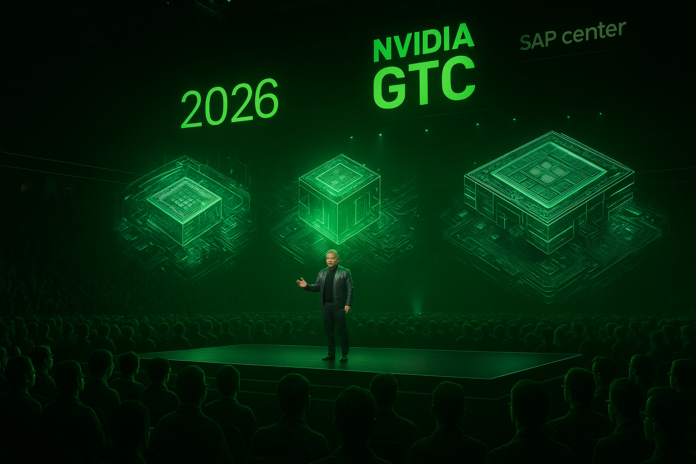
NVIDIA GTC 2026 Preview: What Jensen Huang Will Announce Tomorrow
NVIDIA’s biggest event of the year kicks off Monday. With Tesla challenging their dominance and AI agents demanding new infrastructure, this could be Jensen Huang’s most important keynote ever. Here’s everything to watch.
The Setup
March 16, 2026. 11 AM PT. SAP Center, San Jose.
Jensen Huang walks onto the floor of the San Jose Sharks hockey arena to address 39,000 developers, investors, and competitors from 190 countries. The stream is free. No registration required.
This isn’t just another tech conference. This is NVIDIA’s annual moment to define the future of AI infrastructure—and this year, the stakes have never been higher.
Why now?
- Tesla just announced Terafab, a $10 billion challenge to NVIDIA’s chip monopoly
- AI agents are demanding new computing paradigms
- The market is questioning whether NVIDIA’s dominance can last
- Competitors (AMD, Intel, custom silicon) are gaining traction
Huang needs to prove NVIDIA still owns the future.
What to Expect: The Big Announcements
1. AI Inference Revolution
The Headline: New chips and software specifically designed for autonomous AI agents
Why It Matters: Training AI models (NVIDIA’s current strength) is becoming commoditized. Everyone has GPUs. The next battleground is inference—running AI models in production at scale.
AI agents don’t just train once. They run continuously, making decisions, taking actions, learning from feedback. This requires:
- Low-latency inference
- Massive throughput
- Energy efficiency
- Cost optimization
NVIDIA is expected to announce specialized inference chips that make running AI agents 10x cheaper and faster than current GPUs.
What to Watch For:
- New inference-optimized architecture
- Software stack for agent deployment
- Partnerships with agent frameworks (LangChain, OpenClaw)
- Pricing that undercuts custom silicon
2. The CPU Pivot
The Headline: NVIDIA enters the CPU market with AI-optimized processors
Why It Matters: For decades, NVIDIA stayed in its lane—GPUs for graphics and AI acceleration. CPUs were Intel’s domain, AMD’s territory.
That’s changing. The AI data center of 2026 needs tight integration between:
- CPUs (general computation)
- GPUs (AI training)
- NPUs (neural processing)
- Memory (high-bandwidth, low-latency)
NVIDIA’s Grace CPU, launched in 2024, was the opening salvo. Tomorrow, Huang is expected to announce the next generation—CPUs designed specifically for AI agent workloads.
What to Watch For:
- Grace 2.0 specifications
- CPU-GPU unified memory architecture
- Performance benchmarks vs Intel/AMD
- Server rack designs integrating CPUs + GPUs
3. Vera Rubin Platform
The Headline: Next-generation AI architecture for 2027 and beyond
Why It Matters: Named after the astronomer who discovered dark matter, Vera Rubin represents NVIDIA’s roadmap for the next era of AI computing.
Current AI models (GPT-4, Claude, Gemini) are hitting scaling limits. Training costs are prohibitive. Energy consumption is unsustainable. New approaches are needed.
Vera Rubin is expected to include:
- New chip architecture (beyond Hopper/Blackwell)
- Optical interconnects (faster chip-to-chip communication)
- 3D stacking (more compute per watt)
- Specialized circuits for agent reasoning
What to Watch For:
- Vera Rubin specifications and timeline
- Vera Ultra variant (H2 2027)
- Performance projections
- Cost per trillion parameters
4. The Robotics Push
The Headline: Complete stack for autonomous robots and vehicles
Why It Matters: NVIDIA’s automotive business has been slower than expected. Tesla, the biggest EV maker, uses its own chips. Other automakers are hesitant.
But robotics is exploding:
- Humanoid robots (Optimus, Figure AI, Agility)
- Warehouse automation (Amazon, FedEx)
- Delivery drones (Wing, Zipline)
- Surgical robots (Intuitive, Johnson & Johnson)
All of these need AI compute. NVIDIA wants to own that stack.
What to Watch For:
- Isaac Sim 2.0 (robotics simulation)
- Jetson Thor (robotics processor)
- Partnerships with robot manufacturers
- Tesla competitive response
The Competitive Context
Tesla Terafab: The Elephant in the Room
Three days ago, Elon Musk announced Tesla’s $10 billion chip fabrication facility—Terafab. The message was clear: Tesla is done depending on NVIDIA.
If Tesla succeeds, every major AI company will question whether they need NVIDIA chips. The psychology shifts from “NVIDIA is the only option” to “vertical integration is possible.”
Huang needs to counter this narrative. Expect:
- Emphasis on NVIDIA’s ecosystem lock-in
- Partnership announcements (no one else can match)
- Performance advantages (custom silicon can’t compete)
- Cost reductions (making vertical integration uneconomical)
The Custom Silicon Threat
Amazon (Trainium), Google (TPU), Microsoft (Athena), and Meta (MTIA) are all building custom AI chips. They don’t need NVIDIA for training—they only buy for inference and ecosystem compatibility.
Huang needs to make NVIDIA chips so compelling that building custom silicon becomes irrational.
AMD and Intel
AMD’s MI300X is gaining traction. Intel’s Gaudi 3 is finally competitive. Both are cheaper than NVIDIA’s H100.
Huang needs to re-establish performance leadership—clearly, unambiguously, and with benchmarks that matter.
Investment Implications
Bull Case for NVIDIA
If Huang delivers:
- Clear inference leadership
- Compelling CPU roadmap
- Vera Rubin excitement
- Robotics momentum
NVDA stock: +10-20% this week
Bear Case for NVIDIA
If Huang disappoints:
- Vague AI agent announcements
- No CPU breakthrough
- Terafab unaddressed
- Competition acknowledged
NVDA stock: -5-10% this week
Key Metrics to Watch
Immediate (Keynote Day):
- Stock price reaction during/after keynote
- Social media sentiment
- Competitor stock movements (AMD, Intel, TSLA)
Short-term (This Week):
- Analyst upgrades/downgrades
- Order announcements from hyperscalers
- Partnership reveals
Medium-term (Next Month):
- Product availability dates
- Benchmark releases
- Competitive responses
How to Watch
Livestream: Free, no registration required
- NVIDIA website: nvidia.com/gtc
- YouTube: NVIDIA channel
- Time: March 16, 11 AM PT / 2 PM ET / 7 PM GMT
What to Bring:
- Critical thinking (marketing vs reality)
- Price targets (when to buy/sell)
- Competitive context (what AMD/Intel/Tesla are doing)
The Bottom Line
This isn’t just another product launch. This is NVIDIA’s response to existential threats:
- Tesla building its own chips
- Custom silicon from hyperscalers
- Competition from AMD and Intel
- Questions about AI scaling limits
Jensen Huang has 90 minutes to prove NVIDIA still owns the future of AI infrastructure.
If he succeeds, NVIDIA’s $2 trillion valuation looks cheap. If he fails, the cracks in the empire become visible.
Tomorrow, we find out.
Related Reading
- Tesla’s Terafab — The $10 billion challenge to NVIDIA
- Top 5 AI Crypto Projects — Decentralized AI infrastructure
- How to Build AI Agents with OpenClaw — The software layer
Sources
- NVIDIA GTC 2026 Official — Conference details and livestream
- NVIDIA Blog: GTC Preview — Official announcements
- Technobezz: AI Inference Push — Keynote expectations
- Yahoo Finance: What to Expect — Vera Rubin platform details
- Motley Fool: Stock Implications — Investment analysis
*This preview was published before the GTC 2026 keynote. A live update thread and post-keynote analysis will follow.*

