
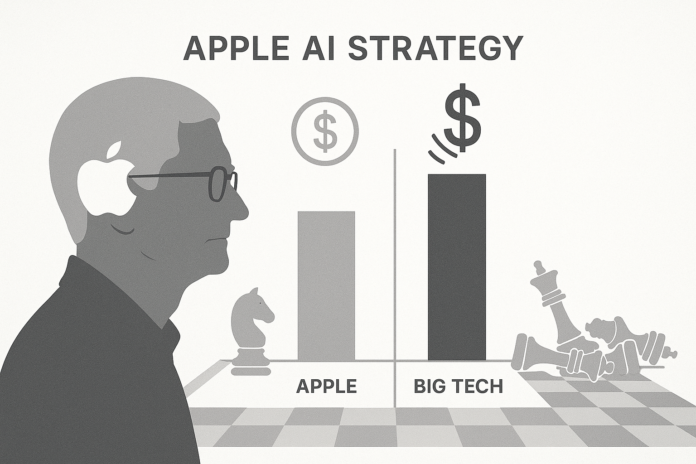
Apple’s $650 Billion Gamble: Why Tim Cook Is Betting Against the AI Arms Race
While Mark Zuckerberg burns $130 billion and fires 20% of his workforce, Tim Cook is doing… nothing. No data centers. No GPU clusters. No mass layoffs. Just a quiet partnership with Google. And it might be the smartest move in tech.
The Number That Stops You Cold
$650 billion.
That’s how much Big Tech will spend on AI infrastructure in 2026. Let that sink in.
Meta: $130 billion.
Amazon: $100+ billion.
Microsoft: $80 billion.
Google: $75 billion.
Combined, they’re spending more than the GDP of Switzerland. More than the US spends on cancer research, education, and infrastructure—combined.
And Apple? Apple is spending pocket change.
Tim Cook didn’t announce a massive AI buildout. He didn’t buy NVIDIA chips by the truckload. He didn’t lay off thousands to fund AI investments.
Instead, he made a phone call. Apple would use Google’s AI models. In exchange, Google gets access to a billion iPhones.
The cost? Maybe $1-2 billion a year. A rounding error compared to competitors.
The question isn’t whether Apple is being cheap. The question is whether everyone else is being stupid.
What Apple Didn’t Build (And Why It Matters)
The Data Centers That Don’t Exist
Mark Zuckerberg is building cities of servers. Elon Musk is building Terafab. Satya Nadella is turning Microsoft into an AI infrastructure company.
Tim Cook? He’s… not.
Apple’s existing data centers handle iCloud, Apple Music, and services. They’re not designed for AI training. And Apple isn’t building new ones for that purpose.
Why this matters: Data centers are the new oil refineries. Whoever controls them controls the AI economy. Apple is voluntarily sitting out the land rush.
The Chips They Didn’t Buy
NVIDIA’s H100 chips are the currency of the AI age. Meta bought hundreds of thousands. Microsoft bought more. Even Tesla is building its own.
Apple bought… almost none.
They have the best chip design team in the world. They build the most efficient mobile processors. But they didn’t design AI training chips. They didn’t buy NVIDIA’s. They simply decided not to play that game.
Why this matters: AI training requires specialized hardware. Without it, you can’t build frontier models. Apple is admitting they don’t need to.
The Workforce They Didn’t Fire
Meta fired 20% of staff—tens of thousands of people—to fund AI. Other tech companies cut thousands.
Apple? Steady hiring. No panic. No “AI productivity gains” justifying layoffs.
Why this matters: While competitors gut their teams to feed the AI machine, Apple is preserving its talent. If the AI bet fails, Apple has the people. Competitors don’t.
The Google Partnership: Apple’s Secret Weapon
The Deal Nobody Talks About
Apple Intelligence—the company’s AI platform—runs on Google’s models.
The economics:
- Apple pays Google an estimated $1-2 billion annually
- Google gets distribution on 1+ billion Apple devices
- Apple gets best-in-class AI without the $100+ billion investment
The genius: Apple gets the capability without the risk. If Google’s models win, Apple wins. If OpenAI’s models win, Apple switches. If something new emerges, Apple adapts.
Competitors are locked into $100+ billion investments. Apple is flexible.
The On-Device Advantage
Apple’s AI runs primarily on your iPhone, not in the cloud.
Why this changes everything:
- Privacy: Your data never leaves your device
- Speed: No network latency, instant responses
- Cost: No cloud inference charges for Apple
- Differentiation: Competitors rely on expensive cloud processing
The limitation: On-device AI is less powerful than cloud AI. But for most consumer tasks—writing emails, editing photos, setting reminders—it’s good enough.
Apple is betting that “good enough” plus privacy beats “most powerful” plus surveillance.
The $650 Billion Comparison
Here’s how Apple’s strategy stacks up against Big Tech’s AI arms race:
| Company | AI Spend 2026 | Strategy | Risk Level |
|---|---|---|---|
| Meta | $130 billion | All-in, build everything | 🔴 High (execution, waste) |
| Amazon | $100+ billion | Build + sell via AWS | 🟡 Medium (diversified) |
| Microsoft | $80 billion | Partnership (OpenAI) | 🟡 Medium (partner risk) |
| $75 billion | Build in-house | 🟡 Medium (cost, ROI) | |
| Apple | ~$1-2 billion | Partnership (Google) | 🟢 Low (flexibility) |
The irony: The company that built the most valuable ecosystem in history is the one not building AI infrastructure.
Why This Is Brilliant (Or Suicidal)
The Case for Genius
Capital efficiency: $650 billion is a massive bet. If AI doesn’t deliver the promised productivity gains, that’s $650 billion wasted. Apple avoids this risk entirely.
Optionality: By not committing to specific infrastructure, Apple keeps their options open. They can switch providers. They can build later. They can acquire. Competitors are locked in.
Historical validation: Apple doesn’t first-mover. Apple best-movers.
- iPhone: Not first smartphone. Captured majority of profits.
- iPad: Not first tablet. Defined the category.
- Apple Watch: Not first wearable. Dominates market.
- AirPods: Not first wireless earbuds. Industry standard.
The ecosystem moat: Apple’s real advantage isn’t AI. It’s the 1+ billion devices, the App Store, the services revenue. AI is just a feature. The ecosystem is the platform.
The Case for Disaster
Platform risk: If AI becomes the new computing platform—like mobile was—whoever owns it wins. Apple doesn’t own it. Google does.
Dependency: If Google raises prices 10x, or cancels the partnership, or builds competing devices, Apple is screwed. They have no backup.
Premium erosion: If Google’s AI is available on $300 Android phones, and Apple’s AI is the same Google AI on $1,000 iPhones, why pay more?
Missing the wave: The next Apple might be an AI-native company. And Apple, by waiting, missed it.
What Happens Next: Three Scenarios
Scenario 1: The Partnership Works (50% probability)
Google keeps providing best-in-class AI. Apple keeps distributing it on a billion devices. Both companies win.
Apple’s position: Strong. Ecosystem intact. Capital preserved for other opportunities.
Stock impact: AAPL continues steady growth, +10-15% annually.
Scenario 2: Apple Builds (30% probability)
The partnership ends—either because Google changes terms or Apple decides to compete. Apple builds internal AI capabilities or acquires a startup.
Apple’s position: Vulnerable during transition. But with $200+ billion in cash, they have resources to recover.
Stock impact: Short-term volatility, -10% to +20% depending on execution.
Scenario 3: Apple Misses (20% probability)
AI becomes the dominant platform. The iPhone becomes commoditized. Premium pricing erodes. Apple enters long-term decline.
Apple’s position: The next Microsoft—dominant for decades, then missed the wave.
Stock impact: Multi-year stagnation or decline, -20-30% from peak.
The Bottom Line
Tim Cook is either the smartest CEO in tech or the most reckless.
While competitors burn $650 billion building AI infrastructure, Apple is spending $1-2 billion on a partnership. The savings are enormous. The flexibility is priceless. The risk is that AI becomes the next platform—and Apple doesn’t own it.
History says bet on Apple. The iPhone, iPad, Apple Watch, and AirPods all followed the same playbook: wait, watch, then build the best version.
But AI might be different. It’s not a device. It’s a platform. And platforms have winner-take-all dynamics.
If Cook is right, he saves Apple $100+ billion and still wins the AI war. If he’s wrong, Apple becomes the next cautionary tale about missing technological shifts.
The $650 billion question: Is this time different?
Key Takeaways
- Apple skipped the $650B AI arms race — Partnered with Google instead
- Capital efficiency: Spend $1-2B, not $100B+, on AI capabilities
- Optionality preserved: Can switch providers or build later
- Ecosystem is the moat: 1B+ devices create stickiness
- Historical precedent: Apple doesn’t first-mover, Apple best-movers
Related Reading
- Meta’s $130B AI Gamble — The all-in approach Apple avoided
- Meta’s $27B Nebius Deal — Outsourcing to catch up
- NVIDIA GTC 2026 — The infrastructure Apple didn’t buy
- Morgan Stanley AI Warning — The $139B agentic AI market
Sources
- Asymco: Brilliant Move Analysis — Apple strategy breakdown
- Motley Fool: Apple Google Partnership — Deal economics
- Reuters: Big Tech AI Spending — Comparative analysis
- Apple Investor Relations — Official statements
- Google AI Blog — Partnership context
*This analysis was published March 17, 2026. Apple’s AI strategy is evolving. Partnership terms and competitive dynamics subject to change.*

