
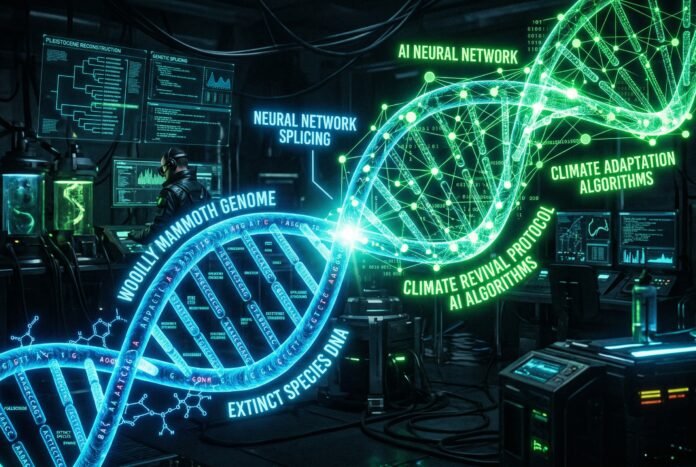
In early 2025, a Texas biotech company made the cover of Time magazine with what it claimed was a resurrected dire wolf — a species that last walked North America 10,000 years ago. Other scientists pushed back hard. What Colossal Biosciences had actually created was a grey wolf with around 20 fragments of ancient dire wolf DNA edited into its genome. Not a true resurrection. But something arguably more interesting: a proof of concept for a technology that could change medicine, conservation, and our response to climate change.
MIT Technology Review named “gene resurrection” one of its 10 Breakthrough Technologies of 2026. And the real story is not about bringing back woolly mammoths. It is about what ancient DNA, decoded by AI, can tell us about surviving an uncertain future.
Moving DNA Through Time
Here is what is actually happening in labs right now. Scientists have spent years building vast banks of genetic sequences from long-dead creatures — the dodo bird, recovered from a museum specimen; the woolly mammoth, extracted from frozen tundra tissue; thousands of ancient humans whose DNA lingers in preserved bone. These are not curiosities. They are a library of biological solutions to problems evolution has already solved.
The challenge was always reading them. Ancient DNA is fragmented, degraded, riddled with errors from millennia of decay. Human analysis could only go so far. AI changes that equation dramatically. Machine learning models trained on modern genomic data can now reconstruct ancient sequences with far greater accuracy — filling gaps, correcting errors, identifying meaningful patterns in what previously looked like noise.
The result is a tool that lets us ask a question that was previously unanswerable: What did evolution already figure out that we haven’t?
The Gout Gene and What It Means for Medicine
Last summer, researchers at Georgia State University studied an enzyme that humans and other apes lost millions of years ago. Its absence in our bodies is linked to gout — a painful joint disease affecting tens of millions of people worldwide. The researchers used gene editing to restore the ancient enzyme to liver cells in the lab. The results were promising enough that they are already planning a gene therapy approach for human patients.
This is the medical application of ancient DNA in its most direct form: finding a biological solution that evolution discarded, understanding why it was lost, and carefully restoring it where it might help. It is not science fiction. It is happening now, in peer-reviewed research, funded by mainstream institutions.
The pipeline extends far beyond gout. Ancient organisms developed adaptations to heat, drought, disease, and environmental stress that modern species — including humans — may lack. Every extinct genome is potentially a pharmacological library we have not yet opened.
Climate Adaptation: The Bigger Prize
The climate application is where the scale of the opportunity becomes truly striking. Plants that survived previous periods of rapid climate change carried specific genetic adaptations — heat resistance, drought tolerance, altered metabolic pathways. Most of those plants are gone. But their DNA is not, if you know where to look.
AI-powered genomic analysis is enabling researchers to identify which ancient genes conferred climate resilience, and to begin exploring whether those traits can be reintroduced into modern crops. A wheat variety that carries a drought-resistance gene from an extinct ancestor. A coral species rebuilt with heat tolerance from a relative that survived the last mass extinction event. These are not distant theoretical possibilities — they are active research programmes at institutions across the world.
The logic is sound: evolution has already run the experiment of surviving climate stress. We just need AI to help us read the results.
Conservation: Rescuing the Living with the Dead
One of the most concrete applications already producing results involves the black-footed ferret — one of North America’s most endangered mammals. With so few individuals remaining, the species faces catastrophic genetic bottlenecking. Limited genetic diversity means vulnerability to disease, reduced reproductive success, and an accelerating spiral toward extinction.
The solution deployed by Revive & Restore was radical: clone new ferrets from cells frozen decades ago, before the population collapsed. Those clones carry tens of thousands of genetic variations no longer present in the wild population — exactly the diversity a species needs to survive. The resurrected relatives are now breeding with living ferrets, injecting new genetic material into a gene pool that had nearly run dry.
This is conservation via time travel. And it works.
The AI Layer That Makes It Possible
None of this scales without AI. The volume of ancient genomic data being generated is beyond human capacity to analyze manually. The patterns connecting ancient adaptations to modern challenges — a drought resistance gene in a 50,000-year-old grass, a disease resistance pathway in a prehistoric fish — require machine learning to detect at meaningful speed and scale.
As we have covered in our analysis of AI-designed drugs entering clinical trials and the broader autonomy convergence across scientific domains, the pattern is consistent: AI is not replacing human scientific expertise. It is operating at a layer of complexity — billions of base pairs, millions of evolutionary decisions encoded in ancient sequences — that human analysis alone cannot reach in a meaningful timeframe.
The ancient DNA field has been building for thirty years. AI is the accelerant that is finally turning it into something practically transformative.
Why This Matters Now
We are living through a period of accelerating environmental pressure. Climate change is not a future problem — it is a present one, compressing the timeline for agricultural adaptation, species survival, and human health. The conventional tools for responding — selective breeding, traditional pharmaceuticals, conservation through habitat protection — are too slow for the pace of change we are facing.
Gene resurrection, powered by AI, offers a different timescale. Evolution already solved many of the problems we are now confronting. The solutions are preserved in ancient DNA, waiting to be decoded. MIT Technology Review’s inclusion of this technology in its 2026 Breakthrough list is not hype. It is a signal that the scientific and investment community is waking up to what is already possible.
The past may be our most powerful tool for surviving the future.
Sources
- MIT Technology Review: Gene resurrection — 10 Breakthrough Technologies 2026
- MIT Technology Review: 10 Breakthrough Technologies 2026 (full list)
- Medium: What Stood Out in MIT Tech Review’s 2026 Breakthrough Technologies List
- Industry Expert: 10 Breakthrough Technologies from MIT Technology Review 2026
- EmitPost: MIT Tech Review Unveils 2026 Breakthroughs
- MIT Technology Review: Game of Clones — Colossal’s New Wolves
- MIT Technology Review: Ancient DNA and evolutionary genetics

