
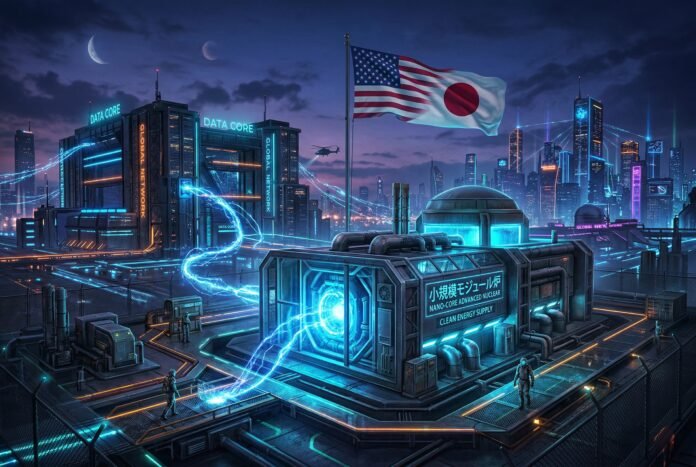
Japan is preparing to invest up to $40 billions in American small modular reactors, targeting Tennessee and Alabama through a partnership with GE Vernova Hitachi Energy. The move signals a dramatic escalation in the global race to secure energy for artificial intelligence infrastructure.
The Deal Structure
The Japanese government, through its state-backed investment vehicles, plans to fund the deployment of small modular reactors across the southeastern United States. GE Vernova Hitachi Energy, a joint venture combining American industrial giant GE with Japanese conglomerate Hitachi, will handle construction and operation.
Tennessee and Alabama were selected for specific strategic reasons:
- Existing nuclear infrastructure — Both states have operational nuclear plants and established regulatory frameworks
- Grid connectivity — Proximity to major data center corridors in Virginia, Georgia, and Texas
- Political support — Republican-led states with streamlined permitting for energy projects
- Cooling water access — Nuclear reactors require significant water resources, which the Tennessee River Valley provides
Why This Matters Now
Power has become the single biggest bottleneck for AI data center expansion. Tech giants including Microsoft, Google, Amazon, and Meta have announced hundreds of billions in data center investments, but grid constraints are slowing deployment.
The problem is acute:
- Grid interconnection queues — New projects face 3-5 year waits to connect to existing infrastructure
- Transmission limitations — Moving power from generation sites to data centers requires massive transmission upgrades
- Baseload requirements — AI training runs 24/7, requiring reliable power that renewables alone cannot guarantee
- Geographic concentration — Northern Virginia alone hosts 35% of global data center capacity, straining local grids
Small modular reactors offer a potential solution. Unlike traditional nuclear plants that take a decade to build, SMRs are factory-manufactured and can be deployed in 3-4 years. They provide carbon-free baseload power with smaller footprints and lower upfront capital requirements.
The Strategic Context
This investment represents more than a commercial energy deal. It reflects three converging geopolitical priorities:
1. Countering China’s Energy Dominance
China currently generates 33% of global electricity and is on track to produce 3X the energy of the United States by 2026-27. Japan’s investment helps the U.S. close this gap while securing energy for the AI race.
2. Securing AI Supply Chains
The U.S.-China tech war has focused on semiconductors, but energy is emerging as an equally critical chokepoint. Japan, already a key partner in semiconductor manufacturing through TSMC’s Arizona expansion, is now extending that partnership to power generation.
3. Revitalizing American Nuclear
The U.S. nuclear industry has stagnated for decades. Japan’s capital injection could restart domestic manufacturing capabilities, create jobs, and establish SMR technology as an exportable American product.
The Companies Involved
GE Vernova (NYSE: GEV) — Spun off from General Electric in 2024, GE Vernova combines GE’s power generation, renewable energy, and grid businesses. The company has been aggressively pursuing SMR technology as a growth vector.
Hitachi Energy — The Japanese conglomerate’s energy division brings nuclear expertise and manufacturing capabilities. Hitachi has operated nuclear plants in Japan for decades and understands the regulatory and technical complexities.
Tennessee Valley Authority (TVA) — The federally owned utility operates the Tennessee River Valley power system and has expressed interest in deploying SMRs at existing nuclear sites.
Market Implications
Nuclear Renaissance
The $40 billion commitment validates SMR technology as commercially viable. Other SMR developers including NuScale Power (NYSE: SMR), Oklo (NASDAQ: OKLO), and BWX Technologies (NYSE: BWXT) could see increased investor interest and potential partnership opportunities.
Uranium Demand
SMRs require uranium fuel. The World Nuclear Association estimates SMR deployment could increase uranium demand by 20-30% by 2040. Uranium miners including Cameco (NYSE: CCJ), Kazatomprom, and Sprott Physical Uranium Trust could benefit.
Data Center Real Estate
Data center developers may prioritize locations near SMR sites. Companies like Digital Realty (NYSE: DLR), Equinix (NASDAQ: EQIX), and American Tower (NYSE: AMT) could adjust development strategies to co-locate with nuclear generation.
Grid Infrastructure
Connecting SMRs to data centers requires transmission upgrades. Grid technology providers including Quanta Services (NYSE: PWR), MYR Group (NASDAQ: MYRG), and MasTec (NYSE: MTZ) could see increased demand.
Risks and Challenges
Regulatory Hurdles
The Nuclear Regulatory Commission (NRC) has approved only one SMR design (NuScale). GE Hitachi’s BWRX-300 design is still under review. Permitting timelines could delay deployment.
Cost Overruns
Nuclear projects are notorious for cost overruns. The $40 billion estimate could balloon if construction faces delays or technical challenges.
Public Opposition
Nuclear energy faces public skepticism despite improved safety records. Local opposition in Tennessee and Alabama could slow deployment.
Technology Risk
SMRs are still largely unproven at commercial scale. First-of-a-kind projects often encounter unexpected technical challenges.
The AI Energy Thesis
This investment validates a thesis that has been building for months: AI infrastructure is fundamentally constrained by energy availability. The companies that solve this constraint, whether through nuclear, renewable plus storage, or grid upgrades, will capture disproportionate value.
The narrative arc is clear:
AI demand → Data center construction → Power shortage → SMR deployment → Energy security
Japan’s $40 billion bet suggests this is not a speculative future. It is happening now.
What Happens Next
Near-term (2025-2026):
- GE Hitachi submits BWRX-300 design for NRC certification
- Site selection and environmental reviews begin in Tennessee and Alabama
- Additional funding mechanisms announced (likely including U.S. government loan guarantees)
Medium-term (2027-2030):
- First SMR units come online
- Data center operators announce co-location agreements
- Additional SMR deployments announced in other states
Long-term (2030+):
- SMR manufacturing scales domestically
- Export opportunities to allied nations
- Potential integration with hydrogen production for energy storage
The Bottom Line
Japan’s $40 billion SMR investment is a watershed moment. It transforms small modular reactors from experimental technology to critical infrastructure. It positions the United States to compete with China’s energy dominance. And it solves the power bottleneck that threatens to stall AI development.
For investors, the signal is clear: energy is no longer a commodity input. It is a strategic weapon in the AI race. The companies that control power generation, particularly carbon-free baseload power, will control the future of computing.
The lobster is growing claws. Now it has a nuclear reactor.
Sources
- Reuters: Japan to invest up to 0 billion in U.S. small modular reactors — Breaking news on the investment commitment
- GE Vernova Investor Relations — Company details on SMR technology and partnerships
- Nuclear Regulatory Commission: SMR Licensing — Regulatory framework for small modular reactors
- Tennessee Valley Authority: Nuclear Development — Utility perspective on SMR deployment
- World Nuclear Association: SMR Overview — Technical and market analysis of SMR technology

