

RunOnFlux (Flux, token FLUX) runs a network of node operators that rent out computing capacity. This review covers 11 October 2025 to 11 October 2026, using Flux’s own blog, its GitHub releases and its block explorer. Most of the record is Flux describing itself, so each item is labelled: confirmed (checked against a primary source), reported (a company statement not independently checked) or plan (an intention, not a fact). TSN has tested Flux’s MCP server and some of its other tools, but not all of its products.
October 2025: the fork
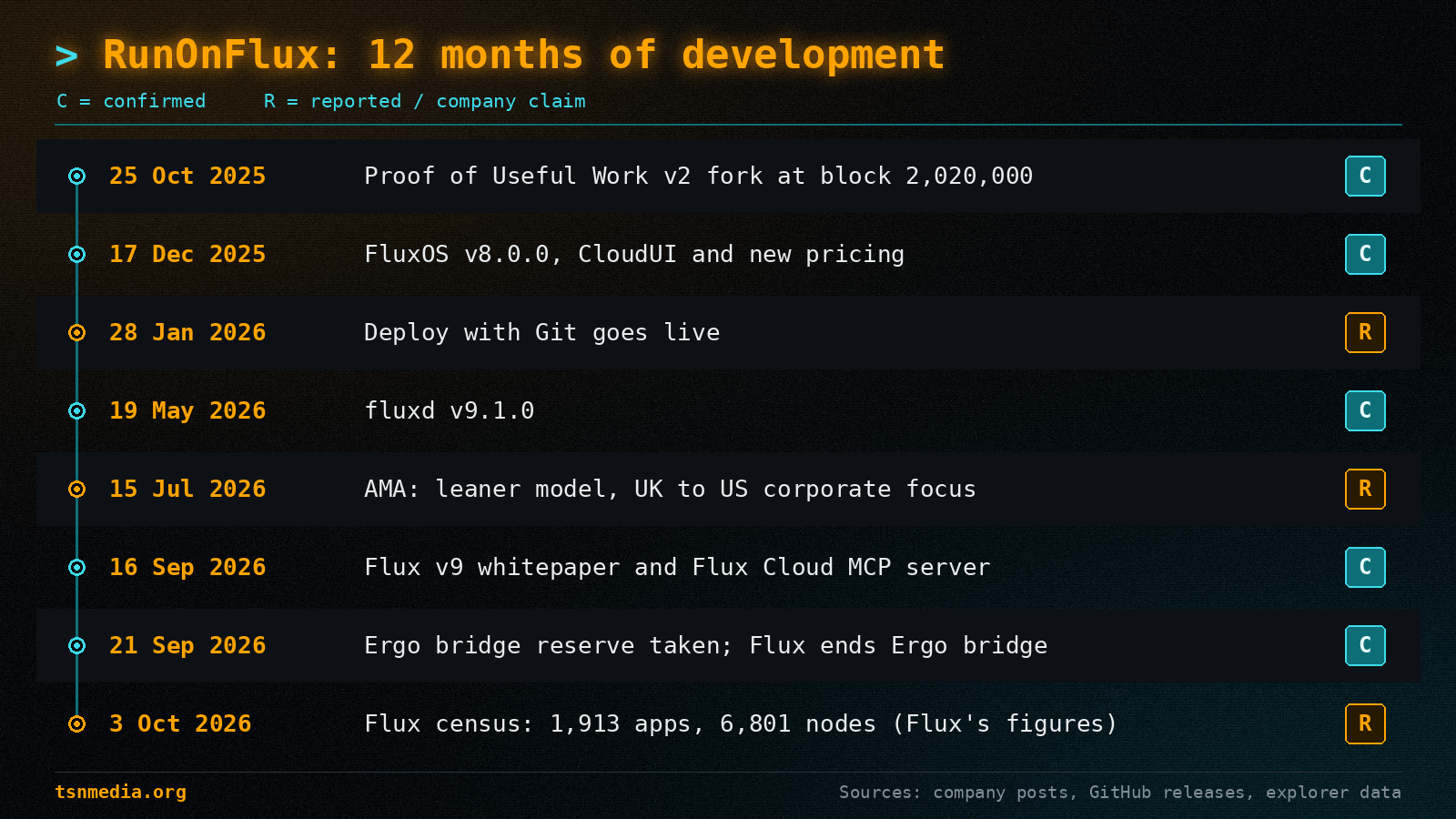
- Proof of Useful Work v2 fork (confirmed). fluxd v9.0.0, published 7 October 2025, set activation at height 2,020,000 and said traditional proof-of-work mining “is no longer used”, with a target block time of 30 seconds. The explorer shows that block carrying a timestamp of 25 October 2025, 19:00:35 UK time.
- Flux’s description of the new rules (company statements). Block time falls “from 2 minutes to 30 seconds”; each block pays 14 FLUX, split 1 to Cumulus nodes, 3.5 to Nimbus, 9 to Stratus and 0.5 to a Flux Foundation development fund; the maximum supply cap is 560 million FLUX.
November and December 2025
- Releases: FluxOS v7.1.0 to v7.2.x (November) added registry authentication and fork-aware pricing maths (confirmed in release notes). Flux also launched a Deployment Academy on 5 November (company announcement).
- FluxOS v8.0.0, 17 December (confirmed). The old HomeUI was replaced by a new CloudUI. Apps targeting v8 and later can run with one instance instead of three. Subscription discounts run 3% for 3 to 5 months, 6% for 6 to 8 months and 12% for 9 months or more. The Nimbus (×1.15) and Stratus (×1.30) tier multipliers were removed.
- 18 December: Flux announced Deploy with Git with a waitlist, “coming early 2026” (plan at the time).
January to March 2026
- Releases (confirmed): FluxOS v8.2.0 to v8.5.0 in January and v8.6.0 in February, which replaced the Watchtower container with a built-in image updater.
- 28 January AMA (reported, recap 29 January). Flux said Deploy with Git was live, and named “Vetted Apps”, Sovereign AI, Website Assistant, Beaver AI and FluxGEN.
- March: FluxOS v8.9.0 on 27 March was described as a “complete P2P networking refactor” (confirmed). ArcaneOS, Flux’s node operating system, had a build on 24 March that added bootstrap verification with sha256 sums.
April to June 2026
- 19 May: fluxd v9.1.0 (confirmed). A C++20 upgrade, OpenSSL moved from 1.1.1a to 3.5.4 LTS, compact blocks (BIP 152) and a new RPC call,
listfluxnodedelegates. - 26 May: FluxOS v8.13.0 (confirmed). About 100 commits, an app state event log, and a node confirmation service.
- 27 May: Daniel Keller, Flux co-founder and CEO of InFlux Technologies, signed an update saying node operators’ ability to independently ban applications “will be removed”, with an abuse-reporting portal planned in its place (company statement).
- June: FluxOS v8.14.x to v8.15.0. The v8.14.1 release notes document a bug in which nodes on default ports could wipe installed apps on restart. The scale of the impact is not stated.
July and August 2026
- 15 July AMA (company claims, recap 17 July). Flux said it is “restructuring its operations around a leaner, more community-driven model”, with a “transition of its corporate focus from the United Kingdom to the United States”. It also said legacy nodes not on Proof of Useful Work v2 “will be brought offline” after a deadline, and that it is building its own language model on FluxEdge GPUs. This rests on one source, Flux’s recap; no corporate filing was checked.
- 26 August, CumulusVPN desktop 1.2.0 (reported). Flux says it has “135 gateways in 23 countries at the last count”, free at 100 KB/s or $0.99 a month for full speed. The project’s GitHub README still says “Pre-launch … there is no live network yet”.
September 2026
- 8 September: FluxOS v8.18.0 (confirmed) with app ownership and tenant isolation, and live application logs. Flux says it contains 945 commits since v8.17.0.
- 16 September: Flux v9 whitepaper (confirmed published). It runs to 423 pages, with a 16-page short paper. Its census of 3 September, Flux’s own figures, gives 6,489 nodes (3,247 Cumulus, 1,615 Nimbus, 1,627 Stratus), 88,514,500 FLUX locked and 1,195 applications.
- 16 September: Flux Cloud MCP server (confirmed published). An npm package,
@runonflux/flux-cloud-mcp. Flux says it was on its Q4 roadmap and “shipped in September”. See TSN’s earlier guide, linked below. - 21 to 23 September: the Ergo bridge (confirmed, Flux’s account, with corroboration). Flux says transactions on 21 September took 400,000,000 FLUX out of its bridge reserve on Ergo, and 18 minutes later a second took the remaining 15,000,000. It says no user funds were lost and no private key was compromised, that the reserve was “returned in full within 24 hours”, and that it granted a 100,000 FLUX critical bug bounty. It also says “roughly 483,623.36 FLUX across 2,842 addresses is user-claimable” and that the bridge “is terminated permanently”. A bot operator on the Ergo community forum wrote that his bot was one of the collectors and “a bounty was offered, but we would have given it back anyway”. The amount and timing of the return rest on Flux’s statement.
October 2026, to 11 October
- 3 October census (Flux’s figures, reported). Applications rose from 1,195 to 1,913 and nodes from 6,489 to 6,801 (3,390 Cumulus, 1,631 Nimbus, 1,780 Stratus). Flux says 865 applications, 45%, are game servers and 945, 49%, are private. It also says more than 350 applications are Orbit deployments, and that its LLM hub has nine models across 140 instances.
Roadmap: what has been announced
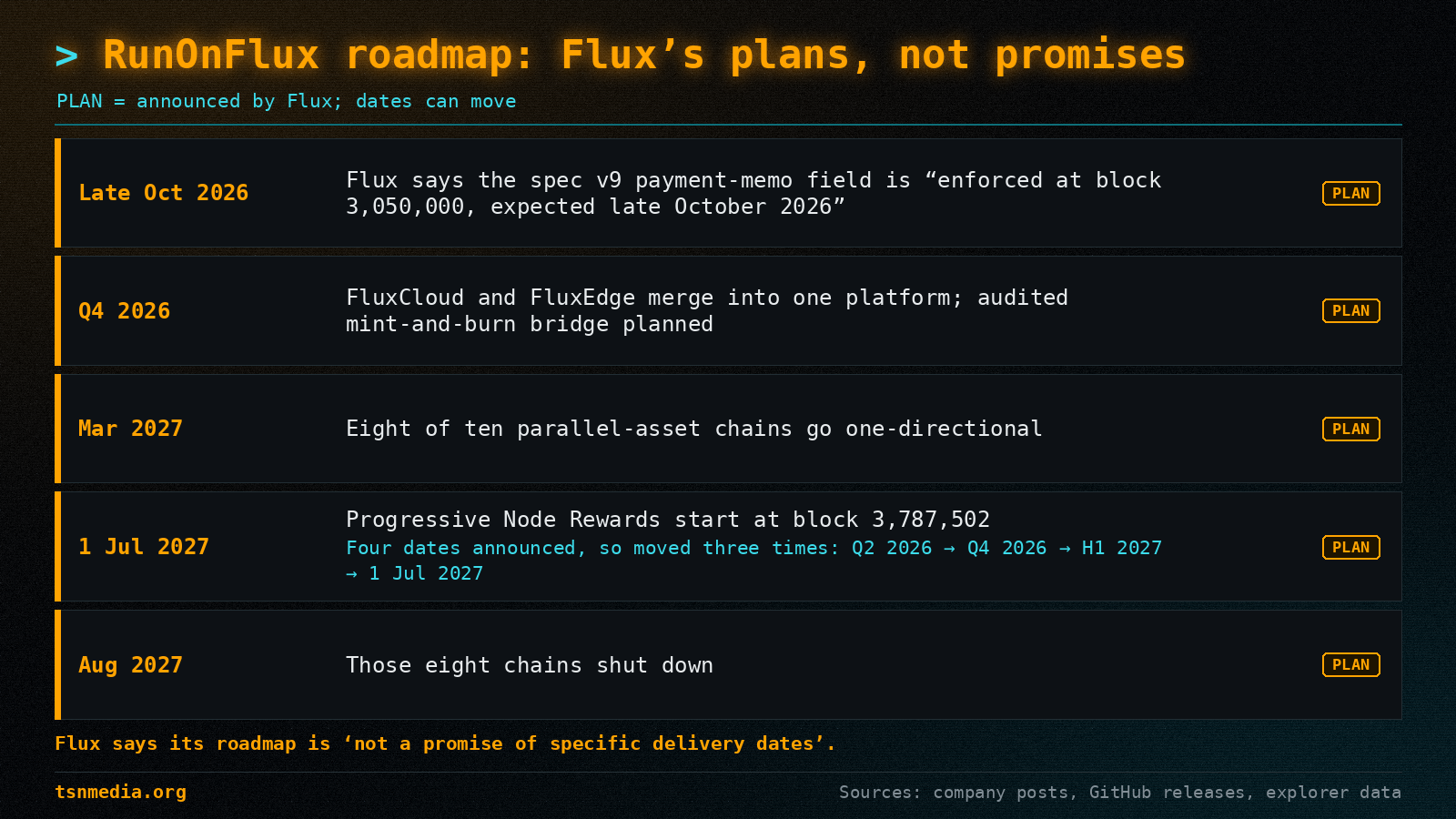
Everything here is a plan. Flux’s roadmap page says it shows “development plans and priorities — not a promise of specific delivery dates, and not investment advice”.
- Late October 2026: Flux says the spec v9 payment-memo field is “enforced at block 3,050,000, expected late October 2026”.
- Q4 2026 (“One platform”): FluxCloud and FluxEdge under one account; a rebuilt interface; FluxOS v9 specifications; managed Postgres and MongoDB; private overlay networks; a mint-and-burn bridge described as audited with proof of reserve; and an ISO 27001 effort described as “underway”.
- Progressive Node Rewards (PNR). On 20 September Flux wrote: “On 1 July 2027, at block 3,787,502, the way Flux node operators get paid changes”. Consensus would take 20% of each application payment into a pool paid out over 86,400 blocks, about 30 days, with the other 80% going to the Foundation address. The date has moved: the 28 January AMA said Q2 2026; the 15 July AMA said Q4 2026, subject to a governance proposal and community approval; the 1 September roadmap said H1 2027; the 20 September post said 1 July 2027.
- “Ten Chains Become Two” (21 September). Flux plans to keep Ethereum and BNB Chain and retire Base, Polygon, Avalanche, Ergo, Algorand, Solana, Tron and Kadena. It gives March 2027 (block 3,450,000) for one-directional movement and August 2027 (block 3,880,000) for shutdown. Flux measured 223,027,781.21 FLUX held outside issuer addresses across all ten chains, with 6,226,900.80 FLUX (2.79%) on the retiring ones. The new bridge would use a 3-of-4 signing quorum and a per-chain cap of 250,000,000 FLUX.
- Other stated plans: a deadline after which legacy nodes “will be banned from FluxCloud” (no date given), and a Foundation bounty marketplace.
Contradictions and open questions
- Fork wording. Flux’s blog calls the fork a “soft fork”; fluxd calls it a “mandatory” upgrade; the 2025 Review uses both “soft fork” and “network hard fork”.
- Emissions wording. The 23 October 2025 post speaks of a “10% annual inflation rate”; later posts say “10% annual reduction rate”. TSN reads it as a yearly 10% cut in emissions, as the first post’s own schedule suggests.
- Deploy with Git. The roadmap lists it for Q4 2026, though Flux said it went live in January 2026. Possibly a managed version; Flux has not said.
- Bridge chains. The 1 September roadmap says “Ethereum and Base first”; the 21 September post retires Base.
- Node count. The whitepaper post says 6,489 nodes; the repository README says 6,479.
- CumulusVPN. The blog says 135 gateways; the README says no live network yet.
- Ergo. Whether Flux’s proposal “EIP-0049” was adopted is unchecked, as are the claim window (“early October”) and its completion.
Sources
- Flux, “Forking Flux: Proof of Useful Work v2”, 23 October 2025. https://runonflux.com/forking-flux-proof-of-useful-work-v2/
- GitHub, RunOnFlux/fluxd releases (v9.0.0, v9.1.0). https://github.com/RunOnFlux/fluxd/releases
- Flux explorer, block 2,020,000. https://explorer.runonflux.io/api/block/d09e1b336b3c5988ec984e39b81036f00d5468946cfa3f0bb1af8afe6d2defbb
- GitHub, RunOnFlux/flux releases (FluxOS v7.0.0, v8.0.0, v8.13.0, v8.15.0, v8.18.0, v8.20.0). https://github.com/RunOnFlux/flux/releases
- Flux AMA recaps: 31 Oct 2025 https://runonflux.com/flux-fork-ama-breakdown/ ; 29 Jan 2026 https://runonflux.com/ama-review-deploy-with-git-fluxcloud-and-fluxai-updates-more/ ; 25 May 2026 https://runonflux.com/flux-ama-review-what-did-i-miss/ ; 17 Jul 2026 https://runonflux.com/flux-ama-recap/
- Flux, “FluxCloud Instant Deploy” (Deploy with Git waitlist), 18 Dec 2025. https://runonflux.com/fluxcloud-instant-deploy-eliminating-docker-headaches/
- Flux, operator and security update, 27 May 2026. https://runonflux.com/flux-network-operator-security-infrastructure-update/
- Flux, CumulusVPN desktop 1.2, 26 Aug 2026. https://runonflux.com/cumulusvpn-desktop-1-2-and-roaming/ ; GitHub README https://github.com/RunOnFlux/cumulusvpn
- Flux, Flux v9 whitepaper, 16 Sep 2026. https://runonflux.com/flux-v9-whitepaper/ ; repository https://github.com/RunOnFlux/fluxwhitepaper
- Flux, Flux Cloud MCP server, 16 Sep 2026. https://runonflux.com/flux-cloud-mcp-server/
- Flux, “Four years, eighteen minutes” (Ergo bridge), September 2026. https://runonflux.com/four-years-eighteen-minutes-ergo-storage-rent/ ; Ergo Community Forum, storage rent discussion, 29 Sep 2026. https://ergoforum.org/t/storage-rent-discussion-and-long-term-impacts/5366
- Flux, “Flux in Numbers”, 3 Oct 2026. https://runonflux.com/flux-in-numbers-october-2026/
- Flux roadmap page and blog, 1 Sep 2026. https://runonflux.com/timeline/ ; https://runonflux.com/flux-roadmap-agent-native-cloud/
- Flux, “Ten Chains Become Two” and Progressive Node Rewards posts, 20 and 21 Sep 2026, via the Flux blog index. https://runonflux.com/blog/
Related stories
- Talk to the Cloud: What Flux Cloud’s MCP Server Lets You Build
- FluxAI Just Launched Beaver and Voice Desk — The Privacy-First AI That Enterprises Have Been Waiting For
- Decentralised IoT: A conversation with Daniel Keller, CEO, InFlux
- What Is DePIN? Decentralised Physical Infrastructure Explained
- DePIN Roundup: Theta at the Stadium Edge, AkashML in an Inference Auction, and Two Company Claims





 shipped from October 2025 to October 2026, what it has announced next, and where its own accounts disagree.)