CONFIRMED: all figures are from the Energy Incident Register’s public data-centre page, counted on 12 October 2026. They cover only incidents that reached public reporting, and the 2026 count is for part of the year.
Data centres are the buildings full of computers that run cloud services and AI. They need huge amounts of electricity, and they carry their own backup power: banks of batteries, diesel generators, and the switching gear that connects it all. When that equipment fails or catches fire, services can go down.
The Energy Incident Register, a website that logs incidents at energy sites from public reporting, has counted 93 data-centre incidents that started in the power systems, across 27 countries, from 2010 to 2026 [1]. Of those, 47 are dated 2024 or later [1].
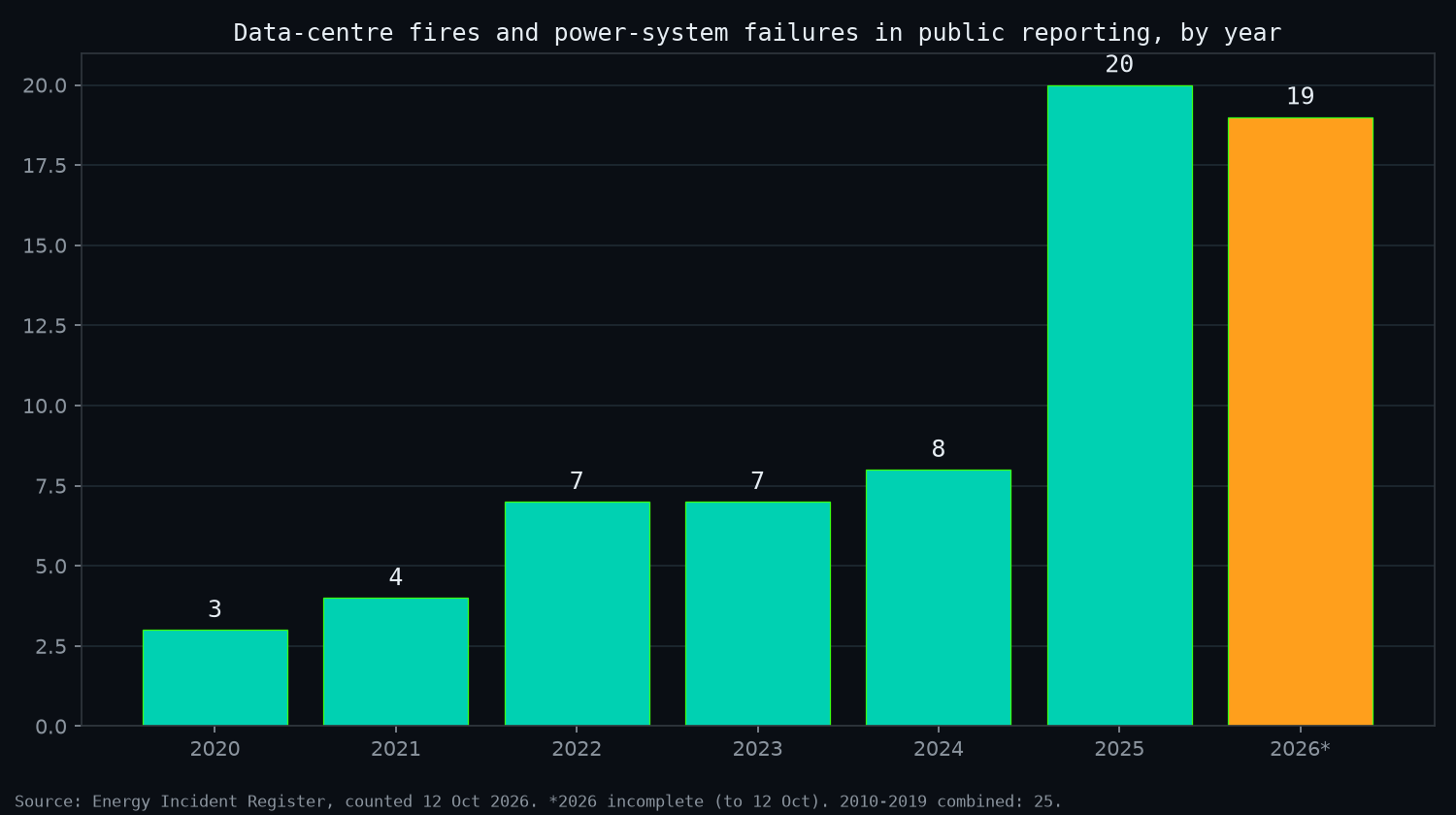
The numbers by year
| Year of incident | Entries |
|---|---|
| 2026 (to 12 Oct, incomplete) | 19 |
| 2025 | 20 |
| 2024 | 8 |
| 2023 | 7 |
| 2022 | 7 |
| 2021 | 4 |
| 2020 | 3 |
| 2010 to 2019 combined | 25 |
Source: Energy Incident Register [1].
So the count went from 8 in 2024 to 20 in 2025, more than double. With under three months of 2026 still to go, the register already lists 19 for this year [1].
What failed
The register counts an incident under each part that the public reporting names [1]. Where the part is named:
- UPS and battery rooms: 22. A UPS (uninterruptible power supply) is a bank of batteries that keeps servers running for the moments between a mains failure and the generators starting.
- Backup generators: 15.
- Switchgear and electrical rooms: 10. Switchgear is the heavy equipment that routes and cuts off electrical power.
- Transformers and substations: 4.
- Fuel systems: 2.
- Not stated: 53. In more than half the entries, the public reporting did not say which part failed.
52 of the 93 entries are fires or thermal (overheating) events, and the register classes 18 as major: in its words, “the longest outages, the worst damage and the incidents where people were hurt” [1].
Where
The United States has the most entries (33), followed by the United Kingdom (14), India (5) and France (5) [1].
What this does and does not show
- Public reporting only. The register only counts incidents that were reported publicly. Many data-centre failures are never made public, so the true number is likely higher. A rise in the count can also reflect more reporting, not only more incidents.
- Power systems only. The register says it records incidents that started in UPS and battery rooms, generators, switchgear, transformers and fuel. “A software outage or a cooling fault with no fire or power failure is not recorded here” [1].
- Not all equipment faults. Several 2026 entries are reported attacks, such as reported drone strikes on Yandex data centres in Russia and a reported fire at an AWS data centre in Bahrain after an alleged attack [1].
- No single cause. The register does not give one reason for the rise, and TSN is not suggesting one.
Why it matters
The AI boom is driving a wave of new data-centre construction, and each site carries large battery banks and generators. How often those systems fail, and how openly failures are reported, is part of the story of AI’s physical infrastructure.
Sources
- Energy Incident Register, “Data centre fires and power failures: the public record”, counted 12 October 2026. https://energyincidentregister.com/data-centre-fires
- DatacenterDynamics, “Number of data center fires and power failures has doubled since 2024”, 12 October 2026 (secondary coverage of the register). https://www.datacenterdynamics.com/en/news/number-of-data-center-fires-and-power-failures-has-doubled-since-2024/
Related stories
- Vertiv Says It Delivered India’s First Direct-to-Chip Liquid-Cooling Deployment, for 30 MW of AI Workloads in Navi Mumbai
- Wärtsilä, Schneider Electric and Stanley Consultants Launch a “Generator-to-Chip” Approach for US Data-Centre Power
- T5 Data Centers Proposes a Fuel-Cell-Powered Data Centre in Chantilly, Virginia