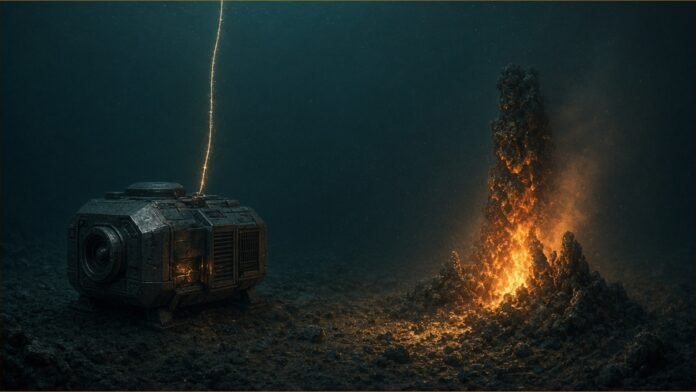
Seattle start-up Endurance Energy says it has run a geothermal power plant on an active underwater volcano and, for 8.7 seconds, got more electricity out than it put in. In a press release on 19 October 2026, the company said its Adélie test plant also drilled and completed what it calls the world’s first subsea geothermal well, about 5,000 feet beneath the Pacific at Axial Seamount, 300 miles off the Oregon coast.
Endurance describes the test as “the first end-to-end demonstration of subsea geothermal power”. That is the company’s claim, and the company is just as clear about the limits: Adélie was a test article, not a commercial-scale power plant. The burst of net-positive output came from a natural vent nearby, not from the new well. Even so, the test marks an early step for a sector that is drawing venture money, and plenty of doubt.
In brief
- Endurance Energy says its Adélie test plant made net-positive power for 8.7 seconds at Axial Seamount, with a median of about 2kW net and a peak of 16.5kW net.
- The company says it drilled a 52-foot subsea geothermal well that flowed at 260°C, but the well was too restrictive to run the plant.
- The run ended when battery overcurrent protection stopped the system; a power cable later failed, ending the dive.
What Endurance says the test showed
During a three-week deployment, Endurance says its subsea lander drill bored two holes less than two feet apart in the Axial Caldera, and both hit hydrothermal fluid. The team cased and cemented the second hole, capped it with a valve and completed a 52-foot (16-metre) well. According to the company, “After cementing, the well flowed at 260°C (500°F).”
The company then landed the 3-ton plant on the seafloor and controlled it in real time from Seattle. It did so over the National Science Foundation’s Regional Cabled Array, a seafloor fibre-optic network run by the University of Washington as part of the Ocean Observatories Initiative. Connected to a natural vent flowing at about 281°C (538°F), Adélie’s turbine reached roughly 26,000rpm. “For 8.7 seconds, the system generated more electricity than it consumed—a median of about 2 kilowatts net and a peak of 16.5 kilowatts net,” the release says.
“On Sept. 27, we put a power plant on an active underwater volcano and made power,” said Andrew Redd, Endurance’s founder and chief executive. He leaned on a rocketry comparison: “Goddard’s first liquid-fueled rocket flew for two and a half seconds. Our first net-positive run lasted about nine. Our approach is to make it exist, then make it good.”
Short run, hard lessons
The release is unusually direct about what did not work. “The newly drilled well delivered hot fluid but was too restrictive to run the plant,” it says, which is why the power run used the nearby natural vent. That run “ended when battery overcurrent protection stopped the system”. About ten minutes later, during a restart attempt, “a power cable feeding Adélie’s refrigerant pump failed, ending the dive.”
Endurance says the deployment still gave it data on seafloor drilling, well flow, heat transfer, mineral build-up, high-temperature power generation and long-distance control of subsea kit. The company, founded in January 2025, says Adélie was its fifth deep-sea deployment and the first to test every step together.
On the environment, Endurance says it ran a voluntary monitoring programme. It reports no unusual seismic or volcanic activity and no significant changes to the seafloor community, with more than 40 water, rock and mineral samples now with independent laboratories. Those results are still pending, and the monitoring was run by the company itself.
Next steps, and the doubters
This winter, Endurance plans to deploy Gentoo, a refurbished and upgraded Adélie aimed at higher power and longer generation. Its current lander drill can reach 80 metres (about 260 feet), and the company expects deeper wells to deliver the flow needed for sustained output. It is also developing Leopard, a 2-megawatt commercial generator. Its first commercial project, in Tonga, is targeting first power in 2027 for a grid that today runs largely on imported diesel.
Money is in place for now. Endurance has raised $63 million to date, Canary Media and Fast Company report, including a $54 million Series A led by Founders Fund.
Outside experts are cautious. Stanford geothermal specialist Roland Horne told Ars Technica: “It’s probably technically feasible, but it would undoubtedly be more expensive than to do it on land.” Emily Pope of the Center for Climate and Energy Solutions told Canary Media: “It’s an eyebrow-raising approach.”
Our read
Under nine seconds of net output from a three-ton prototype is a proof of concept, not a power source, and Endurance does not pretend otherwise. What matters is whether deeper wells can supply steady flow, and whether hardware can survive long periods at around 280°C on the deep seafloor. Cost is the real hurdle: Horne’s point that land-based geothermal will be cheaper is the question investors will press as Gentoo goes in the water this winter.
Sources
- Endurance Energy: “Endurance Energy Drills World’s First Subsea Geothermal Well and Runs First Net-Positive Power Plant” (PR Newswire, 19 October 2026).
- Ars Technica: “Startup taps underwater volcano as energy source in proof-point test” (Jeremy Hsu, 19 October 2026).
- Canary Media: geothermal start-up seafloor drilling test (19 October 2026).
- Fast Company: “This startup just tested turning an underwater volcano into a power plant” (19 October 2026).
Related stories
- Amazon, X-energy and AEP Will Explore 12 Xe-100 SMRs in Indiana
- Hitachi, Brookfield, Hartree and Tokyo Gas Sign Japan Green Data-Centre MoU
Follow @tsnmediahub on X for breaking AI news as it happens.
Follow on X