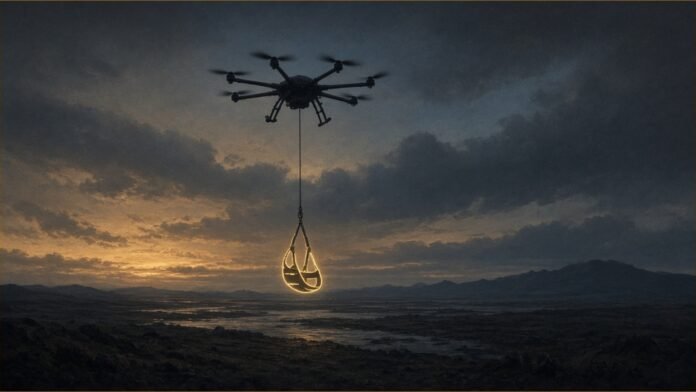
A Ukrainian heavy-lift drone has carried a badly wounded soldier away from a front-line position, the drone’s maker Gurzuf Defence and three Ukrainian military units said on 19 October 2026, describing it as the first operation of its kind. In a post headlined “For the first time in history” (TSN’s translation), the company said its Heavy Shot “Ayudag 6” hexacopter winched the soldier out when evacuation by ground was impossible.
If the account holds up, it marks a shift in what cargo drones are used for: from carrying supplies to carrying people. The maker itself, though, is cautioning against treating it as the start of routine drone ambulances.
In brief
- Gurzuf Defence and the Ukrainian military say a Heavy Shot “Ayudag 6” hexacopter, fitted with a winch, flew a wounded soldier to a safer position; they call it a first.
- It shows heavy cargo drones being pushed into rescue work, a use their makers say the payload makes possible.
- The date, location and independent confirmation of the “first” claim are not available, and the mission figures have not been explained in full.
How the evacuation worked, according to the maker
The soldier, from the 30th Separate Mechanized Brigade, had spent 500 days, almost a year and a half, alone at a dangerous position, Gurzuf Defence says, with comrades supplying food, water, ammunition and medicine by drone. When he was seriously wounded, reaching him by ground would have put a rescue team at deadly risk, the company says.
The Kyiv Independent reported that Russian drone activity and mined ground ruled out the usual options, including a ground robotic vehicle. The military did not disclose the date of the operation or where on the front it took place.
Gurzuf describes a two-step method. First, a drone delivered special equipment with carabiners. Then the hexacopter arrived with a winch, and the soldier attached himself to the evacuation system, following instructions from comrades who stayed in contact throughout. The company calls it “an operation no one had carried out before”, with “no ready protocols, no prior experience, no room for error” (TSN’s translation).
The numbers, and what they do not explain
Gurzuf says the flight was flown under military control, with electronic-warfare cover and monitoring of the airspace, and delivered the soldier to a safer spot where others took him on to hospital. According to the 30th Brigade, via the Kyiv Independent, his life is no longer in danger.
| Figure | Value | Source |
|---|---|---|
| Mission time | 1 h 14 min 36 s | Gurzuf Defence |
| Mission distance | 62 km | Gurzuf Defence |
| Platform range | Up to 25 km | Ukrainska Pravda |
| Payload | 70–90 kg | Ukrainska Pravda |
| Drone weight | About 98 kg | Ukrainska Pravda |
The figures raise a question the sources do not answer. The 62 km mission distance is well beyond the 25 km range Ukrainska Pravda reported for the platform, and neither Gurzuf nor the Kyiv Independent explains whether the 62 km covers the whole sortie, several legs or something else.
Cargo drones as rescue craft
The technology story is about repurposing. Until now, Gurzuf says, heavy drones have carried ammunition and cargo to the front line; this mission, it argues, shows they can bring people back. The company says it designed the Ayudag as “a heavy, modular, multi-purpose platform”, not a dedicated evacuation aircraft, but always expected a drone with that lifting capacity to handle rescue missions (TSN’s translation).
Not everyone involved sees it the same way. A 92nd Brigade programmer known as “Napalm” told the Kyiv Independent it marked “the next stage in the evacuation of the wounded”, adding that “serious, systematic work begins to ensure that such missions take place on a regular basis”.
Gurzuf co-founder Pavlo Feldblium was more cautious. He wrote that he does not believe air evacuation can become routine, because the risks to a wounded person in the air are too high and every mission must be planned for a specific spot on the front (TSN’s translation). “Air rescue is a last resort when there is no other way to save a person,” he said, in the Kyiv Independent’s translation.
The mission adds to a Ukrainian drone industry TSN has followed closely, from interceptor drones to the Stork drone now flown by a US Army training unit.
Our read
Taking the claim at face value, the notable engineering point is how simple the method was: a heavy lifter, a winch and equipment the casualty attached himself to, rather than a purpose-built medical drone. The open question is the one the maker raises: whether this can ever be safe and repeatable, or stays a one-off for when nothing else is possible. Independent confirmation of the “first” claim, and a clear account of the 62 km figure, would help settle how big a step it really is.
How we sourced this
- Gurzuf Defence’s post is in Ukrainian; quotations from it are TSN’s translations, except Feldblium’s “last resort” line, which is the Kyiv Independent’s translation.
- Platform specifications come from Ukrainska Pravda as cited by the Kyiv Independent; TSN has not read that report directly. Other outlets’ differing figures have not been used.
Sources
- Gurzuf Defence: “ВПЕРШЕ В ІСТОРІЇ. ПОРАНЕНОГО ЕВАКУЮВАЛИ З ПОЛЯ БОЮ ЗА ДОПОМОГОЮ БПЛА HEAVY SHOT «АЮДАГ 6»” (in Ukrainian; “For the first time in history: a wounded soldier evacuated from the battlefield by the Heavy Shot ‘Ayudag 6’ UAV”, TSN’s translation) (19 October 2026)
- The Kyiv Independent: “Ukraine war latest: Ukraine evacuates wounded soldier from front line by drone for first time, military says” (19 October 2026)
Related stories
- Ukraine’s Defence Minister Says Bars Interceptor Drones Hit Five of Five Jet-Powered Drones, and Heavy Turrets Are “in the Hundreds”
- US Army’s Hohenfels Opposing Force Is Flying the Ukrainian-Designed Stork Drone
- Ukraine’s Brave1 Defence Cluster Loses Its CEO Mid-War Tech Push
Follow @tsnmediahub on X for breaking AI news as it happens.
Follow on X