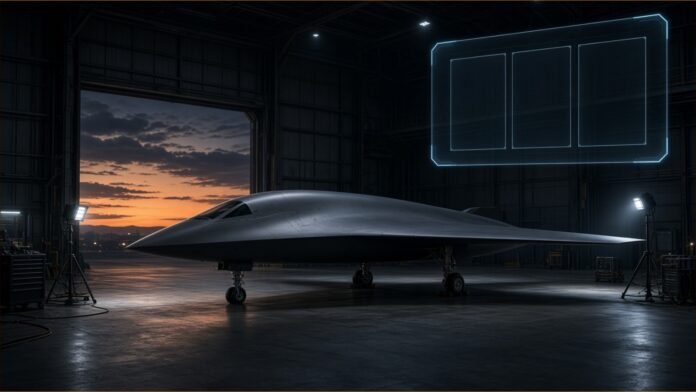
Asked in Sydney on 19 October whether he was disappointed that Germany had lost interest in the Ghost Bat, Australia’s defence industry minister pushed back on the premise. “I wouldn’t characterise the German decision like that,” Pat Conroy said. “My understanding is that the German government has adopted a slightly different procurement strategy where they intend to run a competition.”
That strategy change is a setback for Boeing’s MQ-28 Ghost Bat, the Australian-built uncrewed jet designed to fly alongside crewed fighters. Germany had planned to buy it directly, according to reports; instead, Boeing will have to beat European rivals in an open contest for Germany’s collaborative combat aircraft, and Germany’s own timetable for fielding one may slip.
Boeing heard first, and Berlin is saying little
The change surfaced three days before Conroy spoke. On 16 October a Boeing spokesperson told Breaking Defense that Germany’s defence ministry had “informed” the company it would not be directly procuring the MQ-28. Politico first reported the decision, according to Breaking Defense. Boeing referred questions about the reasons to the ministry and said it “stands ready to support” Germany on next steps.
The ministry itself has given no public explanation. Its spokesperson told Breaking Defense that, as a “matter of principle—and regardless of the specific case in question—we cannot provide information regarding potential procurement projects,” citing procurement law and “the requirement that such matters first be addressed by parliament.”
Conroy filled in the outline at a press conference at Anduril’s Ghost Shark factory, according to the official transcript. “The German Government has decided to run an open competition to acquire a collaborative combat aircraft. We welcome that move. We welcome that because competition is good. And we’re confident that Ghost Bat is the most advanced collaborative combat aircraft in the world,” he said, describing it as “the first combat aircraft designed and built in Australia in 50 years.”
Boeing and Rheinmetall will bid against European rivals
Australia is backing Boeing Defence Australia “in their efforts to enter” the German competition, Conroy said, noting that Boeing had announced at an air show earlier this year that it would partner with Rheinmetall. According to Militarnyi, the two companies agreed a strategic partnership in March, with Rheinmetall as systems integrator responsible for adapting the drone to the Bundeswehr’s requirements, integrating weapons and handling maintenance. In August they pitched a faster route: take the proven Australian airframe and add German sensors, weapons and software rather than develop a new aircraft.
The field is crowded. Breaking Defense lists Helsing’s CA-1 Europa, which the German firm says will be ready for operations by 2029, and the U740 Valkyrie from Airbus and the US manufacturer Kratos, whose first flight in Europe was announced on 12 October. Airbus said at the time that the milestone confirmed the partners were “on track to deliver a combat-ready uncrewed Collaborative Combat Aircraft (CCA) by 2029.” General Atomics could also offer a design from its Gambit family, the outlet adds.
What Ghost Bat brings is flight history. The aircraft was designed and developed by Boeing Australia and the Royal Australian Air Force, as InnovationAus notes, and it fired an AIM-120 air-to-air missile in tests in Australia in December 2025, Militarnyi reports. InnovationAus describes Germany as having been among the more advanced export prospects for the drone.
A contest trades speed for leverage
Germany had set itself a target of fielding a collaborative combat aircraft by 2029, which would have made it the first European country to do so, Breaking Defense reports. Politico has reported that Berlin will now wait until the early 2030s, with test flights of candidate aircraft starting in 2027, according to Breaking Defense; the German government has not confirmed that timetable.
An open competition gives a buyer more leverage on price and terms, at the cost of time. For Boeing and Canberra, the Ghost Bat’s flight record stops being a reason to skip a contest and becomes an argument to win one, against Helsing and the Airbus–Kratos team. Conroy stressed that “Germany is not the only market that we’re offering it to” and that other countries are interested.
The next marker is procedural: the ministry says procurement matters must first be addressed by parliament, so the Bundestag is where Berlin’s plan should surface, and the 2027 test flights reported by Politico would be the first head-to-head look at the contenders.
Related stories
- Australia’s Ghost Shark Drone Subs Will Carry Sea Mines and Strike Drones
- Germany Signs Net-Firing Interceptor Drone Deal; Report Puts It Above €1.1bn
Sources
- Minister for Defence Industry Pat Conroy: Press Conference, Sydney (transcript), 19 October 2026
- Breaking Defense: Germany changes course on plans to buy MQ-28 drone wingman: Boeing official, 16 October 2026
- Militarnyi: Germany Abandoned Plans to Directly Purchase MQ-28 Ghost Bat Uncrewed Fighter Jets in Favor of Open Competition, 20 October 2026
- InnovationAus: Pat Conroy shrugs off Boeing’s Ghost Bat export setback, 19 October 2026
Follow @tsnmediahub on X for breaking AI news as it happens.
Follow on X