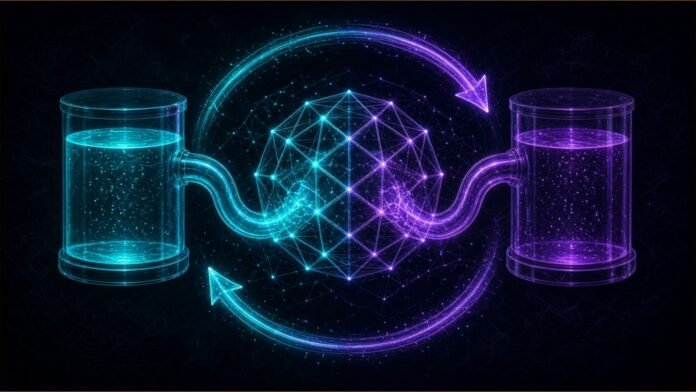
A battery electrolyte made from thioctic acid, a natural sulfur compound, kept 98.1% of its capacity over 2,200 charge cycles in tests at Zhengzhou University, and the spent liquid can be turned back into its raw material with water and acid. The team, led by chemists Wei Guo and Yongzhu Fu, reported the work in Nature Sustainability on 23 October.
Flow batteries store electricity in tanks of liquid rather than in sealed cells, which makes them a natural fit for storing power on the grid for hours at a time. The catch, the authors write, is the negative-side liquid, or anolyte: nobody has found one that combines “high capacity, environmental compatibility, recyclability, low cost and long-term stability”. This paper claims to tick all five boxes in the lab, and the recycling step is what sets it apart.
In brief
- What happened: Zhengzhou University chemists made a flow-battery electrolyte from thioctic acid that kept 98.1% of its capacity over 2,200 cycles, and recovered it from a 63 Wh stack after use.
- Why it matters: grid storage needs cheap, long-lived chemistry, and an electrolyte that can be stripped back to its starting material would cut waste when batteries are retired.
- What’s unknown: how it performs at full concentration over thousands of cycles, what it costs per unit of stored energy, and whether anyone will try to build it at scale.
Sulfur bonds do the work, and acid brings them back
The anolyte is a short chain of thioctic acid units, made by opening the molecule’s five-membered sulfur ring so the units link up. Its sulfur–sulfur bonds are where charge is stored: they break and re-form as the battery charges and discharges. The team says the chain-building step offers “a scalable route to high-concentration redox-active species”.
Paired with a cobalt-based catalyst, the anolyte reached a capacity of 128 amp-hours per litre and used 95.5% of its active material at a current density of 50 mA per square centimetre. In a separate long test, a cell with a carbon-coated membrane kept 98.1% of its capacity over 2,200 cycles at about 70% energy efficiency, running at 100 mA per square centimetre.
Recycling is the part most batteries lack. According to the paper’s supplementary information, the used anolyte is diluted with water and then acidified, and thioctic acid comes out as a solid. Without the dilution step, the team found, the recovered material stayed in chain form. The team ran a 63 Wh stack, using an iron-based electrolyte on the positive side, for more than 20 days, then recovered 75.9% of the thioctic acid from its anolyte. Chemical analysis showed the recovered material matched the original, and cells built with recycled thioctic acid worked.
The authors also put a price on the process. Recycling 100 litres of concentrated anolyte would need about US$0.6 of hydrochloric acid, they estimate, and return 15.6kg of thioctic acid worth up to US$82.7. That sum leaves out the cost of stirring and filtration.
Outside reviewers rate it above vanadium
Nature Sustainability ran an accompanying News & Views article by Sungmin Park and Yongchai Kwon of Seoul National University of Science and Technology. They write that the molecule “not only outperforms the industry-standard vanadium benchmark but also offers exceptional reusability”, and that making water-based flow batteries “truly sustainable” hinges on recycling the organic molecules inside them.
Vanadium is the benchmark the reviewers chose, so that is the bar any newcomer has to clear. The authors’ own framing is that organic anolytes have struggled to combine capacity, recyclability and long-term stability in one molecule. A sulfur chemistry that survives thousands of cycles and can then be recovered goes straight at that problem.
The headline numbers come from different cells
The two most striking figures come from different tests. The 2,200-cycle result was measured at a sulfur–sulfur bond concentration of 0.25 molar, a dilute mix, and the abstract gives no sign that the high-capacity cell was run for that long. Energy for the grid is stored in volume, so the question that matters is whether the concentrated version can hold up for years of daily use. The published summary leaves it open.
The recycling sums are also the authors’ own and deliberately partial. Leaving out stirring and filtration, and saying nothing about labour or plant, is reasonable for a lab estimate, but those are the costs that decide whether a utility bothers to recover the chemicals. Even so, the gap between less than a dollar of acid and more than eighty dollars of recovered material leaves room for those extra costs.
What makes the work stand out is the order of priorities. Most battery research chases capacity first and treats end-of-life as a problem for later. This team designed for recovery from the start and still reached competitive capacity, much as the team behind enzyme-embedded plastics built breakdown into compostable materials from the start. The same day, a UCLA-led team reported an AI-guided robotic lab that found earth-abundant hydrogen catalysts it calls comparable to platinum.
Storage is already changing grids. Batteries recently beat gas at Australia’s evening peak for the first time, and home batteries in California delivered a record 745MW during a heatwave. More solar, such as the flexible perovskite modules reported this week, means more power made at midday that has to be held for the evening. Long-duration chemistry that can be recycled is one way to hold it.
How we sourced this
The full paper is behind a paywall; this report draws on its abstract, its publicly available supplementary information and the News & Views standfirst. No Zhengzhou University press release was available. The article page lists Yongchai Kwon, a co-author of the News & Views, among the paper’s peer reviewers.
The next test is the one the paper leaves open: a concentrated electrolyte running for thousands of cycles in a stack, and then giving its thioctic acid back.
Sources
- Chen, Q., Ou, H. et al., “A circular oligo(disulfide) anolyte enables practical aqueous redox flow batteries”, Nature Sustainability, 23 October 2026 (doi:10.1038/s41893-026-01970-0)
- Supplementary Information for the paper (PDF)
- Park, S. and Kwon, Y., “Recyclable flow battery chemistry”, News & Views, Nature Sustainability, 23 October 2026
Related stories
- Batteries Beat Gas at Australia’s Evening Peak, AEMO Says
- Sunrun and Tesla Home Batteries Deliver a Record 745MW to California’s Grid
- Flexible Perovskite Solar Modules Reach 20.2% at Commercial Size
Follow @tsnmediahub on X for breaking AI news as it happens.
Follow on X