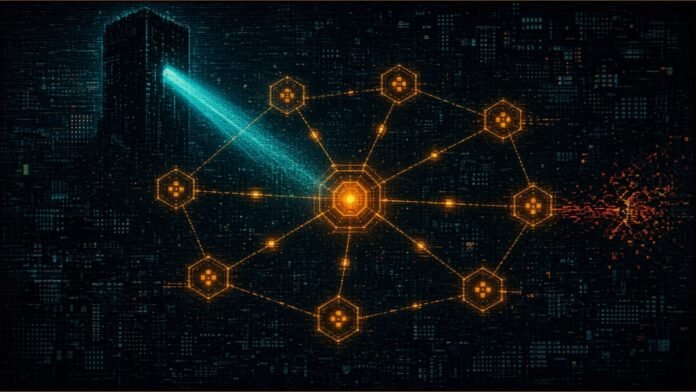
Most people meet AI as a single chatbot: you ask, it answers. An AI agent goes further. It uses tools, such as a web search or a code runner, in a loop until a task is done. An agent swarm goes further again. Instead of one agent doing everything, several agents each take a role and pass work between them, a bit like a small team with a manager.
The idea is moving quickly from research labs into products. TSN has reported on ChatGPT’s GPT-6 Pro gaining multiple agents that work on parts of a task in parallel. This explainer sets out how swarms work, where they help, and where they go wrong.
A swarm is a team of agents, each with a job
Anthropic, which builds Claude, gives a plain definition in its write-up of its multi-agent research system: “A multi-agent system consists of multiple agents (LLMs autonomously using tools in a loop) working together.”
“Swarm” is the looser, catchier word. OpenAI used it for Swarm, which it calls an “educational framework exploring ergonomic, lightweight multi-agent orchestration”. OpenAI says Swarm “is now replaced by the OpenAI Agents SDK, which is a production-ready evolution of Swarm”. Singapore’s Infocomm Media Development Authority (IMDA), in its governance framework for agentic AI, uses the term more narrowly. In a swarm, it says, “Agents work at the same time, handing off to another agent when needed.”
Three common patterns: orchestrators, handoffs and parallel subagents
The first pattern is an orchestrator with workers. Anthropic’s earlier guide, Building effective agents, describes it as “a central LLM” that “dynamically breaks down tasks, delegates them to worker LLMs, and synthesizes their results”. Microsoft’s research system Magentic-One works this way. Its lead agent, the Orchestrator, “plans, tracks progress, and re-plans to recover from errors” while directing other agents to use a web browser, work with files or write and run code.
The second is the handoff. In OpenAI’s Agents SDK documentation, “Handoffs allow an agent to delegate tasks to another agent.” The example is customer support, with separate agents for order status, refunds and FAQs. To the model, a handoff looks like any other tool, such as one called transfer_to_refund_agent.
The third is parallel subagents. Anthropic’s Research feature has a lead agent that plans and then spins up “3-5 subagents in parallel”, each searching a different angle before reporting back.
Where swarms do good: research and science
Anthropic says a system with Claude Opus 4 as lead and Claude Sonnet 4 subagents “outperformed single-agent Claude Opus 4 by 90.2% on our internal research eval”, and that parallelism “cut research time by up to 90% for complex queries”. These are the company’s own tests. Its most common use category for Research was “developing software systems across specialized domains (10%)”.
Science offers a more concrete case. Google’s AI co-scientist is a multi-agent system in which a Supervisor agent assigns work to specialised agents. Google says it proposed drug-repurposing candidates for acute myeloid leukaemia, and that later experiments with partners confirmed the drugs “inhibit tumor viability at clinically relevant concentrations in multiple AML cell lines”. It also points to liver-fibrosis targets that showed activity in lab-grown human liver tissue. All of this happened with “expert-in-the-loop guidance”.
Where swarms go wrong: cost, compounding errors and coordination
The first catch is cost. Anthropic says “agents typically use about 4× more tokens than chat interactions, and multi-agent systems use about 15× more tokens than chats”. It found that “token usage by itself explains 80% of the variance” in performance on one browsing test. In other words, much of the gain comes from spending more.
The second is that mistakes spread. “Agents are stateful and errors compound,” Anthropic writes. IMDA gives an example: a hallucinated inventory figure early in a supply chain could lead later agents to order too much or too little stock. Coordination is hard too. Anthropic’s early agents spawned “50 subagents for simple queries” and duplicated each other’s work.
A team of 13 researchers studied this in Why Do Multi-Agent LLM Systems Fail?. They found that gains on popular benchmarks “are often minimal”, and they catalogued 14 failure modes across more than 1,600 annotated traces from seven frameworks.
Misuse and accountability are the harder risks
Swarms can be used for harm. TSN has reported a security firm’s account, not independently verified, of a criminal group that organised commercial AI models into a team to target banks. A Cooperative AI Foundation report groups multi-agent risks into three failure modes: “miscoordination, conflict, and collusion”.
Then there is the question of blame. IMDA warns that “multiple actors may also be involved in different parts of the agent lifecycle, diffusing accountability”. It wants named human responsibility and human approval before “high-stakes or irreversible actions”. Vendors are starting to build controls, such as ServiceNow’s AI Passport for limiting what agents may do at runtime.
More agents is a trade, not an upgrade
The pattern across these sources is consistent. A swarm buys breadth by spending more compute, which pays off on jobs that split cleanly into independent parts, such as broad research, and wastes money on jobs that are tightly linked. Anthropic itself says most coding tasks have fewer parallel parts than research. Its 2024 advice still holds: start with “the simplest solution possible”, which “might mean not building agentic systems at all”.
That makes the per-task question more useful than the hype. A single agent with good tools may beat a team of five on a simple job, and on Anthropic’s figures a chat uses roughly a fifteenth of the tokens of a multi-agent run. Infrastructure work, such as AWS’s Infinity runtime for parking idle agents, is aimed at bringing that bill down.
Accountability has to be designed in
The beneficial cases share a feature: a human expert stays in the loop and checks the result. Google’s lab work had experts guiding it. Anthropic added a separate citation step and human testers. Harm grows when a swarm acts with no named owner, no audit trail and no checkpoint before an irreversible step. Since errors can pass silently from agent to agent, each handoff is a place to check work, not just to pass it on. A swarm earns trust when someone can say which agent did what, and who signed it off.
Sources
- Anthropic, “How we built our multi-agent research system”, 13 June 2025
- Anthropic, “Building effective agents”, 19 December 2024
- OpenAI, Swarm repository (GitHub)
- OpenAI Agents SDK documentation, “Handoffs”
- Fourney et al., “Magentic-One: A Generalist Multi-Agent System for Solving Complex Tasks”, arXiv:2411.04468
- Cemri et al., “Why Do Multi-Agent LLM Systems Fail?”, arXiv:2503.13657
- Hammond et al., “Multi-Agent Risks from Advanced AI”, Cooperative AI Foundation, arXiv:2502.14143
- Google Research, “Accelerating scientific breakthroughs with an AI co-scientist”, 19 February 2025
- IMDA, Model AI Governance Framework for Agentic AI, version 1.5, May 2026 (PDF)
Related stories
- OpenAI Upgrades GPT-6 Pro in ChatGPT with Parallel Agents
- Straiker Says Cybercrime Group Used Claude and Grok Agents on Banks
- ServiceNow Announces AI Passport to Limit What AI Agents and MCP Servers May Do at Runtime
- AWS Open-Sources Infinity, Saying 75,000 Idle AI Agents Fit in 8GB
Follow @tsnmediahub on X for breaking AI news as it happens.
Follow on X