
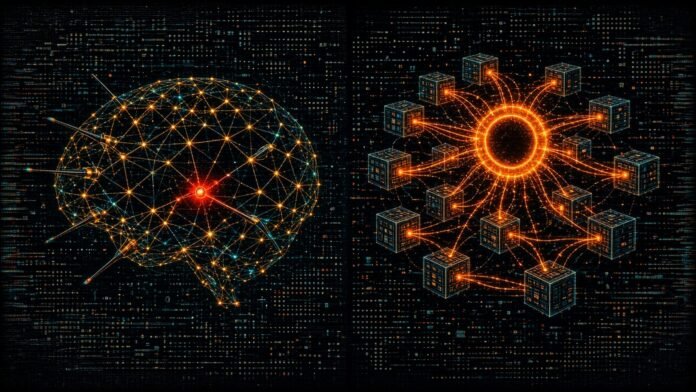
Two launches on 8 October 2026 deal with the machinery behind AI rather than the chatbots on top. One is a cheaper way to spot an AI agent doing something harmful, by reading what happens inside the model. The other is a networking platform meant to link thousands of AI chips as if they were one machine.
Goodfire: monitors that read a model’s internal signals
Confirmed launch; every figure is Goodfire’s own. Goodfire, a start-up that studies how AI models work internally, published research on 8 October describing “probe-based cyber monitors” for the open models Kimi K3 and GLM 5.3, deployed “on a production inference stack” [1].
Most AI monitors are a second model that rereads everything the first one writes. Goodfire’s probes are small classifiers that read the model’s internal activations, the calculations it is already making, as it works. Only suspicious exchanges are passed to a full AI “judge” for a closer look [1].
Who can use it (reported). TechCrunch reports the monitors are available to customers of Baseten, a company that runs AI models for other businesses. Customers choose which risks to watch, including offensive hacking, chemical and biological weapons misuse, and reward hacking, and what happens next: log the event, send it for human review or refuse the request [2]. Goodfire’s research post does not mention Baseten [1].
Goodfire’s claims, quoted exactly [1]:
- The cascade detects “approximately 93% of harmful sessions” while interrupting “at most 5.5% of benign sessions”.
- It “costs $65 without judge reasoning, and $185 with reasoning per one million agent turns”. By Goodfire’s estimate from OpenRouter prices, using Opus 5 as the judge on every turn “would cost on the order of $200K”.
- Against default SGLang serving, throughput showed “a less than 2% decrease, which is within noise”.
- On Kimi K3, harmful-session blocking rose “from roughly 29% to 96%”, while interruptions of harmless sessions rose “from about 5% to 9%”.
Goodfire also asked the safety group FAR.AI to attack the system. In a statement Goodfire publishes, FAR.AI describes “preliminary testing… over a period of two days”. Universal jailbreaks fell from 66 to 0, and jailbroken interactions from 700 to 18 [1].
Upscale AI: Token Fabric
Confirmed announcement; not yet generally available. Upscale AI, a Santa Clara networking start-up, introduced Token Fabric, a full-stack networking platform for “AI factories”. It links “scale-up” networking (chips inside a rack or pod) and “scale-out” networking (pods across a data centre) under one software layer [3].
The company’s specifications [3]:
- SkyFabriX, its own scale-up switch chip, “delivering 115.2 Tbps, with a roadmap to multi-petabits per second (Pb/s)”, supporting the open standards OCP ESUN and UALoE.
- Scale-out switches built on NVIDIA Spectrum-X, at “400G and 800G to 1.6T”.
- SkyOS, a network operating system, and SkyCMD, described as “a single orchestration plane”. Network World reports SkyOS is based on the open-source SONiC [4].
Customers can buy “silicon, systems, software, or the full stack” [3]. Plan: “General availability is planned for early 2027, with early-access and joint-validation programs underway today” [3].
Reported: Network World says Upscale has raised “about $500 million”, has “more than 300 employees”, and that NVIDIA joined its June funding round [4]. The release cites market forecasts from Dell’Oro and 650 Group; those are the analysts’ estimates [3].
What this does not prove
- That Goodfire’s numbers hold up independently. All the recall, cost and throughput figures come from Goodfire’s own tests. Some early coverage gave different numbers, including a 94% detection rate, so TSN uses only Goodfire’s published figures [1][2].
- That the monitors stop every attack. Goodfire still reports some interruptions of harmless work, and FAR.AI’s test was a static, two-day battery, not adaptive attacks [1].
- That Token Fabric is shipping. Only early access is running; general availability is planned for early 2027 [3].
- That its speeds beat rivals’. The figures are Upscale’s specifications, not independent tests [3].
The Bottom Line
Goodfire says reading a model’s internal signals catches about 93% of harmful sessions at a fraction of a full AI judge’s cost, and TechCrunch reports Baseten customers can now switch it on. Those are company claims. Upscale AI’s Token Fabric promises one network for AI chips, but general availability is planned only for early 2027.
Related on TSN: Fences for AI Agents: Microsoft’s Execution Containers and AWS’s Strands Box
Sources
- Goodfire, “Training and Deploying Production Cyber Monitors on Kimi K3”, research post, 8 October 2026 (company research; includes FAR.AI’s statement). https://www.goodfire.com/research/production-cyber-monitors-on-kimi-k3
- Aditya Mehta, “Goodfire says its new ‘inside-out’ monitors catch rogue AI agents at a fraction of the cost”, TechCrunch, 8 October 2026, 17:00 BST (source of the Baseten availability and customer controls). https://techcrunch.com/2026/10/08/goodfire-says-its-new-inside-out-monitors-catch-rogue-ai-agents-at-a-fraction-of-the-cost/
- Upscale AI, “Upscale Introduces Token Fabric, the Industry’s Most Comprehensive Standards-Based Networking Portfolio for AI Factories”, press release, Santa Clara, 8 October 2026, via Public Technologies (company release). https://www.pubt.io/view/B0EA858119B0917F031EF7B4D68C39A195D60C95
- Sean Michael Kerner, “Nvidia-backed Upscale takes on AI networking silos with Token Fabric”, Network World, 8 October 2026 (trade press). https://www.networkworld.com/article/4232707/upscale-takes-on-ai-networking-silos-with-token-fabric.html
, and Upscale AI unveils Token Fabric, a networking platform for AI data centres with general availability planned for early 2027.)