
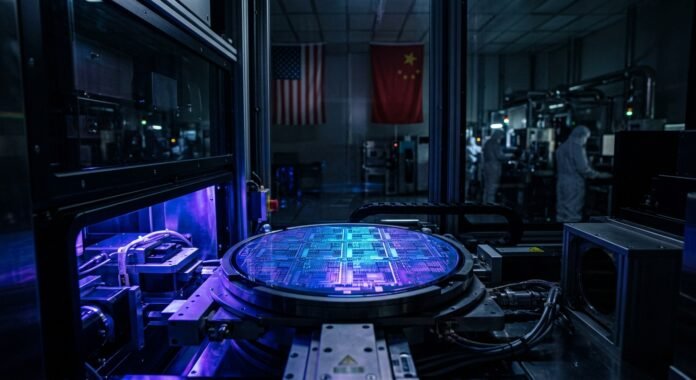

The MATCH Act: Washington’s Newest Weapon in the Chip War
On April 3, 2026, a bipartisan group of U.S. lawmakers introduced a bill that could reshape the global semiconductor supply chain. The MATCH Act — the Multilateral Alignment of Technology Controls on Hardware — aims to cut off China’s access to the machines that make the world’s most advanced chips.
This isn’t another round of executive-branch export controls that can be tweaked or reversed by the next president. This is Congress writing the rules into law. And if it passes, the ripple effects will hit every company in the semiconductor food chain — from the Dutch giant ASML to China’s largest chipmakers.
What the MATCH Act Actually Does
The bill, led by Rep. Michael Baumgartner (R-Wash.) and co-sponsored by House China Committee chairman John Moolenaar (R-Mich.), targets a critical loophole in existing export controls: the equipment, not just the chips.
Current rules block the sale of finished AI chips to China and restrict the most advanced lithography machines. But Chinese companies have still been buying older semiconductor manufacturing equipment — and getting it serviced — from allied companies in the Netherlands and Japan.
The MATCH Act changes that:
- Expands the banned equipment list — immersion deep ultraviolet (DUV) lithography systems, the machines China depends on most, would be fully restricted
- Names specific Chinese companies — SMIC, Hua Hong, Huawei, CXMT, and YMTC are explicitly prohibited from purchasing or receiving servicing on restricted equipment
- Closes the servicing loophole — after-sales maintenance and parts supply to restricted Chinese entities would be banned, ending a grey area that’s persisted for years
- Pushes for allied alignment — the legislation pressures the Netherlands and Japan to implement matching restrictions, ensuring the rules have global teeth
A companion bill is expected in the Senate from Sen. Pete Ricketts (R-Neb.) and Sen. Andy Kim (D-N.J.).
The ASML Problem
The bill’s biggest target is ASML — the Dutch company that holds a near-monopoly on advanced lithography equipment. Under current Dutch regulations, ASML is already barred from selling its most cutting-edge extreme ultraviolet (EUV) machines to China. But the company has continued selling older DUV lines to Chinese chipmakers.
China was ASML’s single largest market in 2025, contributing 33% of total revenue. That share is projected to fall to around 20% in 2026 as existing restrictions take hold. If the MATCH Act passes and allied nations follow suit, ASML’s China revenue could drop to near zero.
💡 $51.1 billion — China’s semiconductor equipment imports in 2025, up from $10.7 billion in 2016. The MATCH Act targets the lion’s share of this spending.
ASML isn’t alone. Tokyo Electron (Japan) and Applied Materials (US) also supply critical equipment and services to Chinese fabs. The bill ensures all three face the same restrictions — eliminating the competitive advantage that came from uneven enforcement.
The Trump Administration Tension
There’s an awkward wrinkle in all this: the Trump administration has recently allowed certain advanced chip exports to China.
While Congress pushes for tighter restrictions through the MATCH Act, the executive branch has been taking a more permissive stance on specific Nvidia chip sales. Senate Democrats have criticized the move, arguing it undermines the broader export control framework.
This creates a policy contradiction: Congress wants to lock down equipment sales to China through legislation, while the administration has been selectively loosening restrictions on finished chips. The MATCH Act is partly a response to this tension — by writing restrictions into law, Congress takes the decision out of the executive branch’s hands.
It’s also a signal to allies. The Netherlands and Japan have been reluctant to impose unilateral restrictions on their companies (ASML and Tokyo Electron, respectively) without clear, lasting commitment from Washington. A bipartisan law — rather than an executive order that can be reversed — provides that commitment.
China’s Counter-Intuitive Boom
Here’s the paradox that makes this story more complex than it appears: US export restrictions are actually boosting Chinese chip revenue.
SMIC, China’s largest chip manufacturer, reported record revenue of $9.3 billion in 2025 — up 16% year-on-year. Analysts expect it to top $11 billion in 2026. Hua Hong posted record quarterly revenue of $659.9 million. Moore Threads, a Chinese Nvidia rival, guided for 231-247% year-on-year growth.
The reason: “rocket fuel.”
That’s how Paul Triolo, a partner at Albright Stonebridge Group, described the effect of US restrictions on Chinese chip demand. When Beijing told domestic tech companies to buy local, they did — even if the chips weren’t as good as Nvidia’s. Huawei stepped in to fill the gap. SMIC filled orders that TSMC could no longer accept.
Memory chip maker CXMT saw revenue jump 130% year-on-year to over $8 billion — driven by the gap left when HBM exports were restricted. Even though CXMT’s technology trails Samsung and SK Hynix by several years, Chinese customers are buying what’s available.
The MATCH Act is Washington’s answer to this dynamic: if restricting finished chips isn’t enough, restrict the machines that make the chips. Cut off the supply chain at the root.
Also worth reading:
Our analysis of TSMC’s 2nm crisis explores how the most advanced chipmaking node is creating its own bottleneck in the AI infrastructure race.
The Servicing Trap
One of the most overlooked provisions in the MATCH Act is the ban on after-sales servicing to restricted Chinese entities. This is a bigger deal than it sounds.
Semiconductor manufacturing equipment isn’t like buying a toaster. These machines require constant maintenance — calibration, parts replacement, software updates, and on-site engineering support. A lithography system that isn’t serviced regularly degrades in performance and eventually becomes unusable.
Under current rules, ASML and Tokyo Electron have continued servicing machines already installed in Chinese fabs. This grey area has allowed SMIC and other Chinese chipmakers to keep operating equipment they purchased before restrictions tightened.
The MATCH Act closes that door. If it passes, ASML engineers stop showing up at SMIC’s fabs. Replacement parts stop shipping. Software updates stop. Over time — likely 12-24 months — the existing installed base of foreign equipment in China degrades to the point where it can’t produce leading-edge chips reliably.
This is the provision that transforms the bill from “stop new sales” to “actively degrade existing capability.” It’s a harder blow than an export ban on new machines.
The Stockpile Race
Chinese companies have been anticipating tighter restrictions. Equipment imports surged in late 2025 as firms rushed to stockpile machines before new rules took effect. That $51.1 billion import figure for 2025 includes a significant amount of front-loading — buying now because they expect the window to close.
But stockpiling only buys time. Equipment degrades. Parts wear out. Technology advances. A machine bought in 2025 will be obsolete by 2028 without continuous upgrades. And without access to the latest equipment, Chinese fabs fall further behind with every product cycle.
The MATCH Act is designed to make the stockpile strategy unsustainable. It’s not just about what China has in its warehouses — it’s about whether those machines can keep running three years from now.
The Three Companies That Matter
The global semiconductor equipment market is concentrated in three countries:
- ASML (Netherlands) — sole supplier of EUV lithography, dominant in advanced DUV. Without ASML, no one can make cutting-edge chips at scale
- Applied Materials (US) — the largest equipment company by revenue, supplies deposition, etching, and inspection tools across the fab
- Tokyo Electron (Japan) — major supplier of coater/developer systems and etching equipment
If the MATCH Act passes and allied nations align, China’s ability to build a fully domestic chipmaking supply chain drops from “difficult but possible” to “nearly impossible at the leading edge.”
Xi Jinping has repeatedly called for “self-reliance and self-strengthening” in semiconductors. He’s told China to pursue independence in “core technologies such as high-end chips.” But China’s domestic chipmaking equipment industry remains years — analysts say more than five — behind the capabilities of ASML, Applied Materials, and Tokyo Electron.
The gap is most severe in lithography. ASML’s EUV machines use light wavelengths of 13.5nm to etch the smallest features onto chips. China’s domestic lithography maker, SMEE, has not demonstrated anything close to this capability. Without EUV, you can’t make chips at 7nm or below — which means you can’t make the GPUs and accelerators that power frontier AI models.
The MATCH Act is designed to ensure this gap doesn’t close. By cutting off DUV equipment (the older but still critical technology) and banning servicing of existing machines, it pushes China’s chipmaking capability back toward mature nodes while Western fabs advance toward 2nm and beyond.
The AI Infrastructure Connection
This bill isn’t just about chips. It’s about who controls the infrastructure layer of the AI economy.
Every AI model — from ChatGPT to Gemini to Claude — runs on chips manufactured by TSMC using equipment from ASML. The entire $650 billion AI infrastructure buildout that hyperscalers are funding depends on a supply chain that passes through exactly three countries: the US, the Netherlands, and Japan.
China has been trying to replicate this supply chain domestically. SMIC can produce chips at older nodes. CXMT is making memory that’s several generations behind Samsung. Huawei is designing competitive GPUs. But none of them can produce at the leading edge without foreign equipment — and the MATCH Act is designed to keep it that way.
The deeper implication: the AI race isn’t just about who has the best models. It’s about who controls the machines that make the chips that run the models.
Washington’s strategy is clear: maintain the equipment chokepoint. As long as China can’t build EUV lithography machines domestically, it can’t produce the most advanced chips. And as long as it can’t produce the most advanced chips, it can’t run AI training at the scale needed to compete with OpenAI, Google, or Anthropic.
What Happens Next
Three things to watch:
1. Allied response. The Dutch foreign ministry declined to comment on another country’s proposed legislation. Japan hasn’t weighed in either. If the Netherlands and Japan don’t match the restrictions, Chinese chipmakers will route purchases through South Korean or Southeast Asian subsidiaries — and the bill’s impact weakens.
2. ASML’s stock reaction. China was 33% of ASML’s revenue in 2025. The market will price in the risk long before the bill becomes law. If ASML’s share price drops 15-20%, that’s the market telling you it thinks this passes.
3. China’s acceleration response. Every restriction has accelerated China’s self-sufficiency push. The MATCH Act will do the same. The question is whether Chinese equipment makers can close a five-year gap before the AI race moves past them — or whether the gap actually widens as Western technology advances.
The chip war just moved from finished products to the machines that make them. That’s a deeper cut — and harder to work around.
The MATCH Act isn’t law yet. It needs to pass both chambers, get signed (or survive a veto), and then get allied buy-in. But the bipartisan support, the explicit company targeting, and the servicing ban signal that Washington is done with half-measures.
For ASML, the clock is ticking on a third of its revenue. For SMIC and Huawei, the window to stockpile equipment is closing. And for the AI industry, the question is no longer “will there be enough chips?” — it’s “who will be allowed to make them?”
Related Reading
- TSMC’s 2nm Crisis: The Chip War That Could Reshape AI — How the most advanced node is creating a bottleneck
- Samsung’s $73 Billion AI Chip Gambit — Why memory is the new oil in the AI race
- NVIDIA GTC 2026: The $1 Trillion Bet on AI Inference — Nvidia’s infrastructure empire
- The Metal Backbone of AI — The supply chain constraints behind chipmaking
Sources
- Bill to ban sale of key AI chipmaking equipment to China — NBC News
- US targets Chinese chipmaking with proposed export restrictions — Reuters
- MATCH Act Targets ASML and Chinese Chipmakers — EconoTimes
- Chinese chip firms hit record high revenue — CNBC
- New U.S. law aims to halt ASML sales to China — Techzine
- US targets Chinese chipmaking — TradingView/Reuters