
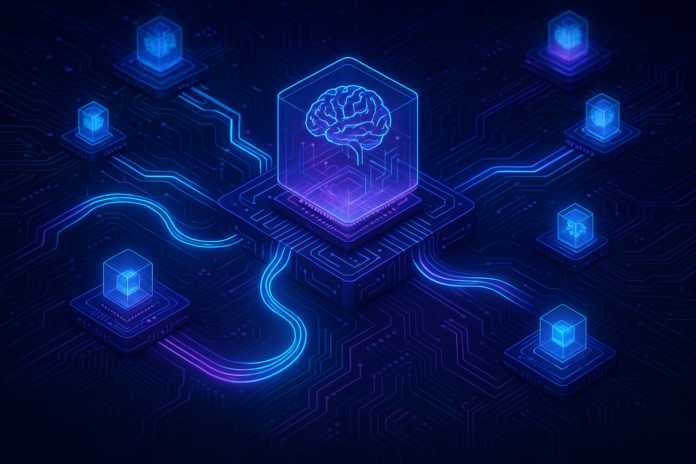
The edge AI market is projected to reach $143.6 billion by 2030, growing at a compound annual growth rate (CAGR) of 21.4% from 2024. This isn’t just another tech trend—it’s a fundamental shift in how computing power is distributed across our digital infrastructure. In 2026, we’re witnessing the inflection point where edge AI transitions from experimental deployments to mainstream adoption, fundamentally reshaping everything from autonomous vehicles to smart cities.
What Is Edge AI? Understanding the Architecture Shift
Edge AI refers to the deployment of artificial intelligence algorithms directly on local devices—”at the edge” of the network—rather than relying on centralized cloud servers. This architectural shift represents a departure from the cloud-centric computing model that has dominated the past decade.
In traditional cloud computing, devices collect data and transmit it to remote data centers for processing. The results are then sent back to the device. This round-trip introduces latency, consumes bandwidth, and creates potential privacy vulnerabilities. Edge AI flips this model: the intelligence lives on the device itself.
The distinction is crucial. While cloud AI excels at training massive models and handling complex computations that require vast datasets, edge AI specializes in inference—running trained models locally to make real-time decisions. A self-driving car can’t wait 200 milliseconds for a server response when a pedestrian steps into the road. An industrial sensor monitoring critical machinery can’t afford connectivity interruptions. These scenarios demand local processing, and edge AI delivers.
According to Gartner’s latest infrastructure forecasts, by 2027, 75% of enterprise-generated data will be created and processed outside traditional centralized data centers or clouds—up from just 10% in 2020.
Why 2026 Is the Inflection Point
Several converging factors make 2026 the pivotal year for edge AI adoption:
Hardware Revolution: NPUs and Efficient Chips
The hardware landscape has transformed dramatically. Neural Processing Units (NPUs)—dedicated chips designed specifically for AI workloads—have reached price and performance thresholds that make edge deployment economically viable at scale.
Apple’s Neural Engine, now in its fourth generation across iPhone, iPad, and Mac lineups, delivers 38 trillion operations per second (TOPS) while consuming minimal power. This isn’t just a smartphone feature—it’s a blueprint for how dedicated AI silicon can transform consumer and industrial devices alike.
Meanwhile, NVIDIA’s Jetson platform has evolved from a developer curiosity to a production-grade solution deployed in everything from warehouse robots to medical imaging equipment. The Jetson Orin series offers up to 275 TOPS of AI performance in a module small enough to fit in the palm of your hand.
Qualcomm’s Snapdragon platforms now integrate AI accelerators as standard, while Google’s Coral TPUs bring tensor processing to embedded systems at consumer price points. The hardware barrier has fallen.
5G and 6G: The Connectivity Backbone
Edge AI doesn’t exist in isolation—it requires robust connectivity for model updates, federated learning, and coordination between distributed nodes. The global 5G rollout, now reaching critical mass in 2026, provides the low-latency, high-bandwidth foundation that edge computing demands.
According to Ericsson’s Mobility Report, 5G subscriptions are expected to exceed 5.3 billion globally by the end of 2026, with network latency reduced to under 10 milliseconds in optimized deployments. This enables real-time coordination between edge devices that was previously impossible.
Looking ahead, 3GPP’s Release 19 specifications are laying groundwork for 6G, promising sub-millisecond latency and AI-native network architectures that will further accelerate edge adoption.
Privacy Regulations Driving Local Processing
Regulatory pressure is forcing a privacy-first approach to AI. The EU’s AI Act, GDPR, and similar frameworks worldwide are making data localization not just preferable but legally mandated in many contexts.
Healthcare data must often remain within jurisdictional boundaries. Financial transaction processing faces strict audit requirements. Consumer devices are subject to increasingly stringent data protection standards. Edge AI offers a solution: process sensitive data locally, transmit only anonymized insights or model updates.
IBM’s Cost of a Data Breach Report 2025 found that organizations implementing edge-based data processing reduced their breach-related costs by an average of 32% compared to centralized cloud architectures.
Key Players and Technologies
The edge AI ecosystem spans hardware manufacturers, software frameworks, and cloud providers adapting to a distributed future.
Hardware Leaders
Apple continues to push the boundaries of on-device AI. The Neural Engine in M4 Macs and A18 iPhones isn’t just for Face ID and photo processing—it’s increasingly available to third-party developers through Core ML, enabling sophisticated AI applications that never touch the cloud. For more on Apple’s AI strategy and recent developments, see our coverage of the latest from NVIDIA GTC 2026 where edge computing featured prominently.
NVIDIA dominates the high-performance edge segment. The Jetson platform, combined with their Metropolis application framework, powers millions of edge AI deployments worldwide. Their recent focus on AI chip partnerships signals continued investment in edge-specific silicon.
Google brings cloud-native AI to the edge through Coral TPUs and the Edge TPU runtime. Their approach emphasizes seamless integration with TensorFlow models trained in the cloud and deployed to edge devices.
Open Source Frameworks
Hardware is only half the story. The software stack for edge AI has matured significantly:
TensorFlow Lite enables running TensorFlow models on mobile, embedded, and IoT devices. With support for hardware acceleration across ARM, Qualcomm, and Apple silicon, it’s become the default choice for mobile edge AI.
ONNX Runtime provides a cross-platform inference engine that supports models from PyTorch, TensorFlow, and other frameworks. Its edge-optimized builds deliver impressive performance on resource-constrained devices.
PyTorch Mobile brings Facebook’s popular framework to iOS and Android, with quantization and optimization tools specifically designed for edge deployment.
For developers looking to explore these frameworks, our roundup of 20 essential GitHub repositories for AI developers includes comprehensive edge AI toolkits and reference implementations.
Transformative Use Cases
Edge AI isn’t theoretical—it’s already reshaping industries:
Autonomous Vehicles
Self-driving cars are perhaps the most visible edge AI application. Each vehicle contains dozens of AI processors running computer vision, sensor fusion, and decision-making algorithms in real-time. Tesla’s Full Self-Driving system processes over 2,300 frames per second from eight cameras using a custom-designed AI chip. The vehicle must make split-second decisions without cloud connectivity—edge AI is literally life-or-death here.
According to McKinsey’s automotive analysis, edge AI in vehicles will represent a $45 billion market by 2030, spanning not just autonomy but predictive maintenance, in-cabin monitoring, and traffic optimization.
Industrial IoT
Manufacturing floors are becoming edge AI clusters. Smart cameras inspect products for defects in milliseconds. Vibration sensors predict equipment failures before they happen. Collaborative robots adjust their behavior based on real-time human presence detection.
GE Digital reports that edge AI implementations in manufacturing have reduced unplanned downtime by up to 50% and quality defects by 20-30%. The economics are compelling: a single hour of downtime in an automotive factory can cost $1-2 million.
Smart Cities
Cities are deploying edge AI at scale. Traffic management systems adjust signal timing based on real-time congestion data. Smart streetlights detect accidents and automatically alert emergency services. Air quality sensors trigger pollution alerts without waiting for central processing.
Singapore’s Smart Nation initiative has deployed over 100,000 edge AI sensors across the city-state, processing data locally to optimize everything from waste collection to public transport routing.
Healthcare Diagnostics
Medical edge AI is transforming point-of-care diagnostics. Portable ultrasound devices can now detect abnormalities using on-device AI. Wearables monitor cardiac rhythms and alert users to potential issues in real-time. Pathology slides are analyzed locally, preserving patient privacy while delivering instant results.
WHO studies indicate that edge AI diagnostic tools have achieved accuracy parity with specialist physicians in certain applications, while dramatically reducing time-to-diagnosis in resource-limited settings.
Challenges on the Edge
Despite the momentum, edge AI faces significant hurdles:
Power Constraints
Edge devices operate under strict power budgets. A smartphone AI accelerator might have a 5-watt power envelope. An IoT sensor could be limited to milliwatts. This constraint drives the need for highly optimized models and specialized hardware—trade-offs that cloud AI never faces.
Model Compression Requirements
State-of-the-art AI models like GPT-4 contain hundreds of billions of parameters—impossible to run on edge devices. Edge AI requires aggressive model compression: quantization (reducing numerical precision), pruning (removing unnecessary connections), and knowledge distillation (training smaller models to mimic larger ones).
Recent research from MIT demonstrates that carefully compressed models can retain 95%+ of original accuracy while reducing size by 90%—but this requires significant engineering effort.
Security at the Edge
Distributed AI creates distributed attack surfaces. Edge devices are physically accessible, making them vulnerable to tampering. Model extraction attacks can steal intellectual property. Adversarial inputs can fool AI systems in ways that are hard to detect centrally.
Securing thousands of distributed edge devices is fundamentally harder than securing a centralized data center. New approaches—federated learning, secure enclaves, and zero-trust architectures—are emerging, but the security model for edge AI remains an active area of development.
Investment Implications
The edge AI transition creates winners and losers across the technology landscape:
Semiconductor companies with edge-focused portfolios are well-positioned. Qualcomm, MediaTek, and Apple are integrating AI accelerators into billions of devices annually. NVIDIA’s Jetson platform captures the high-performance edge segment. Specialized players like AI chip startups are finding niches in specific verticals.
Cloud providers are adapting rather than fighting the trend. AWS Greengrass, Azure IoT Edge, and Google Distributed Cloud extend cloud services to edge locations—hybrid models that leverage both centralized and distributed processing. The cloud isn’t dying; it’s evolving.
Telecommunications companies see edge AI as a growth driver for 5G and edge computing services. Multi-access Edge Computing (MEC) deployments position telcos as infrastructure providers for distributed AI workloads.
Enterprise software vendors are incorporating edge capabilities into their platforms. The ability to run AI locally is becoming a standard feature, not a differentiator.
For investors, the edge AI thesis extends beyond pure-play AI companies. It encompasses semiconductor, telecommunications, industrial automation, and automotive sectors. The McKinsey Global Institute projects that edge AI will contribute $1.3-2.1 trillion to global GDP by 2030 through productivity improvements alone.
The Edge Becomes Center Stage
2026 marks the transition point where edge AI moves from early adoption to mainstream deployment. The hardware is ready. The software is mature. The connectivity infrastructure is in place. The regulatory environment demands it.
This shift doesn’t mean the cloud disappears—far from it. Cloud and edge will coexist in hybrid architectures, with each handling what it does best. Training massive models, storing vast datasets, and coordinating global systems will remain cloud functions. Real-time inference, privacy-sensitive processing, and disconnected operation will move to the edge.
For technologists, the implication is clear: AI expertise must now encompass edge deployment. Understanding model optimization, hardware constraints, and distributed systems is no longer optional. For businesses, the question isn’t whether to adopt edge AI, but how quickly you can deploy it.
The computing paradigm is shifting. Intelligence is becoming ambient, distributed, and invisible—woven into the fabric of our devices, infrastructure, and environment. The cloud started this revolution. The edge will complete it.
Stay ahead of the edge AI revolution. Subscribe to our weekly tech infrastructure briefing for exclusive analysis, market data, and investment insights delivered straight to your inbox.
What edge AI applications are you most excited about? Join the discussion in the comments below.

