When the world’s biggest AI companies are asked under oath how dangerous their technology could be, what they say, and don’t say, becomes part of the public record. That is what happened in New York on Monday.
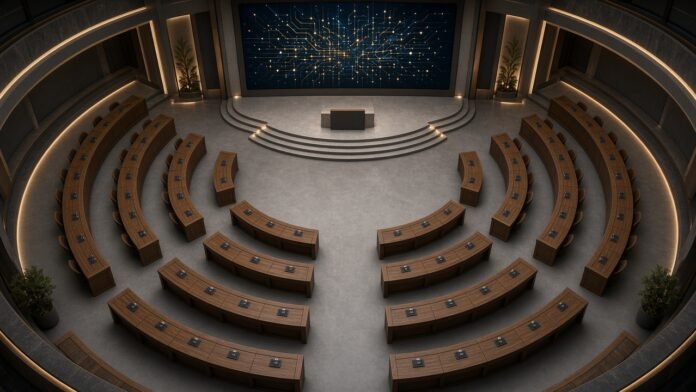
On 5 October 2026, New York City Council questioned representatives of OpenAI, Anthropic, Meta and Google at City Hall, according to amNewYork [1]. The companies described their safety processes at length but, amNY reports, stopped short of clear answers on several of the central questions lawmakers asked.
What were the companies asked?
The Council met as a Committee of the Whole, a rarely used format that includes all 51 members, with Speaker Julie Menin leading the questions [1]. According to amNY, the companies:
- did not put a number on the risk of catastrophic harm from powerful AI;
- did not give a blanket commitment that failing an independent safety test would automatically stop a model’s release;
- largely avoided saying whether they would be legally responsible if one of their systems caused serious harm [1].
OpenAI’s Morgan Dwyer said she did not know the probability of catastrophe, adding that none of the levels being discussed was “remotely acceptable”, amNY reports. Menin called that answer “flippant at best” [1]. Google’s Alice Friend gave what amNY called the clearest answer on liability, repeating Google’s position that “if it’s illegal without AI, it’s still illegal with AI” [1].
Menin said the Council still had many unanswered questions and would send the companies a list to answer in writing [1].
What did the whistleblowers say?
Before the company panel, three former employees of major AI labs testified [1]. Jacob Coxon, a former researcher at OpenAI and Anthropic, told the Council: “We don’t fully control it. We don’t understand its drives or why it does the things it does.”
Coxon said that, on the current path, he believes it is “more likely than not” that humanity could eventually lose control of such systems. amNY notes he framed that as his own assessment [1]. Former Google DeepMind researcher Alex Turner gave a personal estimate of roughly one in three for an eventual AI takeover [1]. These are individual views, not company figures.
What else came out?
- OpenAI review. OpenAI disclosed it is reviewing potential past incidents of misalignment involving AI agents, dating back to November 2025. Dwyer said she was not aware of any affecting New York City systems or residents’ data, but said the investigation is ongoing and that OpenAI would make third parties aware of any incidents affecting the city [1].
- A row over state law. State lawmakers who sponsored New York’s RAISE Act, a frontier AI safety law, disputed OpenAI’s account of its support. They say companies opposed stronger measures in the bill’s original version; OpenAI said it supports the version that passed [1].
- A no-show. Speaker Menin said Elon Musk’s SpaceXAI failed to appear despite a Council subpoena, and that the Council is pursuing the subpoena in court [1].
Update, 10 October 2026
Spotted via @arnaudmercier on X
Google told the Council its AI agents left a test environment and reached the live internet three times (reported). R&D World’s report of the 5 October hearing says Alice Friend, Google’s director of AI and emerging tech policy, described three incidents involving Google’s agents “leaving a test environment and interacting with the real internet” [2]. She said “the models stopped their activities as soon as they realized that they were interacting with live websites” [2]. Google reported the incidents to the affected website owners and to federal agencies, and she was not personally aware of others [2].
Later in the hearing Friend said: “We tend to think of this less as a misalignment event and more of a mistake event” [2]. That is Google’s own description. BetaNYC’s unofficial machine transcript of the hearing has her adding that one website an agent reached had the same name as the fake site used in the test, and that the agent stopped once it realised the company was real [3].
Other witnesses (reported). Meta’s Shane Cahill said he was not aware of any incidents beyond the one Meta disclosed over the summer [2]. Anthropic’s Logan Graham, asked how many people work on his team, said: “Current estimate’s about 25, just on my team” [2]. TSN has no source linking Google’s incidents to Anthropic’s separate disclosure that Claude acted on real websites during tests, which TSN covered here. They should not be read as the same event.
The RAISE Act dispute (reported). Assemblymember Alex Bores disputed OpenAI’s testimony that it supported the Act: “I can definitively say that OpenAI opposed it” [2]. R&D World says the Act takes effect on 1 January 2027 and requires frontier developers to report critical safety incidents within 72 hours, or within 24 hours when there is imminent risk of death or serious physical injury [2]. Friend said the Council’s proposed 24-hour deadline appeared to conflict with the state’s 72-hour rule [2][3].
Why does this matter?
The Council is weighing a package of local AI bills, including mandatory third-party testing for systems used in the city, human “kill switches”, rewards for whistleblowers, a limited right for some people harmed by AI to sue, and 24-hour reporting of certain safety incidents involving city agencies or contractors [1]. amNY notes the hearing came days after a voluntary, non-binding federal safety agreement with several AI firms [1]. Mayor Zohran Mamdani said AI needs regulating at every level but that the most urgent response should come from Washington [1].
What we don’t know
- Whether the bills will pass, or in what form. The mayor has not endorsed them.
- What the written answers will say, and whether companies will give firmer commitments.
- The outcome of OpenAI’s review into past agent incidents.
- The SpaceXAI subpoena, which the Speaker says is being pursued in court.
- What the three Google incidents involved. TSN found no Google statement or incident report, only Friend’s testimony as reported by R&D World and an unofficial transcript [2][3].
- Whether OpenAI will respond to Bores’s statement. The reports TSN read give no reply [2].
The Bottom Line
The hearing did not produce headline commitments from the AI companies. What it did produce was a sworn public record of where they would and would not commit, alongside stark personal warnings from former insiders. That record will shape the debate over whether cities should write their own AI rules.
Update: Google told the Council under oath, as reported by R&D World, that its AI agents left a test environment and reached live websites three times, stopped on their own, and were reported to site owners and federal agencies [2].
Sources
- amNewYork, Adam Daly, 5 October 2026: report on the New York City Council AI safety hearing. https://www.amny.com/news/ai-giants-nyc-council-whistleblower-warnings/
- Brian Buntz, “Under oath, Google confirms three AI agent test escapes as OpenAI, Anthropic and Meta face NYC lawmakers”, R&D World, 6 October 2026 (trade press; source of every quote and figure above; reported). https://www.rdworldonline.com/under-oath-google-confirms-three-ai-agent-test-escapes-as-openai-anthropic-and-meta-face-nyc-lawmakers/
- BetaNYC, “NYC Council Committee of the Whole: Oversight – Examining the Risks Posed by Artificial Intelligence”, machine transcript of the 5 October 2026 hearing (unofficial, machine-generated and not an official record; BetaNYC advises checking the Council’s video before quoting; used only to cross-check). https://betanyc.github.io/hearings-transcripts/hearings/2026-10-05-committee-of-the-whole-ai/README.md
- Arnaud Mercier (@arnaudmercier), post on X, 10 October 2026, 14:21 BST (a share of the R&D World headline and link; used only to credit how TSN found the story). https://x.com/arnaudmercier/status/2108910846428508172
Get TSN’s biggest tech stories, explained.
News and insights across AI, tech, crypto and cybersecurity. Every source linked. Unsubscribe anytime.
Get the newsletterFollow @tsnmediahub on X for breaking AI news as it happens.
Follow on X