
On 9 October 2026 the journal Nature Physics published a study in which an IBM quantum computer repeatedly checked and reset some of its own qubits (the quantum version of bits) while a calculation was running. It tests a technique that future error correction will need. It does not show an error-corrected computer.
What the study reports
Peer-reviewed (Nature Physics). The paper, “Order from chaos with adaptive circuits on quantum hardware”, is by researchers at Rutgers University, IBM and other institutions [1]. Its abstract says the experiments ran “on an IBM superconducting quantum processor with up to 100 qubits”, using a quantum version of a chaotic mathematical map that “scrambles quantum information, whereas local measurements and feedback attempt to steer the dynamics towards a fixed point of the map” [1]. Rutgers says the chip was a 156-qubit IBM Quantum Heron processor, with “a connected chain of as many as 100 qubits” [2].
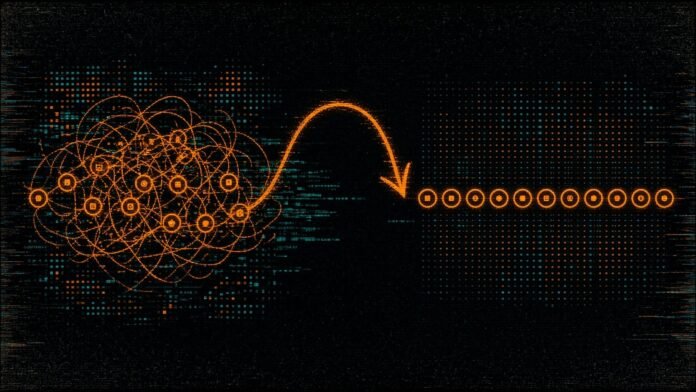
Think of shuffling a deck of cards while sometimes putting cards back in a set order. Rutgers says the team performed “nearly 5,000 operations that linked pairs of qubits, along with nearly 5,000 checks and resets” [2]. The abstract puts it as “up to nearly 5,000 entangling gates and 5,000 non-unitary mid-circuit operations” [1]. When shuffling dominated, the system stayed chaotic; when checking and resetting dominated, the team could steer it. Near an even balance it switched abruptly, which the abstract calls “a dynamical phase transition” [1]. Rutgers adds that, according to the researchers, it was “the largest successful demonstration of this approach to date” [2]. That is the researchers’ own comparison.
Why error correction needs this
A qubit’s state is easily disturbed, so quantum error correction uses extra qubits to check on the working ones, again and again. Each check is a measurement taken partway through the calculation (“mid-circuit measurement”). The checking qubit is then reset so it can be reused, and the result has to be read and acted on quickly, while everything else keeps running. That is the “real-time feedback” in Rutgers’ release. Rutgers’ Jedediah Pixley says a fault-tolerant machine must make such checks “not just once or twice, but a huge number of times during a calculation” [2]. TSN described the same ingredients in its Quantum Hardware Check.
What this does not show
- A fault-tolerant computer. Rutgers defines one as a machine that “can keep computing correctly even though its individual quantum bits are constantly making small mistakes”, and says “No one has yet built such a device” [2].
- Error-corrected qubits. The abstract describes steering a scrambling process, not protecting stored data, and neither it nor the release mentions error-corrected “logical” qubits. TSN could read only the abstract; the full paper is behind a subscription.
- An independent view of its importance. “Landmark” and “critical step” are Rutgers’ and its researchers’ words [2], not an outside assessment.
The Bottom Line
A Nature Physics paper reports that an IBM chip, on a chain of up to 100 qubits, ran nearly 5,000 two-qubit operations alongside about 5,000 mid-circuit checks and resets (Rutgers’ wording), and that this steered a chaotic process into a controlled one. It is a demonstration of a building block. Error correction at useful scale is still to be shown.
Related on TSN: Quantum Hardware Check: DARPA’s Final Test Stage, Universal Quantum’s $100m Round and New Error-Correction Results
Sources
- Bibek Pokharel et al., “Order from chaos with adaptive circuits on quantum hardware”, Nature Physics, published 9 October 2026 (peer-reviewed; abstract read on the journal page, full text subscription-only). https://www.nature.com/articles/s41567-026-03470-6 (DOI 10.1038/s41567-026-03470-6)
- Rutgers University, “Scientists Move a Step Toward Quantum Computers That Can Correct Their Own Mistakes”, 9 October 2026 (university release; source of the Heron processor, chain length, operation counts, “largest” claim and quotes). https://www.rutgers.edu/news/scientists-move-step-toward-quantum-computers-can-correct-their-own-mistakes
