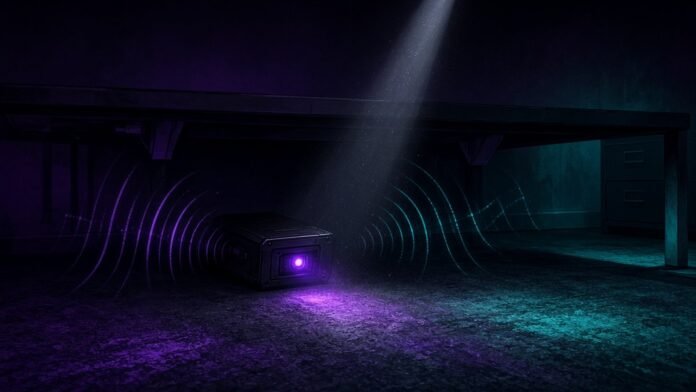
An OpenAI engineer has been arrested and charged after a hidden audio recording device was found in an executive conference room at one of the company’s San Francisco buildings, the US Justice Department said on 13 October 2026 [1]. The case rests on a criminal complaint. The charges are allegations, and he is presumed innocent unless and until proven guilty in court.
The Justice Department said Abdulrahman Alfozan, 35, a national of Saudi Arabia, was charged with “using or endeavoring to use an electronic, mechanical, or other device to intercept oral communications” [1]. He was arrested on 9 October and made his first appearance in federal court on 13 October.
What the complaint alleges
According to the Justice Department’s account of the complaint, Alfozan had worked at OpenAI as an engineer since July 2025 [1].
- The first device. On or about 30 September, OpenAI staff found a hidden audio recording device plugged into a USB port on the back of a television in an executive conference room. The department said OpenAI determined the device, which had been “concealed in toilet paper”, was installed on or about 28 September, and that its contents were encrypted.
- Camera footage. CCTV allegedly showed Alfozan near the room on several dates before the device was found, although, the complaint says, he “had no authority to access” the room or join meetings there. Those meetings often covered highly confidential technical, commercial and strategic information, according to the complaint.
- Questions about meeting rooms. Before 28 September, he allegedly used a productivity tool to ask about OpenAI’s building addresses, meeting rooms and calendars, “leadership and exec” locations and external partner meetings.
- Chatbot prompts. A chatbot account linked to his spouse, which the department said shared several identifiers with his own account, allegedly asked between 24 and 30 September about “build[ing] a continuous audio recorder” and “encrypt[ing] the SD card”, among other things. The same account also allegedly asked about the first device’s custom header and MAC address on 27 and 28 September.
- Return to the room. On 5 October, the complaint alleges, he went into the conference room and appeared to look behind the television.
- A second device. Also on or about 5 October, he allegedly left a bag unattended in another room. OpenAI security staff opened it and found, among other things, his wallet and ID and a second recording device similar to the first.
What officials said
FBI Director Kash Patel said: “According to the complaint unsealed today, Abdulrahman Alfozan allegedly concealed a covert recording device inside his employer’s executive conference room to secretly capture sensitive communications about the company’s super intelligence technology” [1].
Director of National Intelligence Jay Clayton said the case “underscores why winning the global super intelligence race is a national security prerogative” [1].
Craig H. Missakian, the US Attorney for the Northern District of California, said the arrest “highlights our relentless efforts in partnership with the FBI to identify and prosecute those who seek to steal our technology, as alleged in the complaint” [1].
What OpenAI said
In a post on X, OpenAI said it “discovered a sophisticated recording device that was hidden inside one of our offices”, used its models “to understand the device and where it had come from”, identified “that a specific employee had planted it a few days earlier”, and referred the matter to the FBI [2].
In the same post, as quoted by Reuters, OpenAI said: “At this time, we have no indications of this individual inappropriately accessing or exfiltrating model weights, source code, or customer data. The employee was terminated” [3].
What happens next
If convicted, Alfozan faces a maximum penalty of five years in prison and a $250,000 fine, followed by three years of supervised release, the department said [1]. The FBI is investigating. Assistant US Attorney Nicolas Parker is prosecuting, with help from the National Security Division’s Counterintelligence and Export Control Section.
The Justice Department has not said why the device was allegedly installed, or whether anyone else was involved. Those are not part of the charges described in its release.
Why it matters
- The threat was physical. AI labs often focus on hacking and leaked code. This case, as alleged, involved a cheap gadget hidden behind a TV in a room where executives met.
- AI is now treated as national security. Both the FBI and the intelligence chief described the case in terms of the race for “super intelligence”, and the department linked the prosecution to a presidential memorandum on the technology.
- These are only charges. Nothing has been proven in court.
Sources
- US Department of Justice, Office of Public Affairs, “Saudi National Arrested for Installing Surreptitious Audio Recording Device at OpenAI”, 13 October 2026. https://www.justice.gov/opa/pr/saudi-national-arrested-installing-surreptitious-audio-recording-device-openai
- OpenAI Newsroom (@OpenAINewsroom) on X, 13 October 2026. https://x.com/OpenAINewsroom/status/2110095403198849132
- Reuters (Jaspreet Singh), “OpenAI employee arrested over hidden listening device, company says”, 13 October 2026, as published by NBC News. https://www.nbcnews.com/tech/tech-news/openai-employee-arrested-hidden-listening-device-company-says-rcna603262
Related stories
- US Charges 14 People Over Alleged North Korean IT Worker Scheme and Raids Texas “Laptop Farms”
- Microsoft CEO Satya Nadella Says AI Models Should Be Treated Like Insider Risks
- Super Micro-Linked Contractor Willy Sun Pleads Guilty in the Nvidia-Server China Diversion Case, Reuters and Bloomberg Report
- OpenAI Says It Broke Up Two “False Front” Influence Operations, One Its Most Far-Reaching Yet