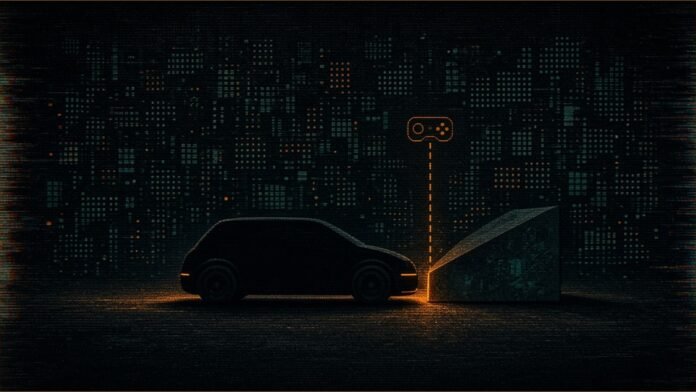
Tesla has told US safety regulators that a remote support operator, not the car’s automated driving system alone, was in control when two of its Robotaxi vehicles made low-speed contact with objects in August 2026. TSN checked the records in the National Highway Traffic Safety Administration’s (NHTSA) Standing General Order ADS crash file.
Electrek reported the same filings on 15 October and framed them as part of a wider pattern: five Robotaxi crashes in the federal data in which a remote takeover ended in contact. That “five for five” count is Electrek’s analysis, not an official NHTSA statistic.
Nobody was injured in the two newest cases. Both were property-damage-only, at about walking speed, with no passengers aboard.
What Tesla’s reports say
Under NHTSA’s Standing General Order, companies must report certain crashes involving automated driving systems (ADS). In the September 2026 monthly release, Tesla filed two reports for August incidents. TSN verified both in the public CSV.
Dallas (report 13781-16678). A 2026 Model Y, coded Driver/Operator Type “Remote (Commercial / Test),” Engagement Status “Verified Engaged.” Tesla’s narrative says: the ADS was stopped on a residential street between a concrete mixer truck on the right and a parked SUV on the left. “The remote support operator remotely took control and while moving forward, the vehicle made contact with the SUV at approximately 0.40MPH.” No passengers were present. Highest injury severity: property damage only.
Austin (report 13781-16679). Another 2026 Model Y, same remote-operator code and “Verified Engaged.” Narrative: the remote support operator was in control, proceeding straight through an alley with a utility pole on the right and a dumpster on the left, and “made contact with the dumpster at approximately 1MPH.” Again, no passengers; property damage only.
In TSN’s count of the ADS file, Tesla, Inc. has 36 unique Report IDs. Exactly three are formally coded “Remote (Commercial / Test)”: the two August cases above, plus an earlier Houston case (13781-15395) in which a remote operator recovering a car from a dead-end road contacted a hidden tree stump.
Electrek’s five-crash framing
Electrek said Tesla now has 36 unique Robotaxi incident reports, up from 22 when it last counted in July. It credits two more remote-takeover crashes that appear in older narratives Tesla unredacted earlier: an Austin fence contact at about 8 mph (July 2025) and an Austin construction-barricade contact at about 9 mph (January 2026). Together with Houston and the two new reports, Electrek counts five remote takeovers that all ended in contact.
“Here’s the problem,” Electrek wrote. “Tesla doesn’t disclose how often remote operators intervene, so there’s no way to calculate a rate. But five remote takeovers have surfaced in the crash data, and all five ended in contact.”
TSN’s CSV check supports the three formally coded remote cases and the overall Tesla report count of 36. The other two in Electrek’s five rely on Electrek’s reading of earlier unredacted narratives, which TSN has not independently re-parsed from archived CSV versions for this post.
How this differs from advice-only remote help
Tesla’s filings describe a remote support operator taking control and moving the vehicle. That is different from remote staff who only advise software that keeps driving.
Waymo, in a February 2026 letter to Senator Ed Markey that TSN fetched, said it “has not used remote driving or ‘tele-operations’ where a human performs the Dynamic Driving Task.” It described a narrow tool that could prompt a stopped vehicle to move forward at 2 mph at fixed steering angles to clear a lane, and said that tool “has never been used outside of training.” That is Waymo’s own claim, included here only for context; this post is about Tesla’s filings.
What this does not show
- These two crashes do not show passengers were at risk: Tesla says none were aboard.
- Low speed (0.4–1 mph in the newest narratives) is not evidence of high-speed failure.
- Without intervention rates, five-for-five in crash reports is not a rate of how often remote driving fails.
- The records do not explain latency, camera views or training for remote operators.
What this means
- Remote control, then contact. Tesla’s own narratives say a remote operator was driving when the Dallas and Austin cars hit objects.
- A pattern Electrek is tracking. Electrek counts five remote-takeover crashes in the data that all ended in contact; only three are formally coded remote in the current CSV.
- Still Level 4 operations with human backup. When the ADS gets stuck, Tesla’s filings show humans can take the wheel remotely — and sometimes bump things.
Sources
- NHTSA Standing General Order ADS incident reports (CSV), reports 13781-16678, 13781-16679 and 13781-15395
- Electrek, “Tesla remote operators keep crashing the company’s robotaxis”, 15 October 2026
- Waymo response letter to Sen. Ed Markey on remote assistance, February 2026 (PDF)
Related stories
- Tesla Cybercab: A Philadelphia Crash, Texas Registry Growth and a 300+ Austin Claim
- Tesla’s Own Report to US Regulators Marks Driver-Assist as “Verified Engaged” in a Fatal Crash in Vineland, New Jersey
- Tesla’s Robotaxi Fleet Just Got Wireless Charging. Here’s Why It Matters for the Autonomy Thesis.
- Tesla: The Last 12 Months, What Shipped, What Slipped and What Is Only Planned
Follow @tsnmediahub on X for breaking AI news as it happens.
Follow on X