Hitachi, Brookfield Japan, Hartree and Tokyo Gas said on Monday, 19 October 2026, that they signed a Memorandum of Understanding (MoU) on 30 September to collaborate on green data centres in Japan. The joint release is on Hitachi’s site as a PDF (Tokyo Gas also published a copy).
The MoU now includes Tokyo Gas and builds on a previous MoU signed by Hitachi, Brookfield and Hartree that was announced in July 2025. It is a collaboration agreement to develop a concept — not a disclosed build contract with megawatts, fuel choice, sites or capex.
What they say they are aiming for
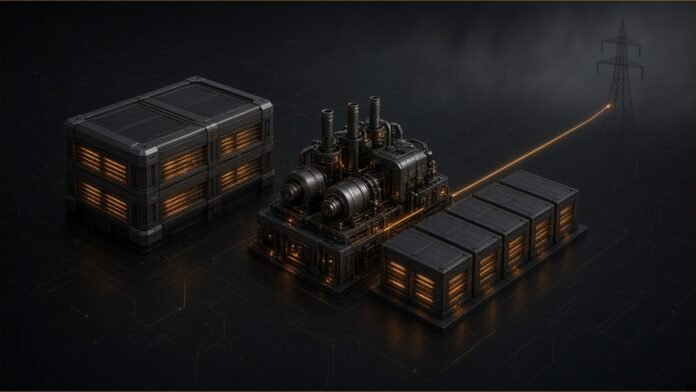
Through the MoU, the four companies will formulate a basic concept for “power-integrated green data centers that generate their own energy,” utilise it reliably and efficiently, and contribute to decarbonisation through green energy and other related measures, while promoting a “standardized model that can be deployed flexibly.”
Stated aims include:
- reduce excessive reliance on the power grid
- expand data centre siting options
- promote local production and consumption of energy
- shorten project lead times
- enable scalable deployment
The four-part model (release wording)
The companies describe a standardised green data-centre model with high reliability across energy supply and operations:
- Energy supply combining multiple power sources — “uses on-site generation facilities as the primary power source and combines multiple other sources, including battery storage and grid power.”
- Redundancy across the entire infrastructure — including cooling and power distribution equipment, to keep operations stable through equipment failures or power-supply fluctuations.
- Definition of decarbonisation requirements — including utilisation of carbon credits, environmental attributes, renewable energy, and other measures.
- Standardisation and modularisation of major facilities — data-centre buildings and equipment, plus on-site power plants and related kit — aiming to “shorten data center project lead times” and scale with demand.
First projects: Kanto and Kyushu
“As their first projects under the Collaboration, the four companies will conduct due diligence and formulate a development plan, including the facility configuration and business model for green data center projects in the Kanto and Kyushu regions.”
They will also seek more partners — IT companies, manufacturers that use data centres, and financial institutions.
Brookfield figures in the release
The joint release’s company-strengths table credits Brookfield with:
- 150+ data centres and “~2GW of operating data center capacity” globally
- “~47GW of operating renewable power generation”
- bringing online “~8GW of new generation capacity annually”
Those are Brookfield figures as stated in the joint release, not TSN measurements. Brookfield Japan CEO Luke Edwards is also quoted saying Brookfield has “more than US$100 billion deployed across data, power and compute assets” and a “US$144 billion” renewable-energy portfolio — again, his/company wording in the release.
Why Japan’s grid shows up in the background
The release’s background section points to surging AI-driven data-centre electricity demand, longer lead times for securing power capacity amid grid constraints, and Japan’s Green Transformation (GX) push, including the Ministry of Internal Affairs and Communications’ “Watt-Bit Collaboration” framing. That is context the parties themselves give for why an on-site-primary model is being explored — not independent grid analysis by TSN.
Caveats — read before calling this “green power”
- This is an MoU only. No MW, investment, fuel type, exact site or construction timeline is disclosed.
- Decarbonisation language in the release includes carbon credits and environmental attributes. Footnote 2 says measures contribute to decarbonisation by offsetting — fully or partially — greenhouse-gas emissions over the fuel lifecycle (mining to combustion) through carbon credits (carbon offsetting) as well as non-fossil fuel certificates and other environmental attributes.
- Do not call the planned sites zero-carbon or simply “renewable-powered.” On-site generation is the primary source in the concept; the grid and batteries are also in the mix; offsets are explicitly part of the decarbonisation toolkit.
- Tokyo Gas’s own “Power Hybrid DC Solution” brand (mentioned in the About section) combines grid power with on-site gas cogeneration — useful colour on Tokyo Gas’s toolkit, not a statement that the MoU projects will use gas.
What’s still unknown
- Generation fuel and plant sizes for Kanto / Kyushu
- Whether projects proceed past due diligence
- Capex, customers and energisation dates
- How much of any “green” claim will rest on credits versus on-site renewables
What this means
On 19 October 2026, Hitachi, Brookfield Japan, Hartree and Tokyo Gas published a joint release saying they signed an MoU on 30 September — adding Tokyo Gas to a July 2025 three-party understanding — to develop a standardised model of power-integrated green data centres that generate their own energy in Japan, starting with due diligence and development plans in Kanto and Kyushu. Until capacity, fuel and sites appear, treat this as a framework MoU, and keep decarbonisation claims tied to the release’s own mix of on-site power, grid, batteries, renewables and credits.
Sources
- [1] Hitachi / Brookfield / Hartree / Tokyo Gas joint press release PDF, 19 October 2026
- [2] Tokyo Gas English PDF copy of the same release, 19 October 2026
Related stories
- Microsoft Reportedly Pulls Out of Nscale’s Loughton AI Data Centre in Essex
- Enerflex Wins Contract for Over 1 GW of On-Site Gas Power for a North American Data Centre
- SemiAnalysis Forecasts 50GW of New Data Centres in 2027 and Rebuts a Sceptic
- Hitachi Energy and Ansaldo Energia Sign an MoU to Offer Combined Generation and Grid Packages
- Mitsubishi Heavy Industries and Ingeteam Sign a US MoU on Power for AI Data Centres
Follow @tsnmediahub on X for breaking AI news as it happens.
Follow on X