In brief
- Meta Engineering (19 October 2026) says the first phase of Prometheus, its “gigawatt-scale supercluster” in New Albany, Ohio, is already complete.
- For anyone watching AI CapEx, Meta says the site now holds hundreds of thousands of GPUs across interconnected buildings and was used to train the Muse foundational models, with a path toward ~1 million GPUs.
- What’s still unknown: total power draw, an exact GPU count, and project cost — Meta does not give those figures.
Two years ago New Albany was a conventional web-traffic site. Meta says it reworked the campus for frontier-model training, with closed-loop liquid cooling and a dedicated GPU back-end network.
What has Meta built so far?
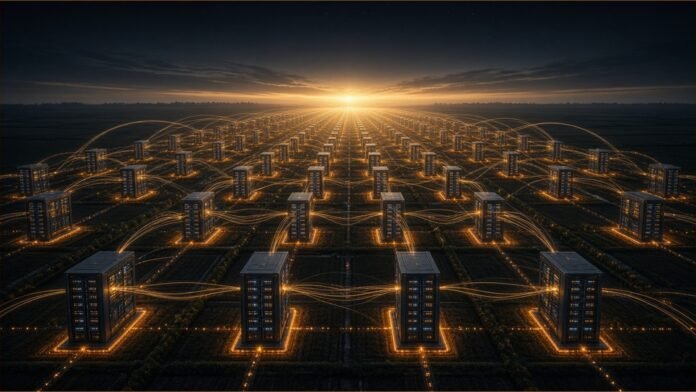
“The first phase of Prometheus, our gigawatt-scale supercluster, is already complete and we’re working toward scaling it to comprise ~1 million GPUs,” the company writes. Today it “comprises an array of hundreds of thousands of GPUs across multiple interconnected buildings.”
| Item | Meta’s description |
|---|---|
| Site | New Albany, Ohio |
| Status | Phase one complete |
| Scale now | Hundreds of thousands of GPUs |
| Target | Toward ~1 million GPUs |
| First use | Train Muse foundational models |
| Power / cost | Not disclosed |
Which GPUs are in the cluster?
Meta names two live NVIDIA NVL72 platforms and a third arriving soon:
- Catalina — NVIDIA GB200 NVL72 (Ariel two-rack variant), ~120 kW per pair, 800G scale-out per GPU
- Clemente — NVIDIA GB300 NVL72, 288 GB HBM3e per GPU, ~135 kW rack, Meta cites a 5–10% performance lift over GB200 NVL72
- Next — a platform based on NVIDIA’s Vera Rubin NVL72, “arriving soon”
How reliable is training on it?
Meta says it achieved more than 85% goodput for Muse Wonder pre-training and more than 90% for reinforcement-learning runs. Wall-clock mean time between interruptions moved from about 47k to more than 54k GPU hours after firmware fixes.
Interruptions peaked at “nearly 1,000 events per 8K GPUs daily” in mid-2025; Meta claims a subsequent 99% reduction.
How is the network built?
Building-level Ethernet fabrics interconnect up to 20,736 GPUs. An aggregation network spans 2 km to over 100 km on Arista 7800 / Broadcom Jericho3 gear — Meta’s answer to training across multiple buildings as one machine.
Who is affected?
- Competitors and suppliers sizing hyperscale AI campuses
- Researchers using Muse / Meta APIs that rode this stack
- Ohio communities and utilities hosting a gigawatt-class AI load
Our read
Prometheus is Meta’s public case that multi-building, multi-generation GPU fabrics can hold agentic-model training together — goodput and interruption maths included. The gap for CapEx trackers is deliberate opacity: “gigawatt-scale” and “hundreds of thousands” without watts, units or dollars. Watch Vera Rubin racks and any Ohio utility filings if you need the power side.
What’s still unknown?
- Exact GPU count and total site power
- CapEx and schedule to ~1 million GPUs
- How much capacity sits in rapid-deployment structures versus permanent halls
How we sourced this
- Sole primary: Meta Engineering: Inside Prometheus — 19 October 2026.
- All scale, hardware and reliability figures are Meta’s own. No total power, GPU count or cost invented.
Sources
Related stories
- Meta Launches Muse Wonder and Muse Wonder Full, Its “Most Capable Models to Date”, Built for AI Agents
- Meta Releases the Weights for Muse Spark Open, and Apple Shows It Running Across Two to Four Mac Studios
- Optical Fibre Prices Jump Severalfold as AI Demand Outruns Supply Until 2028
Follow @tsnmediahub on X for breaking AI news as it happens.
Follow on X