
In brief
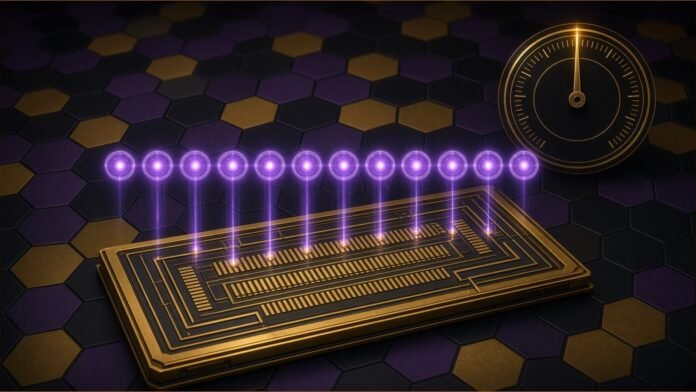
- Quantinuum (19 October 2026) says its Helios commercial computer achieved a logical fidelity of 99.9995% — “just five errors per million operations” — using a colour code.
- For the fault-tolerance race, the company calls this a world record: 10× lower error than its own September result and 100× lower than the best published result on other modalities (attributed to Google Quantum AI on superconducting hardware). Those rankings are Quantinuum’s claims.
- What’s still unknown: whether the result scales to larger logical computation and commercial use — the release itself flags replication risk — and whether Apollo by 2029 arrives on that company forecast.
Trapped-ion Helios is the same machine that hosted Quantinuum’s September Helix-code demo; the company says switching codes inside one architecture is the point.
What did Quantinuum measure?
The release says Helios achieved 99.9995% logical fidelity with the company’s error-correction architecture. It also says each tested increase in code distance cut remaining logical errors by a factor of 12.
| Claim (company) | Figure |
|---|---|
| Logical fidelity | 99.9995% |
| Errors | 5 per million operations |
| vs own Sept record | 10× lower error |
| vs best other modality | 100× lower (Google Quantum AI, superconducting) |
| Code | Colour code |
| Physical qubits / logical | Up to 37 (colour); Helix used 10 |
What did an independent researcher say?
Robin Blume-Kohout of Sandia National Laboratories’ Quantum Performance Lab, who was not involved in the study, said the paper shows “a logical qubit nearly 100x better than its component physical qubits,” and that a scaled version “could reach the reliability required for useful fault-tolerant computation at a feasible size—less than a million physical qubits.”
What about Apollo?
Quantinuum says the result puts accuracy “within the target range for Apollo,” its planned universal fault-tolerant machine “expected to be available by 2029.” That timeline is a company forecast, not a shipping date.
CEO Rajeeb Hazra said the team had “reduced error rates tenfold in rapid succession using a different code on the same commercial hardware.”
Who is affected?
- Quantum algorithm and materials teams watching logical error floors
- Competitors on superconducting and other modalities named in the comparison
- Investors tracking Quantinuum’s path to Apollo
Our read
A second logical-memory leap in two months on one commercial Helios box is a strong trapped-ion signal — especially if the Sandia reading of “nearly 100× better than physical” holds under scrutiny. The catch is the company’s own forward-looking caveat: experimental settings may not replicate at larger scale or in logical computation. Treat “world record” and the Google 100× line as Quantinuum-framed, and wait for peer review and independent replication before calling the FTQC race settled.
What’s still unknown?
- Peer-reviewed publication detail and independent reproduction
- Logical computation (not only memory) at this fidelity
- Whether Apollo’s 2029 window holds
How we sourced this
- Sole primary: Quantinuum press release, 19 October 2026.
- “World record” and 10× / 100× comparisons attributed as company claims. Blume-Kohout quote taken from the same release.
Sources
Related stories
- Google Quantum AI Shows “Magic State Cultivation” Working on Its Willow Chip, Cutting Errors About 40-Fold
- RIKEN Researchers Run Five Silicon Spin Qubits at Once While Keeping Fidelity Near 99.9%
- Quantum Hardware Check: DARPA’s Final Test Stage, Universal Quantum’s $100m Round and New Error-Correction Results
Follow @tsnmediahub on X for breaking AI news as it happens.
Follow on X



 — company-claimed 10x below its Sept mark and 100x below Google’s best.)