In brief
- Euronews (19 October 2026) reports that Greece has inaugurated Daedalus, its most powerful supercomputer, in Lavrio (Attica), with measured performance of 85.69 petaflops.
- For Greek researchers and firms, that means domestic capacity for AI training and sensitive-data work, backed by a €58.9 million investment (HPE €41m, Mainsys €17.9m, amounts including VAT), run by GRNET (EDYTE).
- What’s still unknown: final business pricing and access rules — broader commercial service via Pharos AI Factory is scheduled for March 2027 and is not yet finalised.
Euronews places Daedalus 31st worldwide on available ranking data and 23rd on the June 2026 Green500. Those standings are as reported by Euronews.
What is Daedalus?
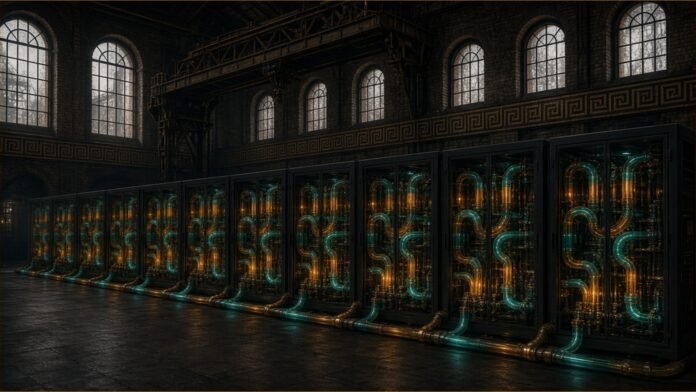
The system uses Nvidia Grace Hopper GH200 technology with liquid cooling, installed in the former power station at the Lavrio Technology and Cultural Park (NTUA). Funding comes from the Recovery and Resilience Facility and EuroHPC.
| Item | Detail (Euronews) |
|---|---|
| Performance | 85.69 petaflops |
| Investment | €58.9m |
| HPE equipment | €41m (incl. VAT) |
| Mainsys fit-out | €17.9m (incl. VAT) |
| Rank (reported) | 31st worldwide; Green500 23rd |
| Operator | GRNET (EDYTE) |
When can businesses use it?
Broader service provision to businesses is scheduled to begin in March 2027 after technical testing. Start-ups and SMEs are expected to get free use “within the limits set by European state aid rules”; larger companies may pay by time. Euronews says final access conditions and pricing have not yet been finalised.
Commercial exploitation sits with Hellenic AI Factory S.A. (Superfund 70%, Ministry of Digital Governance 30%).
Is there a second machine?
Yes, in planning: a second supercomputer at the University of Western Macedonia in Kozani, with a tender budget of €21.57 million (incl. VAT) for equipment — that figure is for the sub-project, not a full campus investment.
Why does in-country compute matter?
Euronews stresses the ability to process sensitive or confidential data inside Greece under local safeguards — relevant for medical research, public administration and other tightly regulated workloads. Daedalus is not pitched as a rival to Europe’s exascale machines; its value is national access and a seat in the wider European AI-infrastructure ecosystem.
Who is affected?
- Greek universities, labs and health/public bodies needing in-country HPC
- Start-ups and SMEs waiting on Pharos access rules
- European AI-factory peers watching another national node come online
Our read
Daedalus is a sovereign mid-tier play: useful national capacity and Green500 efficiency, not an exascale rival to Europe’s biggest boxes. The policy test is whether Pharos pricing and state-aid limits actually open the machine to SMEs in 2027 — inauguration is the easy part.
What’s still unknown?
- Final commercial tariffs and eligibility
- Sustained utilisation once large training jobs compete with research queues
- Kozani’s revised budget and timetable
How we sourced this
- Primary reporting: Euronews, 19 October 2026.
- Rankings, budgets and Pharos dates attributed to Euronews. Label: reported.
Sources
Related stories
- NVIDIA Joins the European Commission’s AI in Science Enablers Initiative
- Britain Bets £500 Million on Sovereign AI: What the Fund Launching April 16 Actually Means
Follow @tsnmediahub on X for breaking AI news as it happens.
Follow on X