Robotics start-up Dream Labs has come out of stealth with $90 million in seed funding and released its first robot model, Dream-1, through a public API. The company announced the launch in an October 2026 research post and on X on 19 October. It describes Dream-1 as “a World Action Model that controls robots it has never seen, performs tasks it was never shown”, priced from $3 an hour.
Those capability claims are Dream Labs’ own. The pitch targets one of robotics’ oldest bottlenecks: every new robot usually needs its own training data before it can do anything useful. If a single model can drive cheap, unfamiliar hardware out of the box, the company argues, robots could become useful sooner and start generating the data that makes them better.
In brief
- Dream Labs launched with a $90 million seed round, which SiliconANGLE reports was co-led by B Capital and Kindred Ventures.
- Dream-1 is available through a public API at $3 an hour, or $2 an hour for the lighter Dream-1-flash; each call returns 1.6 seconds of actions.
- The company says Dream-1 can control two-armed, parallel-gripper robots it was not trained on, but it calls the model a research beta not validated for safety-critical use.
What Dream Labs says Dream-1 can do
Dream Labs says Dream-1 works zero-shot, with “no fine-tuning, no demonstrations from that robot, and no machine learning expertise required”, on bimanual robots with parallel grippers. Its research post shows the model running on a long list of arms it says it never trained on, from Franka and KUKA machines to a Unitree R1. It even claims to run the PR2, a research robot released 18 years ago. In simulation, the company says it tested 27 unseen robots, with results measured against YAM, the robot Dream-1 was actually trained on.
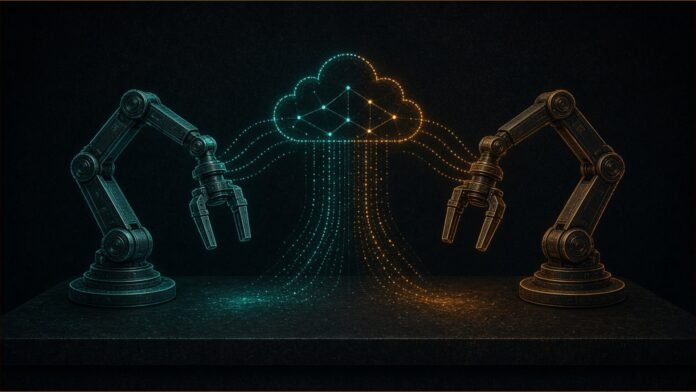
The approach builds on DreamZero, a paper the team released in February 2026 that introduced World Action Models. These models predict video and actions together. Instead of outputting one robot’s joint angles, Dream-1 can predict where each gripper should be and whether it should be open or closed, and leaves the robot’s own inverse kinematics solver to turn that into joint commands. Because every robot appears to the head camera as pixels, the company says, video becomes the representation all robot types share.
Dream Labs also cites an evaluation by Robocurve, which it calls an independent public benefit corporation. According to the company, that report puts Dream-1 ahead of the next-best models tested, at lower cost per task attempt. Those comparisons come via Dream Labs’ post.
Pricing and the limits the company admits
The company says running the model costs “$3 per hour for Dream-1, or $2 per hour for Dream-1-flash. Each call to the model returns 1.6 seconds of actions”. It adds that this works out at 2,250 calls an hour, or about $0.0013 per action for Dream-1. Where zero-shot falls short, a Fine-Tuning-as-a-Service offering adapts the model using a customer’s own robot data. Dream Labs shows gains from as little as five minutes of data, rising to 77 and 98 minutes for robots far from its training set.
The post is frank about the trade-offs. Performance depends on the quality of each robot’s inverse kinematics solver and varies across robots. Machines whose kinematics differ sharply from what Dream-1 has seen may get predictions they cannot physically follow. Dream Labs says the model “will make mistakes, and it has not been validated for safety-critical use”, and urges testing in controlled settings, especially near people.
Investors and the hardware bet
According to SiliconANGLE, the round was jointly led by B Capital and Kindred Ventures, with A.Capital, Unusual Ventures, Wing VC, SV Angel, Scribble VC and angel investor Adrian Aoun also taking part. The outlet reports that chief executive Joel Jang’s company works with more than 20 robotic hardware companies whose machines cost between $2,000 and $10,000. Jang told SiliconANGLE the money will mainly pay for compute.
“The hardware is ready, but what’s been missing is a brain any robot can use,” Jang said, according to SiliconANGLE. Daisy Cai of B Capital told the outlet: “What they need now is intelligence.”
Our read
A large seed round, published prices and an open API are an unusually public way to launch a robot foundation model, and they invite developers to test the claims for themselves. The zero-shot results come from the company and its chosen evaluators, so independent rollouts on everyday hardware will be the real test. The bigger bet is commercial: that a wave of $2,000 arms will create enough customers for robot intelligence sold by the hour.
Sources
- Dream Labs: “Zero-Shot to New Robots: Introducing Dream-1” (October 2026).
- SiliconANGLE: “Dream Labs raises $90M to help build more intelligent robots with simple video feeds” (Mike Wheatley, 19 October 2026).
Related stories
- Unitree Releases UniUni, Free Swarm-Control Software for Its H2 and G1 Robots
- Devanthro Becomes Plim Robotics and Reveals Plim Home Robot
Follow @tsnmediahub on X for breaking AI news as it happens.
Follow on X