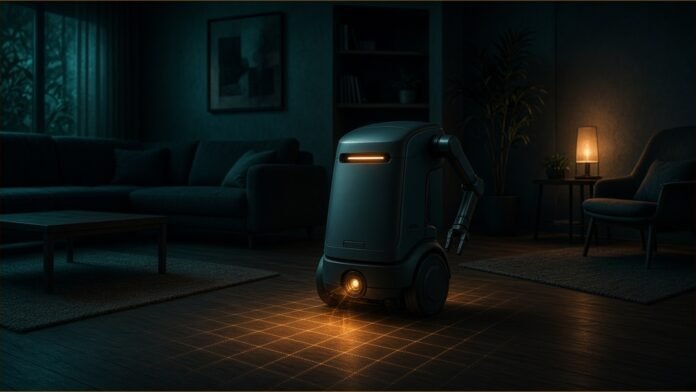
Munich robotics company Devanthro has rebranded as Plim Robotics and published product pages for Plim, a wheeled home robot that combines an autonomous chores mode with a remote “step-in” mode. The rebrand is on Devanthro’s own site; the robot’s specs and modes are on Plim’s “Meet Plim” page. Humanoids Daily reported the reveal on 17 October 2026.
Every hardware figure below is a company claim from those pages. Plim’s site invites families and care organisations to register interest. It does not state a price or a delivery date.
Rebrand: Devanthro → Plim Robotics
The Devanthro post opens: “Devanthro is now Plim!” and positions the new name as approachable. It adds: “Plim is decidedly not a household slave, but it really likes doing all those chores and better even, doing them together with you.” The page still lists a Munich address at Freddie-Mercury-Str. 5, 80797 München.
Humanoids Daily notes the company’s earlier emphasis on elderly care and experience in real homes dating to 2024; the new Plim positioning broadens the pitch toward households while still naming care organisations as an audience.
Two modes: autonomous chores and step-in teleoperation
Plim’s marketing centrepiece is a dual operating model.
24/7 Autonomous Mode. The site says Plim “offers 24/7 support with the help of deep AI reasoning and real home training,” and that “The more tasks it takes care of, the more helpful it gets.” Household copy shows the robot tidying and “know[ing] the ropes from day one.”
Step-in Mode. Separately, Plim advertises remote presence: “Our step-in technology puts you in touching distance from up to 9000km, using your own voice, face and movement.” The framing is that a distant relative or caregiver can appear through the robot’s body, not only on a video call — Humanoids Daily says the remote operator’s face can show in the visor.
Specs (company claims)
From the “Deeply connected, from the inside out” table on Meet Plim:
| Spec | Company claim |
|---|---|
| Height | 1.65 m |
| Weight | 80 kg |
| Arms | 7 DoF, 3 kg payload |
| End-effector | 2-finger gripper |
| Compute | Nvidia Jetson Thor |
| Middleware | ROS2 |
| Mobility | 3-wheel Omnidrive |
| Battery | 2 h runtime, self-dock |
| Sensors | 4K fisheye RGB, mm-wave radar, stereo mic |
| Connectivity | 5G + WiFi 6 |
The same page also markets “Stereo RGB + Depth,” “Edge AI + Cloud,” and “Continuously Learning AI.” Actuation is listed as QDDs. TSN has not independently verified payload, runtime, range or learning performance.
The 24/7 claim versus a two-hour battery
This is the main caveat on the published sheet. Plim sells “24/7 Autonomous Mode” while listing battery as “2h runtime, self-dock.” Continuous availability, if achievable at all, would depend on docking and scheduling — not on a single two-hour charge. Humanoids Daily flags the same tension. Treat “24/7” as marketing for always-on service intent, not as a claim that the robot runs 24 hours without charging.
What is not announced
- Price — not listed
- Delivery / ship date — not listed; CTA is interest / “bring Plim home” for families and care organisations
- Task-success rates or how often a human must intervene — not published on the linked pages
- Independent third-party demos — not cited here
Plim Robotics pairs home chores with telepresence in one robot
Consumer and care-side robots keep splitting between full bipedal humanoids and wheeled “home helper” form factors. Plim’s pitch is unusual mainly for putting telepresence / step-in control beside chore autonomy in the same product story — remote kin using “your own voice, face and movement” at up to 9,000 km, on company copy. Related TSN coverage includes Faraday Future’s FF Nova consumer humanoid, NEURA’s Neuron AI physical-AI model, JAKA’s Kargo50 wheeled humanoid, and broader how robots learn human skills reporting.
Until price, ship dates and measured chore performance appear, Plim is a rebrand plus spec sheet, not a shipping product launch.
Step-in teleoperation brings a remote person into the home
The step-in mode is the part of the Plim pitch with the most potential for good and the most open questions. For a family spread across countries, or a carer checking on an older relative, a home robot that a trusted person can briefly control could do more than a video call: fetch something, check a room, or simply be present. That is a humane use of robotics, and it fits the care audience that Devanthro started with.
It also means a person outside the household can see through the robot’s cameras and move an 80 kg machine with a working arm inside a private home. Plim’s published pages do not say who is allowed to step in, how a session is authorised, whether people in the room are told when someone is connected, or how video and sensor data are stored. Those details, along with latency over long distances and safety limits on arm force, will decide whether teleoperation feels like reassurance or intrusion. Until Plim Robotics publishes them, buyers and care organisations have only the marketing promise to judge.
What’s still unknown
- Commercial terms and launch geography
- How step-in latency behaves on 5G / Wi-Fi 6 at long range
- Whether autonomous chore claims hold outside demo kitchens
- Safety certification and liability framing for remote operators in a private home
Plim has a spec sheet but no price or ship date
Devanthro’s Munich team is now Plim Robotics, and Plim is pitched as a 1.65 m / 80 kg wheeled home robot with 7 DoF / 3 kg arms, Jetson Thor, ROS2, 2-hour self-docking battery and step-in teleoperation “from up to 9000 km.” Quote the sheet as the company’s; hold the 24/7 line against the 2-hour runtime; and note that buyers still cannot see a price or delivery date.
Sources
- [1] Plim Robotics: Meet Plim
- [2] Devanthro: Devanthro is now Plim Robotics
- [3] Humanoids Daily: Devanthro Becomes Plim Robotics, Reveals a Home Robot Loved Ones Can Step Into, 17 October 2026
Get TSN’s biggest tech stories, explained.
News and insights across AI, tech, crypto and cybersecurity. Every source linked. Unsubscribe anytime.
Get the newsletterRelated stories
- Faraday Future Launches the FF Nova Humanoid Robot at $2,490, Plus a $299 Robot for Children
- NEURA Robotics Unveils Neuron AI, a Model That Lets Robots Combine Sight, Touch, Sound and Memory
- JAKA Launches Kargo50 Heavy-Duty Wheeled Humanoid and Zu50 High-Payload Cobot at Shanghai Industry Fair
- Beyond the iPhone on Your Forehead: Every Way Robots Are Learning to Be Human
Follow @tsnmediahub on X for breaking AI news as it happens.
Follow on X