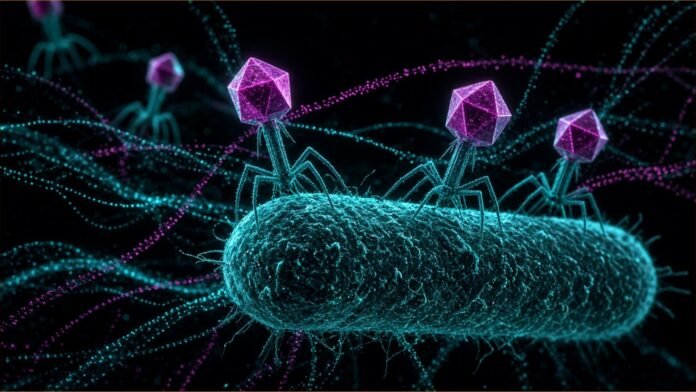
A patient whose E. coli infection had resisted antibiotics and every available phage has been treated with viruses designed by artificial intelligence, according to the San Francisco start-up behind them. What Radical Numerics will not yet say is how the patient is doing.
The company made the claim on 20 October as it launched Omnii-1, a model it trains on DNA, RNA, proteins and other molecular data. In a release, it calls the case “the first AI-designed phage given to a human patient”. It is a striking milestone if it holds up, but it rests on the company’s own account: its technical report has not been peer reviewed, and it withholds the patient’s clinical course and outcome for privacy reasons.
In brief
- Radical Numerics says phages designed with its Omnii-1 model were part of a cocktail given to one patient with a drug-resistant E. coli infection under an FDA-authorised compassionate-use pathway.
- The cocktail killed the patient’s bacteria in the lab first; the company has disclosed no clinical outcome and no peer-reviewed paper.
- Omnii-1 launched alongside seven other applications, from cancer vaccines to biodefense, all backed so far by the company’s own benchmarks.
The cocktail passed the lab test; the clinical result is private
Phages are viruses that infect and kill bacteria, and they have drawn renewed interest as antibiotic resistance spreads. Their precision is also the problem: a phage that kills one strain may miss another, so finding the right one for a patient can mean months of screening. The company’s release notes that drug-resistant infections were linked to an estimated 4.95 million deaths worldwide in 2019.
Radical Numerics says its researchers used Omnii-1 to redesign the tail fibres of T7, a well-studied phage that infects E. coli, changing the part that grips the bacterial surface. It says the designs were produced “within weeks”, and that a cocktail containing them “killed the patient’s bacterial isolate in laboratory testing” before being given to the patient. The company’s Omnii Phage page says treatment went ahead under an FDA-authorised single-patient Investigational New Drug application, through the expanded-access route also known as compassionate use.
The company is careful about what that proves. Its report says it is “not disclosing details of their clinical course or outcomes”, and that “observations from a single patient cannot establish general safety or efficacy.” Chief executive Eric Nguyen told The New York Times that the company intends “to publish our scientific findings through peer-reviewed research, with any future disclosure of clinical details subject to appropriate consent.”
Outside scientists are waiting for results
Researchers not involved in the work were curious but cautious. “If it works, that’s incredible,” Michael Baym, a Harvard microbiologist, told the Times, adding: “My impulse is to be skeptical.” He wants to see the treatment finished and to judge how novel the viruses really are.
Brandon Berryhill, an evolutionary microbiologist at Uppsala University, pointed to the gap between a dish and a body. “We cannot measure anything in the lab and say how good it’s going to be at controlling something in an infection,” he told the paper. Phage therapy can run for days or weeks, and doctors typically watch patients for months in case an infection returns, the Times noted.
The most enthusiastic outside voice in the release, Dr Marisa Azad, an infectious diseases physician-scientist at The Ottawa Hospital, is working on a collaboration with the company, according to the Times. “The hardest part of phage therapy is the blind search, not the biology,” she said in the release.
The phage is one of eight launch applications
Radical Numerics describes itself as a lab “building general biological intelligence”, founded by members of the team behind the Evo and Evo 2 genome models. Nguyen is one of three Evo researchers who left to start it, according to the Times. The company says Omnii-1 was trained on trillions of tokens across 28 types of biological data, and calls it “the world’s most advanced multimodal genome language model”.
The phage case is one of eight applications shown at launch. The company says Omnii-1 beats Google DeepMind’s AlphaGenome and the Borzoi model on its chosen gene-regulation benchmarks; nominates candidate causal variants in four of five unsolved congenital myopathy cases; and improves early-stage cancer detection from a blood marker, though it adds that “prospective screening studies are still needed to establish clinical benefit.” It is also working with Lawrence Livermore National Laboratory on proteins that bind rare earth metals.
Biodefense gets particular weight. In the company’s early tests, adding Omnii-1 to a conventional screening tool lifted the share of pathogen-related protein sequences it caught “from 78.6% with DIAMOND alone to 95.8%”. Its biodefense advisers include Andrew C. Weber, a former US assistant secretary of defense, and Microsoft’s chief scientific officer, Eric Horvitz. The model is in research preview.
What would settle the claim
For now, the record shows that AI-designed phages were made, killed the target bacteria in the lab and, by the company’s account, were cleared by US regulators for use in one patient. It says nothing yet about whether they helped. “For most of medicine’s history, we’ve searched for drugs that might work against a disease,” Nguyen said in the release. “We’re entering a future where we can design medicines for the exact biology of a patient.”
He told the Times he hopes to cut the time to design a patient-specific phage to days. The evidence that would test that ambition, a disclosed outcome or the promised peer-reviewed paper, has no date attached.
Related stories
- Google DeepMind Shows Its Antigravity Agent Finding a New Antimicrobial Peptide Candidate
- Anthropic Says Claude Designed Protein Binders Against Scorpion Neurotoxins
Sources
- Radical Numerics: Introducing Omnii-1: a leap toward general biological intelligence, 20 October 2026
- Radical Numerics: Radical Numerics creates first AI-generated phages to reach human patient with Omnii-1, 20 October 2026
- Radical Numerics: Omnii Phage (updated 20 October 2026)
- Business Wire release, via Yahoo Finance: Radical Numerics Launches Omnii-1, a New Generation of Biological AI, as First AI-Designed Phage Therapy Reaches Human Patient
- The New York Times: “Start-Up Claims to Treat a Patient With A.I.-Created Viruses”, 20 October 2026
Follow @tsnmediahub on X for breaking AI news as it happens.
Follow on X